 edory
edory
Reading is much more than quickly skimming letters and pages. It shapes the development, thinking, and personality of our children from the ground up. It sounds simple, doesn't it? Yet research shows that regular read-aloud sessions alone significantly improve children's social competence and strengthen their emotional intelligence. But the biggest surprise often remains hidden: comics not only excite young readers, but are proven to be a particularly effective entry point into reading for children.
Table of Contents
- What does reading mean and what forms does it take?
- Why is Reading Important for Children's Mental Development?
- How Does Reading Influence Social and Emotional Competence?
- What Role Does Read-Aloud Play in Family Life?
- How Can Reading Habits Be Promoted in Daily Life?
Brief Summary
| Takeaway | Explanation |
|---|---|
| Reading promotes cognitive abilities | Regular reading sustainably improves children's concentration, memory, and vocabulary. |
| Develop empathy through stories | Children learn through reading stories to put themselves in others' shoes and understand emotions. |
| Read-aloud strengthens emotional bonding | Shared reading sessions create trust and closeness between parents and children. |
| Designing the reading environment matters | An inviting reading corner motivates children to spend more time with books. |
| Actively promote motivation for reading enjoyment | Interest in reading can be increased through engaging approaches and positive reinforcement. |
What does Reading Mean and What Forms Does It Take?
Reading is more than just recognizing and understanding written characters. It is a complex cognitive process that fundamentally shapes our perception, thinking, and communication abilities.
The Basics of Reading
The reading process encompasses several cognitive processes that occur simultaneously. The brain transforms letters and words into meaningful information. Children learn this skill step by step:
- Letter recognition
- Word comprehension
- Understanding meaning and context
Reading can take various forms: printed books, digital texts, magazines, comics, and even picture books for young children. Research shows that comics in particular are a particularly effective method for getting children excited about reading.
Different Forms of Reading
Each form of reading has its own characteristics and learning potential:
- Aloud reading: Promotes pronunciation and text comprehension
- Silent reading: Improves concentration and reading speed
- Comprehension reading: Aims for deeper text understanding
The type of reading varies depending on age, interest, and reading proficiency. What matters is that reading is more than just a technique. It is a creative process that stimulates our imagination and supports our personal development.
To give you a clear overview of the different forms of reading and their characteristics, here is a comparison table with the most important features:
| Form of Reading | Characteristics | Benefit for Children |
|---|---|---|
| Aloud reading | Emphasis, correct pronunciation, listening | Improves language sense and pronunciation |
| Silent reading | Independent reception, fast reading | Promotes concentration, reading fluency |
| Comprehension reading | In-depth engagement with the text | Develops critical thinking and understanding |
| Reading comics | Connection of images and text, low-barrier access | Increases motivation and reading enjoyment |
| Read-aloud | Shared activity, interaction between reader and listener | Strengthens bonding and language development |
Reading opens doors to new worlds, broadens horizons, and develops critical thinking. It helps children understand complex relationships, develop empathy, and improve their communication skills.
Why is Reading Important for Children's Mental Development?
Reading is a powerful tool that means far more than just deciphering letters. It is a crucial process that fundamentally shapes children's cognitive, emotional, and social development.
Cognitive Development Through Reading
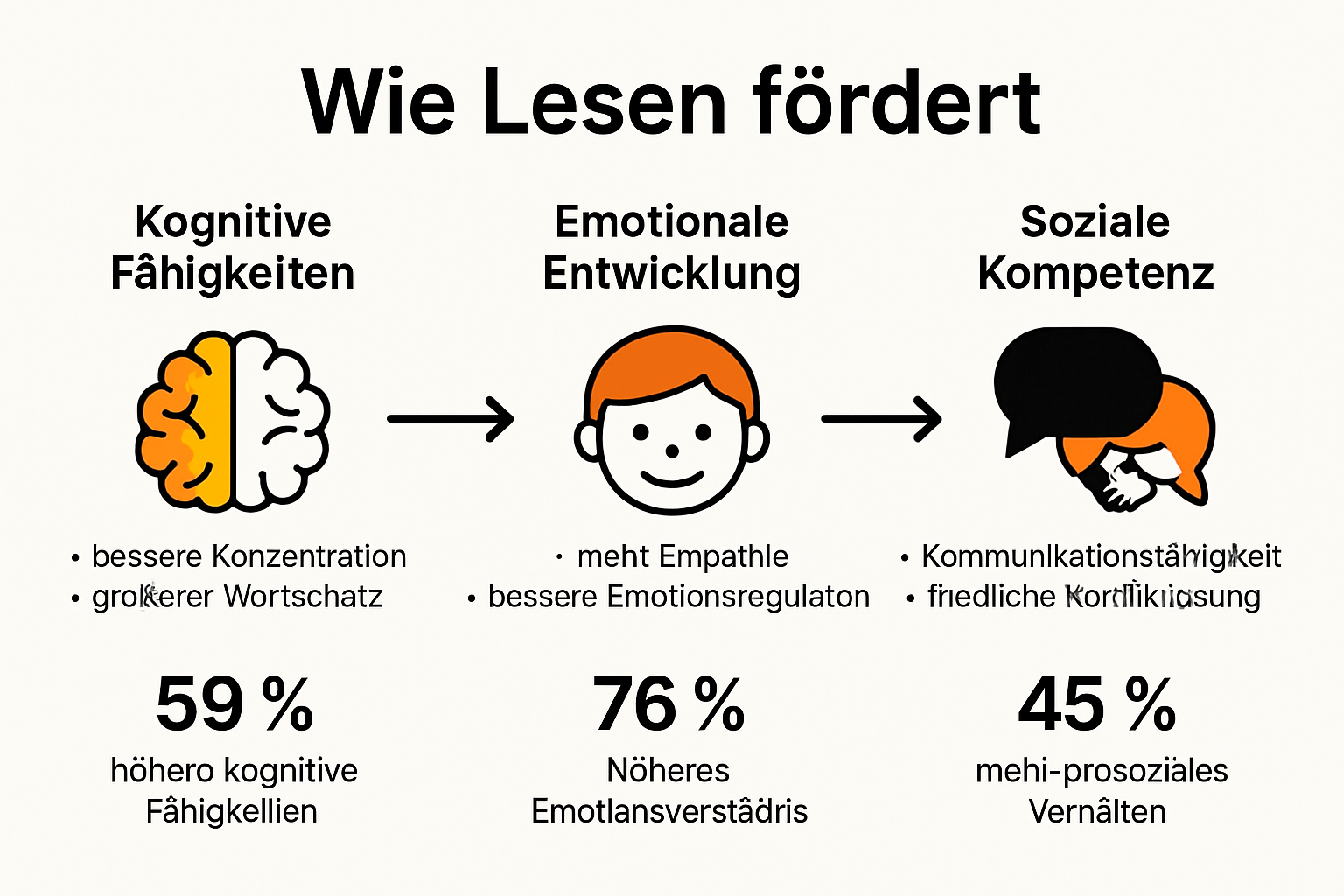
The reading process stimulates the child's brain in many ways. During reading, complex neural networks are activated that promote concentration, memory, and language comprehension. Research from the University of California, Berkeley shows that regular reading positively influences brain development and improves cognitive abilities in the long term.
The most important cognitive benefits of reading include:
- Improvement of concentration ability
- Expansion of vocabulary
- Strengthening of logical thinking
- Promotion of imagination
Emotional and Social Intelligence
Reading is more than an intellectual exercise. It is a window to other worlds, perspectives, and emotions. By immersing themselves in stories, children develop empathy, learn to understand complex emotional states, and interpret social interactions.
Children who read regularly often show:
- Better understanding of human emotions
- Enhanced communication skills
- Stronger empathy
- Improved conflict resolution competence
Reading enables children to view the world from different perspectives and thus develops their emotional intelligence in a unique and profound way.
How Does Reading Influence Social and Emotional Competence?
Reading is a unique way to develop social and emotional skills in children. It's not just about deciphering letters, but about deeper understanding of human interactions and feelings.
Empathy and Perspective-Taking
By immersing themselves in stories, children learn to put themselves in the shoes of different characters. They experience situations from different viewpoints and thus develop a deeper understanding of human emotions. Research by the Stiftung Lesen (Reading Foundation) shows that regular read-aloud sessions sustainably promote children's social competence.
The most important aspects of learning empathy through reading include:
- Recognizing and understanding different emotional states
- Development of compassion for others
- Learning complex social interactions
- Expansion of emotional understanding
Emotional Intelligence and Conflict Resolution
Reading provides children with a safe space to explore complex emotional situations. Stories demonstrate conflict resolution strategies, help with managing feelings, and support the development of emotional resilience.
Children develop important emotional competencies through reading:
- Better understanding of their own feelings
- Ability to regulate emotions
- Constructive communication
- Strategies for conflict resolution
Reading thus becomes a powerful tool for emotional education, helping children understand and navigate the complexity of human relationships.
The following table provides an overview of the key aspects of how reading contributes to the development of emotional and social competencies:
| Competency Area | What is Promoted? | How Does It Show? |
|---|---|---|
| Empathy | Recognition of different feelings | Show compassion, understand other perspectives |
| Social Interaction | Interpretation of relationships and communication | Better cooperation, ability to resolve conflicts |
| Emotional Intelligence | Regulation and understanding of own emotions | Self-confident handling of feelings |
| Conflict Resolution | Experience constructive solution strategies in stories | Adopt strategies for conflict resolution |
What Role Does Read-Aloud Play in Family Life?
Read-aloud is far more than a simple activity. It is a magical moment of connection that brings families together, strengthens bonds, and fundamentally shapes children's development.
Emotional Bonding and Closeness
Shared reading creates a special atmosphere of security and trust. Parents and children share not just a story, but emotions, glances, and nonverbal communication. Research from the University of Connecticut shows that read-aloud accomplishes far more than just knowledge transfer.
The most important emotional aspects of read-aloud include:
- Strengthening the parent-child relationship
- Creation of a safe emotional space
- Building trust and security
- Promotion of mutual appreciation
Language and Cognitive Development
Read-aloud is a powerful tool for language development. Children learn new words, sentence structures, and ways of expressing themselves. They develop a sense of language, rhythm, and communication long before they can read themselves.
The most important language development aspects:
- Expansion of vocabulary
- Improvement of speech melody
- Promotion of text comprehension
- Development of narrative skills
Read-aloud thus becomes a daily ritual that is far more than just an activity. It is a gift of attention, education, and loving connection.
How Can Reading Habits Be Promoted in Daily Life?
Developing a love of reading is an active process that requires creativity, engagement, and strategic approaches. Parents and caregivers play a crucial role in sustainably inspiring children to read.
Creating a Reading Environment
An inviting reading environment can motivate children to spend more time with books. It's about presenting reading as a positive, exciting activity. The Provo City School District