 edory
edory
Over 80 percent of children wish for stories with magical beings and adventures. Fantasy stories appeal to children deeply within, because they open doors to worlds where everything seems possible. At the same time, they not only promote creative thinking, but also help with understanding emotions and developing social skills. Here parents learn how fantasy stories are structured, why they do much more than pure entertainment, and how misunderstandings around the topic arise.
Table of Contents
- What are Fantasy Stories? Characteristics and Misconceptions
- Recognizing Different Types of Fantasy Stories
- How Fantasy Stories Come to Life Step by Step
- Modern Techniques for Story Creation with AI
- Challenges and Avoiding Mistakes When Storytelling
Key Insights
| Point | Details |
|---|---|
| Fantasy Stories Promote Creativity | They help children develop their imagination and understand complex emotions. |
| Diversity of Fantasy Stories | Different forms, such as fairy tales and modern fantasy, offer diverse learning opportunities. |
| Creative Process of Story Creation | The development of fantasy stories requires creativity and a structured approach. |
| Challenges in Storytelling | It is important to make stories accessible and actively involve children. |
What are Fantasy Stories? Characteristics and Misconceptions
Fantasy stories are creative narratives that take children into magical worlds full of adventure and wonder. These stories differ fundamentally from realistic narratives by employing elements that go beyond the boundaries of our normal reality. They are more than just entertainment - they are an important tool for developing children's creativity and imagination.
The main characteristics of fantasy stories include:
- Supernatural characters such as dragons, fairies, or talking animals
- Magical settings that do not exist in the real world
- Unexpected twists and events that lie outside logical explanations
- Symbolic representations of emotions and moral lessons
A common misconception is that fantasy stories only serve for entertainment. In fact, they play a crucial role in children's cognitive and emotional development. How Does Children's Fantasy Work? Complete Parent's Guide shows that such stories help children understand complex emotions, develop empathy, and learn creative problem-solving strategies.
While some parents worry that fantasy stories could lead to unrealistic expectations, experts show that on the contrary, they promote cognitive flexibility and abstract thinking in children. They enable children to view situations from different perspectives and develop an open, creative way of thinking. The power of fantasy lies not in escape from reality, but in the ability to explore new possibilities and view the world with curiosity and imagination.
Recognizing Different Types of Fantasy Stories
Fantasy stories exist in various forms and styles, each using different magical worlds and narrative strategies. Wikipedia defines fantastical children's and young adult literature as a literary form that characteristically depicts the meeting between the real, ordinary world and a magical, irrational world.
The main types of fantasy stories are:
- Fairy Tale Worlds: Traditional stories with enchanted kingdoms, princesses, and magical creatures
- Mythological Narratives: Stories based on ancient legends and myths
- Animal Fables: Stories featuring talking animals as main characters
- Modern Fantasy: Contemporary stories with elements of supernatural magic
How Fairy Tales Stimulate Fantasy: Complete Parent's Guide clarifies that folk narratives in particular maintain a rich tradition of magical stories. According to Wikipedia, folk tales often contain vague place and time specifications and include talking animals as well as fantasy creatures such as giants, dwarves, elves, nymphs, trolls, witches, wizards, and legendary creatures like dragons and unicorns.
Each type of fantasy story has its own characteristics and educational potential. They help children not only entertain themselves, but also promote creativity, emotional intelligence, and moral understanding.
 The variety of fantasy stories allows children to explore different perspectives and develop their imagination in a playful and educational way.
How Fantasy Stories Come to Life Step by Step
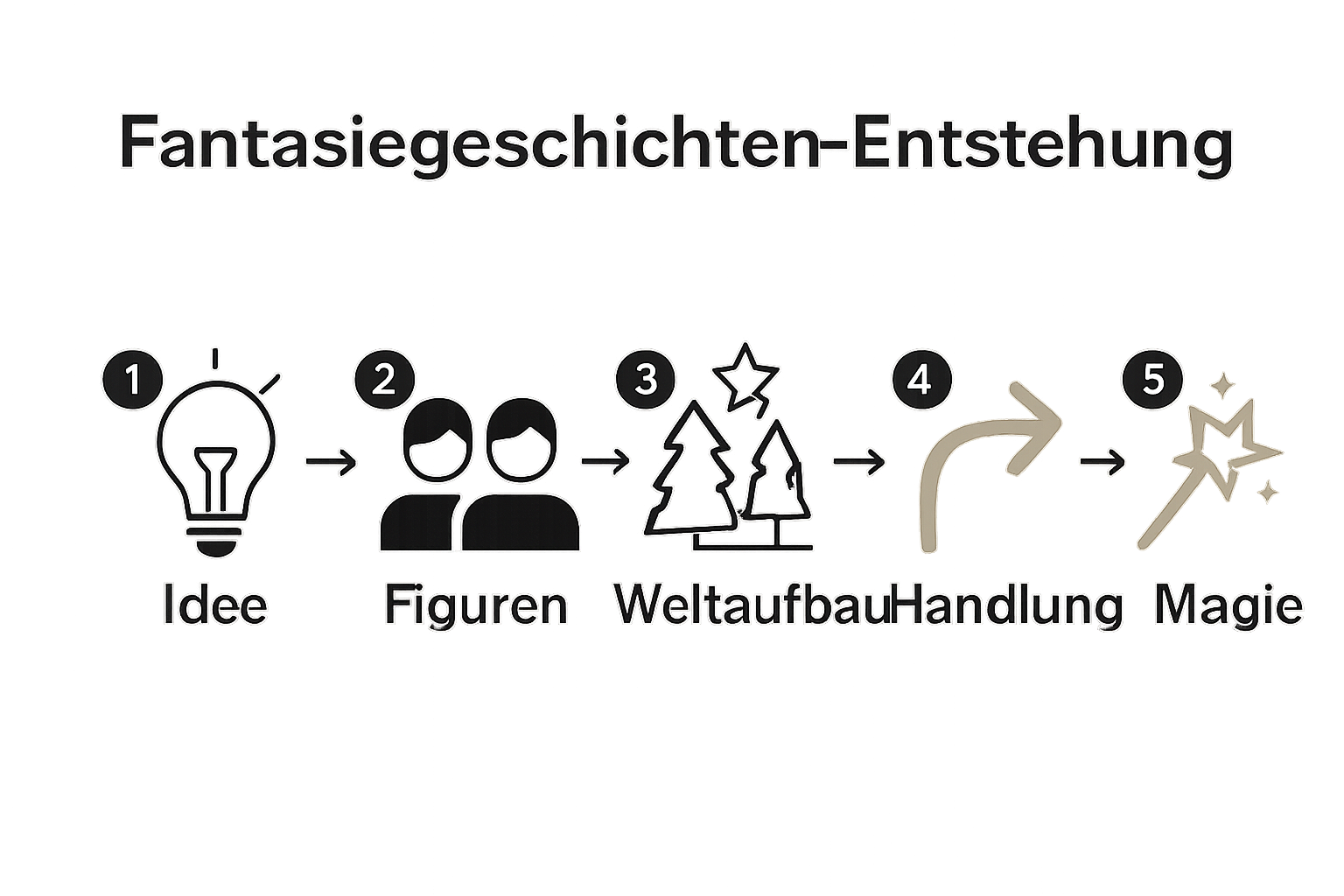
The creation of a fantasy story is a creative process that requires inspiration, imagination, and a structured approach. Creative Storytelling with Children: Crafting Imaginative Stories shows that this process can be exciting and educational for both children and adults.
The main steps in developing a fantasy story include:
- Idea Generation: Start with a creative basic idea or unusual starting point
- Character Creation: Develop unique, vivid characters with special qualities
- Worldbuilding: Create a magical world with its own rules and special features
- Plot Development: Construct an exciting plot with surprising twists
- Magical Elements: Integrate fantastical components that make the story special
Each step requires creativity and imagination. How Children Learn to Tell Stories: Step-by-Step Guide emphasizes how important it is to show children that no story can be too wild or unusual.
The key to a successful fantasy story lies in the balance between fantasy and structure. Encourage children to explore their wildest ideas, but also help them transform these ideas into a coherent and engaging narrative. Fantasy stories are more than just entertainment - they are a powerful tool for developing creativity, imagination, and emotional intelligence.
Modern Techniques for Story Creation with AI
Artificial intelligence is increasingly revolutionizing the way stories are created and told. Why Use AI for Children's Stories: Complete Guide clarifies how AI technologies can support and enrich creative processes.
Modern AI-based story generation includes the following techniques:
- Automatic Plot Generation: AI develops storylines based on given parameters
- Character Creation: Generation of complex and individual character profiles
- Contextual Adaptation: Dynamic adjustment of the story to age and interests
- Multimedia Storytelling Elements: Integration of images, voice, and interactive elements
AI Storytelling: Everything Parents and Children Need to Know shows that according to scientific findings, fantasy stories do not require a pre-structured framework and can be developed completely freely.
The technology makes it possible to generate stories that not only entertain but are also individually tailored to children's developmental stages. Through intelligent algorithms, stories can now be created that dynamically adapt to young listeners' imagination and needs while conveying educational values.
Challenges and Avoiding Mistakes When Storytelling
Telling fantasy stories can be challenging, especially when you want to captivate children while remaining educational. Learning Storytelling for Parents: Captivate and Foster Children shows how important a sensitive and strategic approach to storytelling is.
Common mistakes that parents and storytellers should avoid include:
- Overly Complicated Plots: Stories should be age-appropriate and understandable
- Lack of Interaction: Children should be actively involved in the story
- Missing Emotional Depth: Stories need characters and conflicts that feel real
- Too Many Fantasy Elements: The story should have a comprehensible structure
- Neglecting Children's Perspectives: The fantasy world must be age-appropriate
Parent's Role in Storytelling: The Complete Guide emphasizes that good storytelling is more than just telling stories. It's about emotionally reaching children, stimulating their imagination, and at the same time imparting important life skills.
The greatest challenge is finding a balance between fantasy and comprehensibility. Stories should inspire children without overwhelming them. They must be complex enough to spark interest, but simple enough to be understood. It is important to view children as active participants whose own creativity and interpretation of the story are equally valid.
Bringing Fantasy Stories to Life with Edory.ai
Fantasy stories unfold their full impact only when they are told creatively, age-appropriately, and emotionally engaging. The article shows how important the balance between freedom and structure is in the creation of such stories. Many parents are looking for simple ways to delight their children daily with new stories that promote both imagination and learning. This is exactly where Edory.ai comes in and offers an innovative solution that automatically creates personalized children's stories while considering each child's individual interests.
With Edory.ai, you can support the creative process with modern AI and thus create magical worlds without the pressure of finding ideas. Our platform combines educationally valuable content with exciting narratives and makes reading aloud a daily adventure. Discover important background information and practical tips in the Uncategorized – Edory AI – Educational Children's Stories section and take the opportunity to enrich your family with custom-made stories.
Start now at https://edory.ai and experience how simple and inspiring telling fantasy stories can be. Foster your children's creativity with daily storytelling and give them the opportunity to grow with fantastic characters and worlds.
Frequently Asked Questions
What are the main characteristics of fantasy stories?
Fantasy stories contain supernatural characters, magical settings, unexpected twists, and symbolic representations of emotions.
How can fantasy stories support children's development?
Fantasy stories promote creativity, emotional intelligence, and understanding of complex emotions in children.
What types of fantasy stories exist?
There are various types of fantasy stories, including fairy tale worlds, mythological narratives, animal fables, and modern fantasy.
How do I develop my own fantasy story?
To develop a fantasy story, start with a basic idea, create unique characters and a magical world, develop the plot, and integrate magical elements.
Recommendations
- Children and Fantasy Stories: What They Mean and How They Work – Edory AI – Educational Children's Stories
- How Does Children's Fantasy Work? Complete Parent's Guide – Edory AI – Educational Children's Stories
- Fantasy Stories for Kindergarten: Creative Storytelling – Edory AI – Educational Children's Stories
- How Fairy Tales Stimulate Fantasy: Complete Parent's Guide – Edory AI – Educational Children's Stories