 edory
edory
Selecting the right stories for children sounds simpler than it actually is and appears at first glance like child's play. However, children show with remarkable clarity which topics truly excite them and what quickly bores them. Surprisingly, there are no rigid rules – each child develops their own unique preferences and can dive much deeper into a seemingly simple picture book page than adults would expect.
Table of Contents
- Step 1: Determine Your Child's Age and Interests
- Step 2: Research Suitable Story and Book Types
- Step 3: Read Reviews and Recommendations from Other Parents
- Step 4: Test the Stories with Your Child
- Step 5: Evaluate Reactions and Prefer the Best Stories
Quick Overview
| Key Point | Explanation |
|---|---|
| 1. Consider Interests and Age | Understand your child to select age-appropriate stories. Observations are important for choosing content that fascinates. |
| 2. Explore Variety of Book Types | Choose from different book types that address different developmental areas to encourage your child's curiosity. |
| 3. Read Reviews from Other Parents | Authentic experience reports help with selecting suitable books and provide insight into children's emotional reactions. |
| 4. Actively Test Stories with Your Child | Conduct joint reading sessions and pay attention to your child's reactions to assess interest. |
| 5. Evaluate Reactions and Document | Note your child's favorite stories and analyze what sparks enthusiasm and understanding to refine your selection. |
Step 1: Determine Your Child's Age and Interests
Selecting age-appropriate stories begins with a deep understanding of your child. Each age and developmental stage requires an individual approach to story selection. A preschooler has completely different needs than a school-aged child, which is why careful observation and analysis are crucial.
Start by observing your child closely. What topics fascinate them? Do they love adventure stories, magical worlds, or stories about animals? Pay attention to their reactions when reading aloud or looking at books and media. Children show very clearly what interests them – whether through attentive listening, asking questions, or repeatedly requesting certain books.
Age groups play a crucial role in story selection. Our guide to creative activities with toddlers can provide you with additional insights. Basically, some developmental stages can be roughly outlined:
- 0-3 Years: Simple picture books with clear, colorful images
- 3-5 Years: Short stories with simple plots and recognizable characters
- 5-7 Years: First reading stories with more complexity and suspense
- 7-10 Years: Adventure stories and early chapter books with deeper themes
Note individual differences. Not every child develops at the same pace. Observe attention span, understanding, and emotional reactions to stories.
Below you will find an overview of typical age groups and the recommended book types that, according to the article, correspond to the respective developmental needs of children.
| Age Group | Recommended Book Types | Typical Features |
|---|---|---|
| 0-3 Years | Picture Books | Clear, colorful images; very simple texts |
| 3-5 Years | Short Stories, Read-Aloud Books | Simple plots, recurring characters |
| 5-7 Years | First Reading Stories, Early Reader Books | More complexity and suspense |
| 7-10 Years | Adventure Books, Chapter Books | Deeper themes, longer stories |
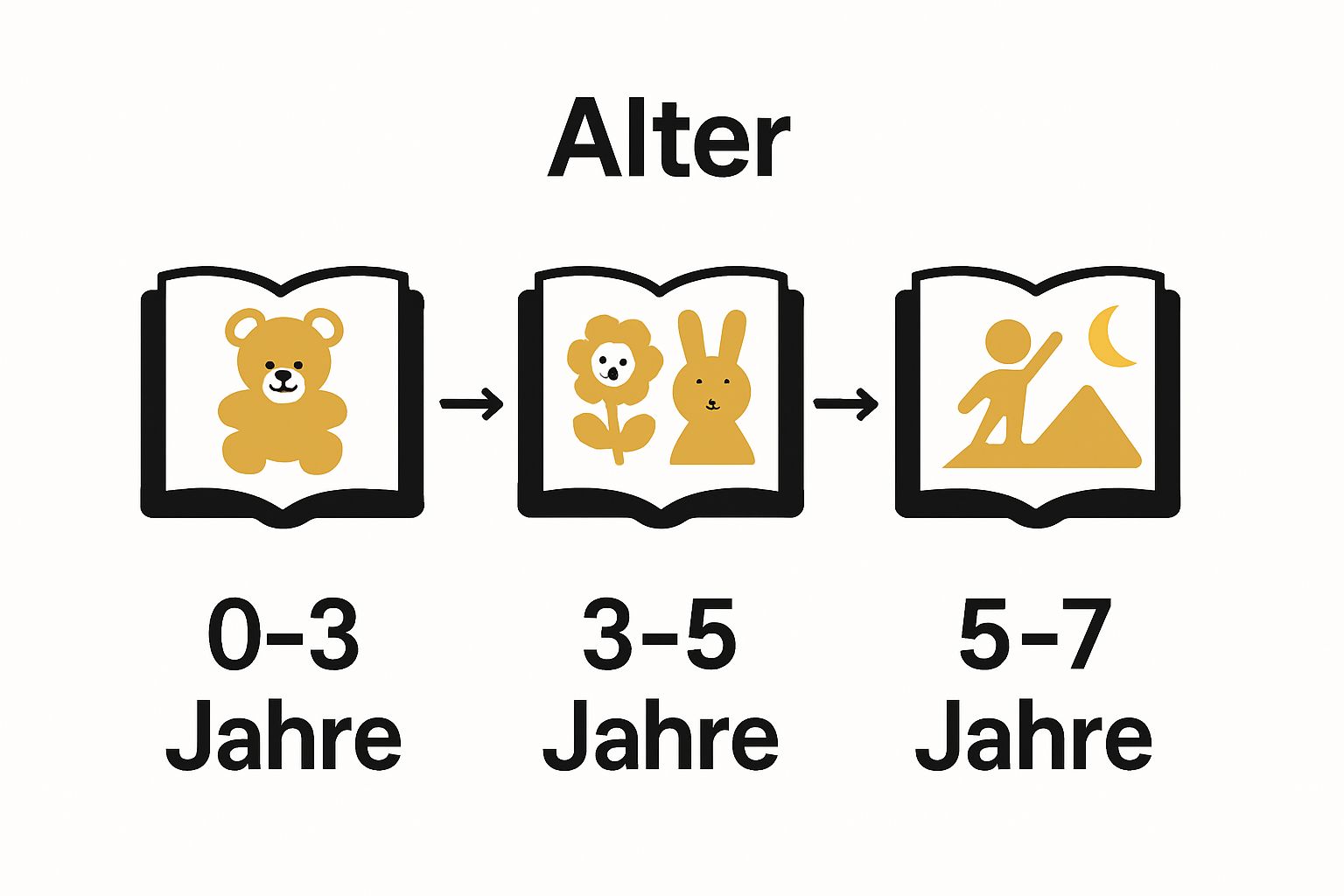 A child can certainly be more or less mature than the age average.
A practical method is exploring books together. Let your child select and flip through books and react. Their enthusiasm and curiosity are the best indicators for suitable stories. Don't hesitate to read stories multiple times – repetition is important for children and promotes language understanding.
The goal of this first step is to develop a deep understanding of your child's individual preferences and abilities. The better you know their interests and developmental level, the better you can select age-appropriate stories.
Step 2: Research Suitable Story and Book Types
After analyzing your child's age and interests, the exciting phase of book research begins. Good children's literature is more than just a pastime – it is a window to the world that awakens imagination, empathy, and love of learning. The right story can create magical moments that shape a child's life.
Libraries and bookstores are your best allies. Here you can experience different book types directly and explore them together with your child. Librarians and booksellers have extensive expertise and can provide individual recommendations. Our guide to creative storytelling can provide you with additional inspiration.
There are various book types that address different developmental areas:
- Picture Books: Perfect for small children, with magnificent illustrations
- Read-Aloud Books: Ideal for shared reading experiences
- Early Reader Books: Support children in learning to read
- Adventure and Fantasy Books: Promote creativity and imagination
Online resources also offer excellent research opportunities. Specialized parenting portals, book blogs, and reading recommendations from educators provide valuable insights. Look for book reviews that include age recommendations and educational assessments.
When selecting, pay particular attention to topic variety and educational value. Good children's books subtly convey important life skills such as empathy, problem-solving skills, and social understanding. You should choose stories that not only entertain but also encourage reflection and conversation.
A practical tip: Let your child actively participate in the selection. Show different books, let them flip through and react. Their immediate enthusiasm and curiosity are the best indicators of a successful book selection.
The goal of this step is to make a diverse selection of potential stories that will bring joy to your child while supporting their development.
Step 3: Read Reviews and Recommendations from Other Parents
After targeted research, a crucial step now begins: gathering experience reports and recommendations from other parents. Nothing is more valuable than authentic insights from people who have already mastered similar challenges in book selection. Parent recommendations are like a compass in the vast landscape of children's literature.
Parent forums, book blog comments, and social networks are excellent sources for honest experience reports. Look for detailed descriptions that not only provide book recommendations but also describe children's reactions. Our guide to fostering reading enjoyment can provide you with additional insights.
When researching reviews, pay particular attention to these aspects:
- Age Appropriateness: Do the feedback align with your child's developmental stage?
- Educational Value: Do parents report positive learning effects?
- Emotional Reactions: How have other children reacted to the stories?
Online platforms offer a wealth of information. Parent reviews on bookseller websites, Goodreads, and specialized parenting blogs often provide surprisingly detailed insights. However, be critical and always consider reviews in the overall context.
A clever strategy is consulting expert recommendations. Educational magazines, library recommendations, and book awards such as the German Youth Literature Prize offer high-quality guidance. These sources combine educational expertise with literary quality.
Pay particular attention to recurring themes in parent reviews. When multiple parents highlight similar positive or critical points, this indicates reliable observations. It's also important to consider individual differences – what works for one child doesn't automatically work for all.
The success of this step shows itself in the fact that you gain a nuanced picture of potential books. Your research should give you confidence and inspiration for the next selection phase. The goal is not just to find good books, but stories that will truly excite and challenge your child.
Step 4: Test the Stories with Your Child
Now the most exciting part of book selection begins: discovering and testing stories together. Your child's immediate reaction is the best indicator of a successful book selection. This step is more than just a test – it is a valuable interaction and bonding experience between parent and child.
Create a cozy, relaxed atmosphere for the shared reading experience. Choose a quiet place where your child feels comfortable – perhaps a reading corner with pillows, a cozy sofa corner, or even a self-built reading tent. Our tips on learning to read offer additional suggestions for a positive reading experience.
Observe these important points while reading:
- Attention: Does the child stay focused or lose interest quickly?
- Emotional Reaction: Does it laugh, is it excited or does it seem bored?
- Understanding: Does the child ask questions about the story?
Interactivity is key. Don't constantly interrupt the reading, but let your child immerse themselves in the story. Occasionally ask open questions like "What do you think happens next?" or "How would the story continue?". These questions not only promote understanding but make reading a dynamic experience.
Be flexible and ready to switch stories if your child shows no enthusiasm. Not every book works for every child, and that's completely normal. A book that doesn't work today might suddenly become fascinating in a few months.
A proven technique is reading the same story multiple times. Children love repetition, which helps them understand plot connections and improve their language skills. Observe whether enthusiasm remains the same or even grows with repeated reading.
The success of this step shows itself in developing a feel for which stories truly excite your child. The goal is not to find a perfect book, but to awaken joy in reading and create shared reading moments that remain in memory.
Step 5: Evaluate Reactions and Prefer the Best Stories
The art of story selection culminates in this crucial evaluation step. After the previous research and testing, the goal now is to systematically evaluate the results and identify the best stories for your child. Our tips for creative personalized children's stories offer additional support in this process.
Effective evaluation is based on several observation criteria. Your child's emotional and cognitive resonance is the most important indicator. Pay attention not just to superficial reactions but to deeper signs of engagement and understanding.
Consider these evaluation criteria:
- Recurring Reading Enthusiasm: Does the child actively request repeated reading aloud?
- Lasting Impression: Does the child talk about the story after reading?
- Identification: Can your child connect with the characters and situations?
Documentation is key to success. Keep a brief reading journal or notebook where you record your child's reactions and developments. Note the date, book title, child's age, and characteristic reactions.
 This personal documentation helps you recognize progress and patterns.
When evaluating, don't just look at obvious aspects. Pay attention to subtle signs like body language, tone of voice, and attention span. A child who suddenly becomes quiet during a story can be just as fascinated as one who reacts lively.
This table summarizes key evaluation criteria to assess your child's reactions after reading aloud and select the best stories.
| Criterion | What to Observe? | Why Important? |
|---|---|---|
| Recurring Reading Enthusiasm | Does the child request the same book more often? | High enthusiasm, identification |
| Lasting Impression | Does the child talk about the story later? | Deeper understanding and processing |
| Identification | Can your child connect with characters/situations? | Promotes empathy and learning success |
| Attention | Does the child stay focused during the story? | Indicator of interest and suitability |
|
🦉
📱 Now Available
Ready for the First Adventure?Get Edory AI for free and start today with personalized children's stories your child will love. ⭐⭐⭐⭐⭐ Over 1,000+ happy families · Start for free |