 edory
edory
Nearly every third child wishes for individually told stories, yet not all parents find enough time and ideas in their daily routines. Digital story generators offer a creative solution here by creating personalized adventures for every age group. For many families, this opens access to exciting, educational, and safe storytelling worlds that are perfectly tailored to your child's interests and needs.
Table of Contents
- What is a Story Generator for Children?
- Types of Story Generators and Differences
- How Automatic Story Creation Works
- Personalization: Stories by Age and Interest
- Safety Factors and Data Protection for Children
- Benefits and Possible Limitations of Story Generators
Key Takeaways
| Point | Details |
|---|---|
| Personalization | Story generators enable the creation of individual stories tailored to children's ages and interests. |
| Interactivity | Different types of story generators offer varying degrees of reader interaction, which promotes creativity and decision-making. |
| Educational Value | The integration of educational learning goals into stories supports children's language development and learning. |
| Safety | Protecting children's privacy and safety is essential, which is why modern tools must implement strict security mechanisms. |
What is a Story Generator for Children?
A story generator is a digital tool specifically designed to create personalized and age-appropriate stories for children. These innovative tools use artificial intelligence to generate dynamic and interactive narratives tailored to children's individual interests and developmental stages.
The core idea behind a story generator is to make storytelling more accessible and exciting. Parents can generate a complete story with just a few clicks, tailored to their child's age, preferences, and educational goals. The educational value of storytelling demonstrates how important creative narratives are for child development.
Modern story generators offer a range of unique features:
- Personalization of character names and story settings
- Adaptation to various age groups
- Integration of educational learning goals
- Diverse story categories
- Safe and child-friendly content
By combining technology and creativity, story generators enable parents to present their children with entertaining and educational stories that simultaneously foster imagination and learning processes.
Types of Story Generators and Differences
There are various types of story generators that differ in functionality, target audience, and complexity. Basically, three main categories can be identified: traditional narrative generators, interactive storytelling tools, and AI-based story generators.
An interesting variant is interactive story generators, such as the concept of Choose Your Own Adventure, where readers actively influence the course of the story through their own decisions. This type of story promotes creativity and decision-making in children.
The different story generator types differ as follows:
Here is a comparison of the main types of story generators:
| Type | Main Feature | Interactivity | Target Audience |
|---|---|---|---|
| Classic | Linear narrative structure | Low | Children ages 3+ |
| Interactive | Reader makes decisions | High | Elementary school children |
| AI-Adaptive | Learning from preferences | Medium | All age groups |
| Thematic | Genre or learning goal selection | Medium | Special interests |
- Classic Generator Tools: Generate linear stories with predefined structures
- Interactive Generators: Enable reader interactions and decision-making options
- AI-Adaptive Generators: Learn and adapt to children's preferences
- Thematic Generators: Specialized in specific genres or learning goals
Modern story generators like Why use AI for children's stories combine technological innovation with educational responsibility to create unique and adaptable storytelling experiences. They consider not only entertainment but also educational goals and individual developmental stages of children.
How Automatic Story Creation Works
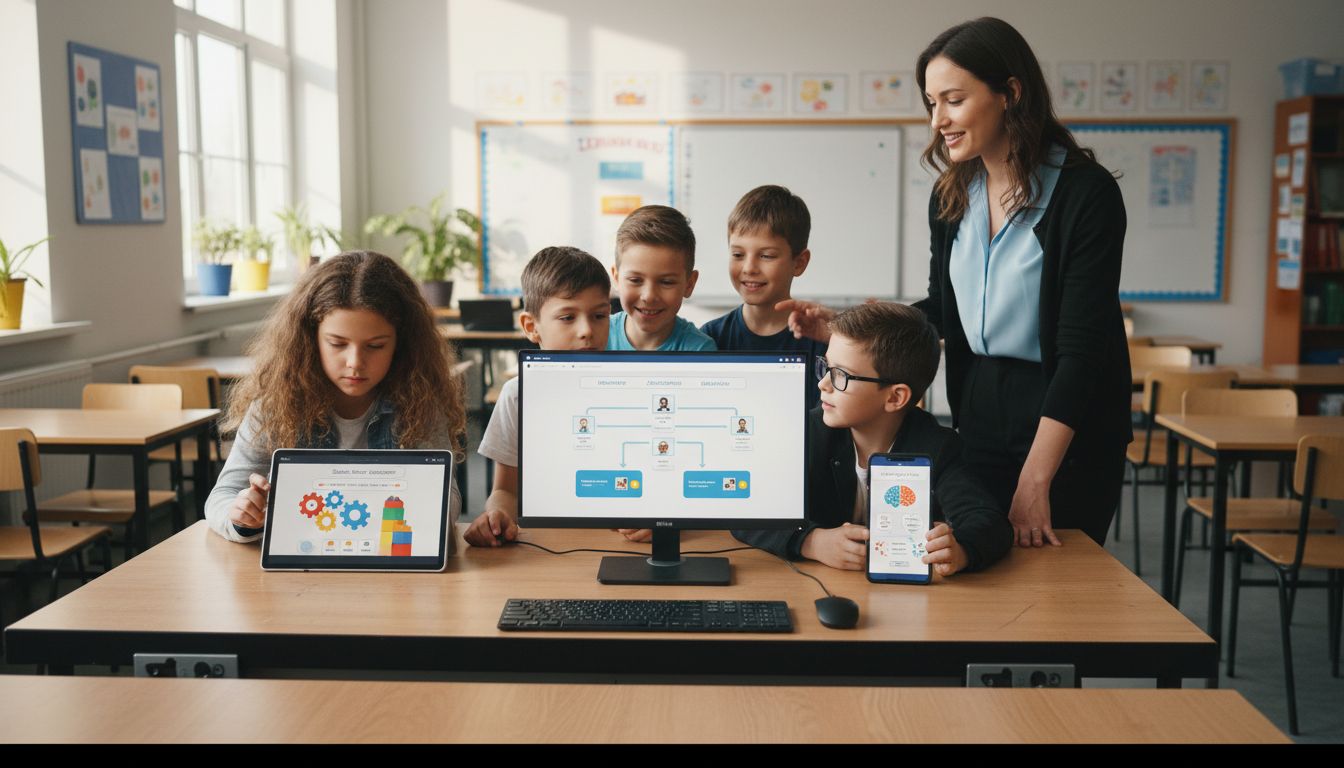
Automatic story creation is a complex process that combines modern artificial intelligence and advanced algorithms. The core goal is to generate personalized and structurally coherent stories tailored to the specific needs and interests of children.
StoriesForKids.ai demonstrates how AI platforms can automatically create stories and matching illustrations. The technology is based on advanced language models capable of understanding and reproducing narrative structures.
The process of automatic story creation can be divided into several key steps:
- Input of user parameters
- Analysis and selection of appropriate narrative structures
- Generation of coherent sentences
- Semantic verification of text logic
- Optional: Creation of matching illustrations
An innovative approach to improving story generation is proposed by Arxiv researchers: A skeleton-based model that first generates critical phrases and then expands them into complete, coherent sentences.
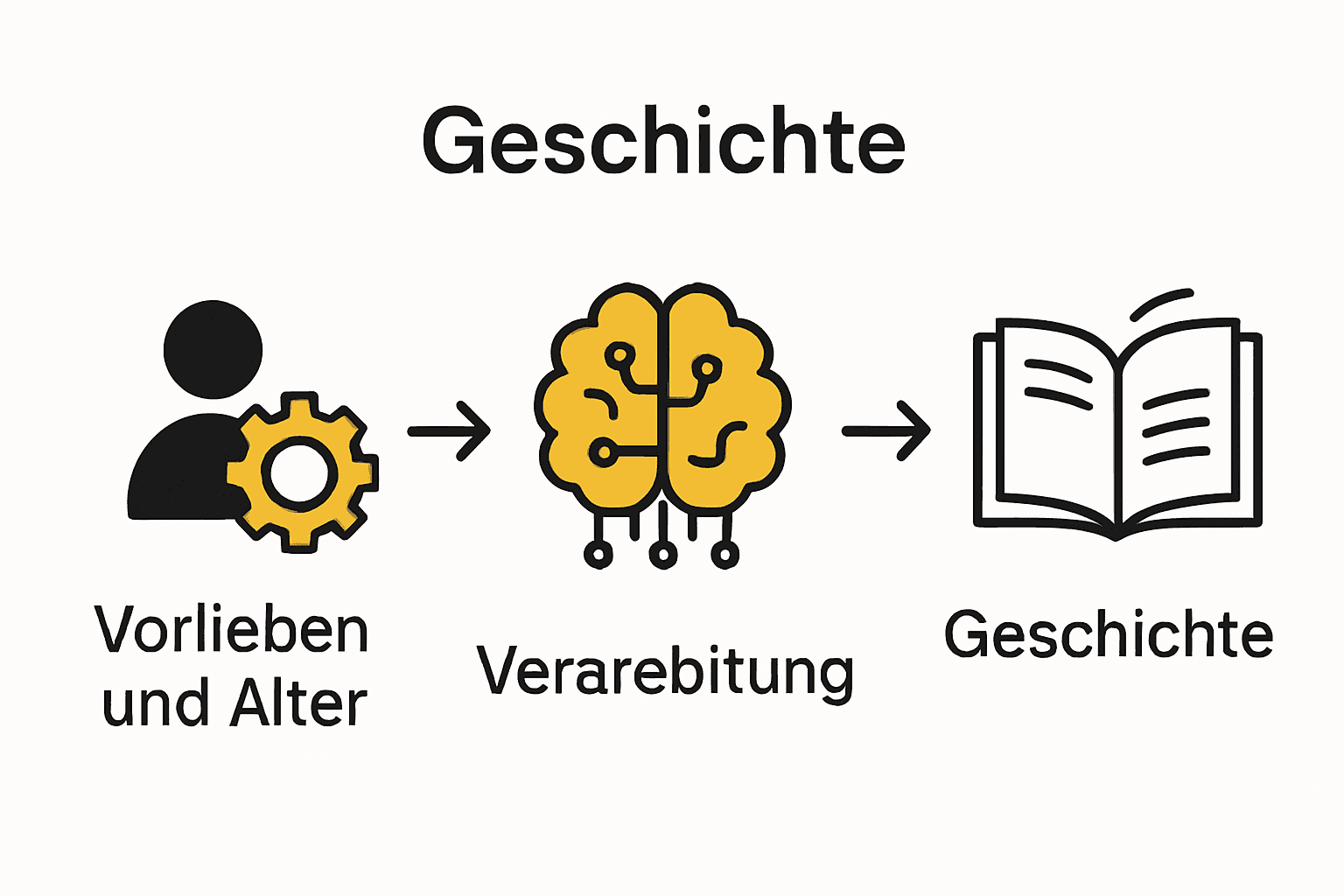 This algorithm increases narrative coherence and ensures more natural reading flow.
Personalization: Stories by Age and Interest
Personalizing children's stories is a crucial aspect that can significantly increase reading enjoyment and learning motivation. Modern story generators use advanced algorithms to create stories precisely tailored to a child's age, interests, and developmental stage.
LET'S STORY! exemplifies how parents and children can jointly create personalized adventure stories in a safe environment. Personalization occurs across several key dimensions:
- Age-Appropriate Complexity: Adaptation of sentence structure and vocabulary
- Thematic Preferences: Consideration of individual interests
- Character Design: Integration of personal names and characteristics
- Learning Goals: Integration of educational elements
- Emotional Resonance: Alignment with children's emotional worlds
The personalization process is based on intelligent systems that continuously learn and adapt to the child's development. Why personalized stories are important for children lies in their ability to actively engage children in their reading experience and foster their creativity and language development.
Safety Factors and Data Protection for Children
Protecting children in digital environments is more important than ever today. Story generators must be designed with particular care to ensure the privacy and safety of young users. This means not only technical protection but also pedagogically responsible design.
Important security mechanisms include:
- Anonymization: No storage of personal identification data
- Age Verification: Control of user groups
- Content Filtering: Automatic review of generated stories
- Parental Controls: Setting options for guardians
- Encrypted Communication: Protection against unauthorized data access
Child safety on the internet demonstrates how crucial comprehensive security concepts are for digital children's applications. Modern story generators integrate multi-layered security strategies that go far beyond simple access restrictions.
The key lies in balancing creativity and protection. Technical systems must be designed so that children can freely and safely experience their stories while maintaining the highest data protection standards.
Benefits and Possible Limitations of Story Generators
Story generators are innovative technologies that bring both impressive benefits and potential challenges. They open new creative horizons for children but simultaneously pose risks that must be carefully considered.
The central benefits include:
- Promoting language development
- Increasing creativity
- Individual adaptation to learning needs
- Accessibility and time savings for parents
- Motivation for reading and storytelling
Storytelling for parents: inspiring and supporting children demonstrates how important creative storytelling formats are for child development. At the same time, parents must understand the possible limitations: AI-generated stories cannot completely replace human interaction and personal storytelling skills.
The critical challenge lies in balancing technological innovation with pedagogical meaningfulness. Story generators should be viewed as a supplement, not a replacement for traditional storytelling.
Discover the Future of Storytelling with Edory.ai
The complex world of automatic story creation, as explained in our guide, shows how important personalized and age-appropriate stories are for children's development. Parents face the challenge of finding creative, safe, and interest-tailored stories for their children. This is exactly where Edory.ai comes in, offering an innovative platform based on cutting-edge AI technology. With Edory, you can generate new, individually customized stories daily that not only entertain but also strategically pursue learning goals.
Would you like to experience the benefits of personalized children's stories right away and give your child a special reading experience? Visit Edory.ai now and discover more exciting content in our Uncategorized – Edory AI – Educational Children's Stories section. Start today and make stories a magical part of your family's everyday life.
Frequently Asked Questions
How does automatic story creation work with a story generator?
Automatic story creation works through modern artificial intelligence that analyzes user parameters and generates appropriate narrative structures. This involves creating coherent sentences and checking their logical semantics.
What types of story generators exist and how do they differ?
There are various types of story generators, including traditional narrative generators, interactive storytelling tools, and AI-based story generators. They differ in functionality, interactivity, and target audience.
How are stories adapted for different age groups?
Adaptation occurs by considering the age group in sentence structure, vocabulary, and theme preferences. Modern story generators also integrate specific learning goals and emotional resonance to increase reading enjoyment.
What safety measures are important when using story generators for children?
Important safety measures include anonymization of data, age verification, content filtering for generated stories, parental control options, and encrypted communication to ensure children's privacy and safety.
Recommendation
- Storytelling for Parents: Inspire and Support Children – Edory AI – Educational Children's Stories
- Accompany Children with Stories: Creative Ways for Parents – Edory AI – Educational Children's Stories
- Storytelling for Toddlers: Understanding What It Means – Edory AI – Educational Children's Stories