 edory
edory
Digital media is now a permanent part of everyday life for many children. Parents face the question of how to use this variety meaningfully and safely for learning. Surprisingly, learning success often doesn't depend on expensive technology or spectacular apps. Instead, research shows that simply observing your child's interests carefully is essential, and that short learning sessions of just 20 to 45 minutes are significantly more effective than long sessions according to research. If you remain creative in selecting, planning, and supporting your child's learning, you can transform digital learning into a real motivational boost for children.
Table of Contents
- Step 1: Evaluate Your Child's Interests
- Step 2: Choose Suitable Digital Media Platforms
- Step 3: Create a Learning Schedule
- Step 4: Integrate Interactive Learning Games
- Step 5: Check Your Child's Progress
Quick Summary
| Key Point | Explanation |
|---|---|
| 1. Observe Your Child's Interests | Identify the topics that attract your child to select motivating learning resources. |
| 2. Choose High-Quality Platforms | Look for digital media that promotes active learning and critical thinking to achieve real learning progress. |
| 3. Create a Flexible Learning Schedule | Integrate short, effective learning sessions into daily life while remaining flexible in planning. |
| 4. Use Interactive Learning Games | Choose games that promote creative thinking and are tailored to your child's interests. |
| 5. Regularly Check Progress | Use various methods to comprehensively evaluate and adjust development. |
Step 1: Evaluate Your Child's Interests
The foundation of successful learning with digital media begins with a deep understanding of your child's individual interests. Each child has unique preferences, inclinations, and learning styles that hold the key to motivating and effective digital learning.
Observe your child carefully in various situations. Pay attention to which topics make their eyes light up, which activities they pursue with enthusiasm, and what keeps them engaged and focused for particularly long periods. Is it dinosaurs, space, musical instruments, or art projects? This natural curiosity is the perfect starting point for digital learning resources.
Use digital tools and observation methods to explore interests systematically. Modern parenting guides recommend interactive apps and online platforms that make it possible to discover your child's preferences playfully. Keep a digital learning journal where you document topics, reactions, and moments of enthusiasm from your child.
What's important is maintaining an open and supportive attitude. Avoid judgments or restrictions. If your child develops an unexpected fascination with computer programming, for example, you should take this motivation seriously and actively encourage it.
Prepare various digital resources and observe the reactions. Watch for signs of enthusiasm such as:
- Sustained concentration and focus
- Spontaneous questions and follow-up questions
- Voluntary deepening into a topic
- Enthusiastic sharing of discoveries
The goal of this first phase is to develop an authentic understanding of your child's natural learning impulses. Digital media thus become a personalized educational tool that is fun and awakens a love of learning.

Step 2: Choose Suitable Digital Media Platforms
After identifying your child's interests, the decisive phase of platform selection begins. Digital educational media are not all the same - the right choice can make the difference between boredom and enthusiasm.
Start with careful analysis. UNESCO emphasizes the importance of high-quality digital educational technologies that not only entertain but also enable real learning progress. Look for platforms that are interactive, age-appropriate, and aligned with your child's interests.
Pay attention to several core selection criteria. Pedagogical quality comes first. A good platform offers more than just entertainment - it promotes active learning, critical thinking, and problem-solving skills. Look for clear learning objectives, meaningful challenges, and progress measurements.
Safety is another critical aspect. Check privacy policies, age restrictions, and user reviews. Avoid platforms with unfiltered communication options or questionable advertising content.
Consider technical compatibility. Choose media that runs on your existing devices and offers a user-friendly interface. Overly complicated systems can quickly dampen your child's motivation.
Key selection criteria include:
- Age-appropriate content
- Interactive learning elements
- Positive user reviews
- Clear pedagogical structure
- Adjustable learning difficulty
A practical strategy is gradual testing. Use free trial versions or time-limited access to explore the platform together with your child. Observe their reactions, engagement, and learning progress.
Success lies in the balance between education and entertainment. The perfect digital learning platform is fun, challenging, and simultaneously expands your child's horizons.
Below you will find a clear comparison table of important selection criteria for digital learning platforms to help you make an informed decision for your child.
| Criterion | Explanation | What to Look For |
|---|---|---|
| Pedagogical Quality | Promotes active learning and critical thinking | Clear learning objectives, meaningful tasks |
| Safety and Data Protection | Protects privacy and sensitive data | Privacy policies, secure communication |
| Age-Appropriate Content | Content matches developmental stage and interest | Age ratings, topic relevance |
| Technical Compatibility | Works on existing devices and is easy to use | Platform requirements, user-friendliness |
| User Reviews | Reflects the experiences of other parents and children | Positive reviews and feedback |
Step 3: Create a Learning Schedule
A structured learning schedule is the heart of successful digital learning. It not only provides orientation but also creates a balance between education, leisure time, and your child's personal development opportunities.
Start with a realistic assessment of available time. Consider school hours, homework, leisure activities, and family time. The key is flexibility and consistency. A rigid schedule quickly leads to frustration, while a too-loose schedule enables no progress.
Research on digital education shows that short, focused learning sessions are significantly more effective than long, exhausting sessions. Therefore, plan time blocks of 20 to 45 minutes, depending on your child's age and attention span.
Integrate learning times into your existing daily routine. Morning learning phases can be particularly productive when children are still well-rested. Alternatively, time periods after school work well, when school tasks are completed. Avoid times when your child is tired or stressed.
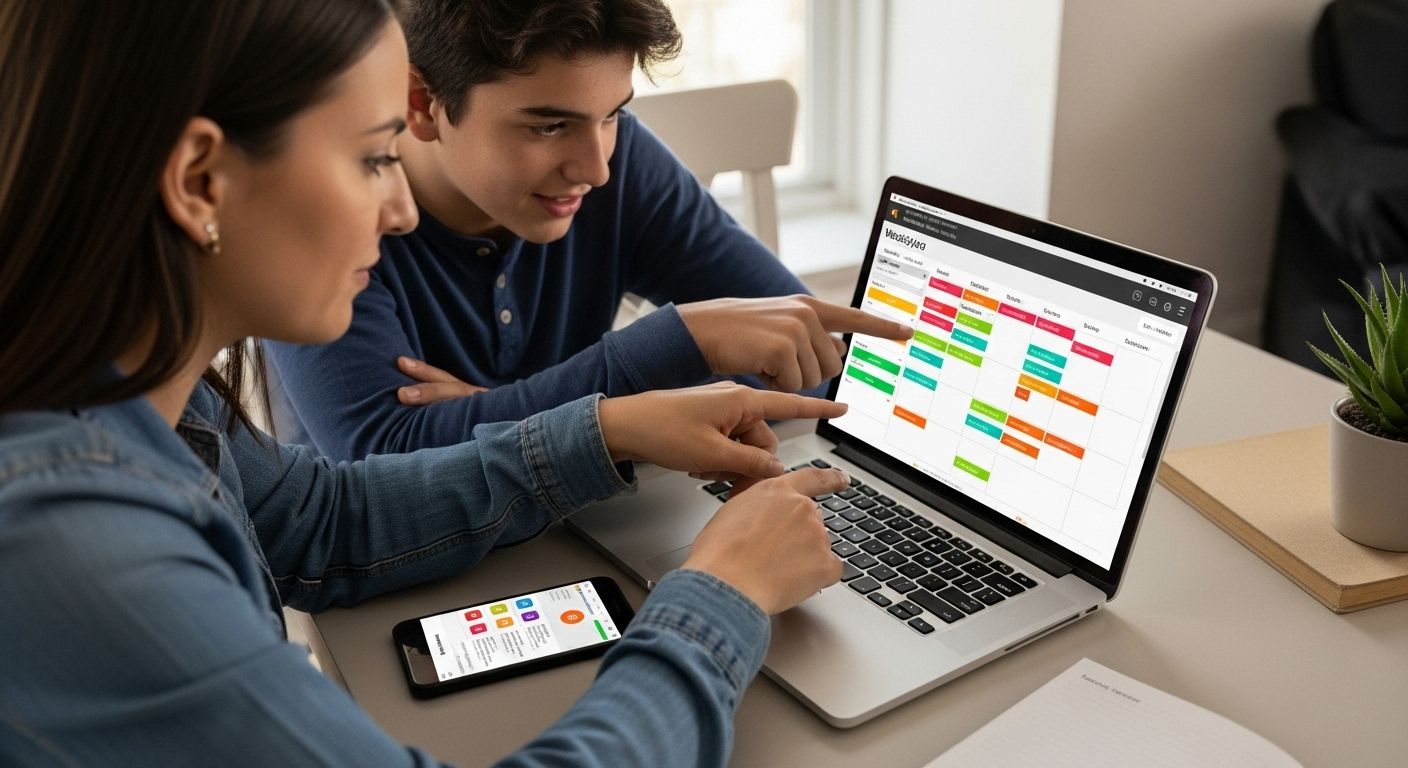
Visualize the schedule together with your child. Use colorful calendars, digital planning apps, or interactive whiteboards. This makes the process transparent and actively involves your child in scheduling.
Consider important aspects when planning:
- Regular short learning sessions
- Adequate breaks between sessions
- Variety between different learning topics
- Flexibility for unexpected activities
Review and adjust the plan regularly. Observe your child's motivation and progress. A good schedule adapts to needs and developments. Be willing to shift times or change activities if they no longer work.
A successful learning schedule is more than a collection of time blocks. It is a dynamic tool that integrates learning into daily life, awakens joy in education, and promotes your child's individual strengths.
Step 4: Integrate Interactive Learning Games
Interactive learning games are more than just entertainment - they are powerful educational tools that transform learning into an exciting, motivating experience. They enable children to explore complex concepts playfully while developing skills that go far beyond traditional learning methods.
UNESCO emphasizes the importance of interactive multimedia tools as transformative educational instruments. These games offer more than entertainment - they create immersive learning environments that actively engage children and challenge their problem-solving abilities.
Begin with careful game selection that perfectly matches your child's interests and learning objectives. Not every game is equally suitable. Look for games that promote complex thinking processes, stimulate creativity, and are fun at the same time.
Pay attention to age-appropriate content and pedagogical quality. Mathematical strategy games can develop logical thinking, language adventure games can improve vocabulary and communication skills. Scientific simulation games awaken curiosity about science topics.
Gradually integrate learning games into the daily routine. Start with short gaming sessions and gradually increase duration and complexity. Be present and interested to jointly reflect on learning successes.
When selecting games, you should consider the following criteria:
- Age-appropriate difficulty levels
- Clear learning objectives
- Positive user reviews
- Child-friendly user interface
- Data protection and security standards
Monitor gaming time and ensure a balanced ratio between gaming and other learning activities. A controlled, conscious use of digital learning games is the key to success.
Observe your child's reactions and progress. Does it show enthusiasm? Is it learning new concepts? Is it developing problem-solving skills? These signs indicate that the learning games are effective and motivating.
The ultimate goal is to transform learning into an exciting adventure where children not only absorb knowledge but actively discover and grow.
Step 5: Check Your Child's Progress
Monitoring learning progress is crucial for an effective educational journey. It enables you to understand your child's development, foster strengths, and identify areas that need additional support.
The Brookings Institution emphasizes the importance of real-time data in educational monitoring. Modern digital tools offer precise ways to document and analyze learning progress.
Develop a holistic evaluation system that encompasses more than just grades. Consider progress in various dimensions: cognitive development, emotional intelligence, problem-solving skills, and motivation. Digital learning platforms often provide integrated progress trackers that offer detailed insights.
Conduct regular, joint reflection conversations with your child. These should not feel like interrogations but rather be designed as supportive dialogues. Ask about their feelings, challenges, and successes. Praise effort, not just results.
Use various assessment methods. Digital portfolios can document work and progress over time. Screenshots of game achievements, learning certificates, and project documentation provide a comprehensive picture of development.
Pay attention to the following progress indicators:
- Increasing independence in learning
- Growing confidence
- Willingness to accept new challenges
- Improved concentration ability
- More creative problem-solving approaches
Be flexible and ready to adjust learning strategies. If your child shows difficulties in certain areas, this is not a setback but an opportunity for further development. Set realistic, individual learning goals.
Technological tools can be helpful, but don't let them replace human observation and intuition. Your role as a parent who carefully and lovingly accompanies your child's development remains irreplaceable.
To systematically monitor the learning process, this table helps you present typical signs of your child's learning progress in a compact way.
| Progress Indicator | Description |
|---|---|
| Increasing Independence | Your child solves tasks independently and seeks solutions on their own. |
| Growing Confidence | They approach new topics with more confidence. |
| Willingness for New Challenges | Your child voluntarily tries new things. |
| Improved Concentration Ability | Longer, focused work phases become visible. |
| More Creative Problem-Solving | New and original solutions are found. |
A successful progress check is more than a snapshot - it is a dynamic process of discovery, support, and encouragement.
Discover Individual Learning Stories – Perfectly Suited for Your Child
In your daily life, you discover how