 edory
How Long Should a Bedtime Story for Children Be?
· 7 minutes read
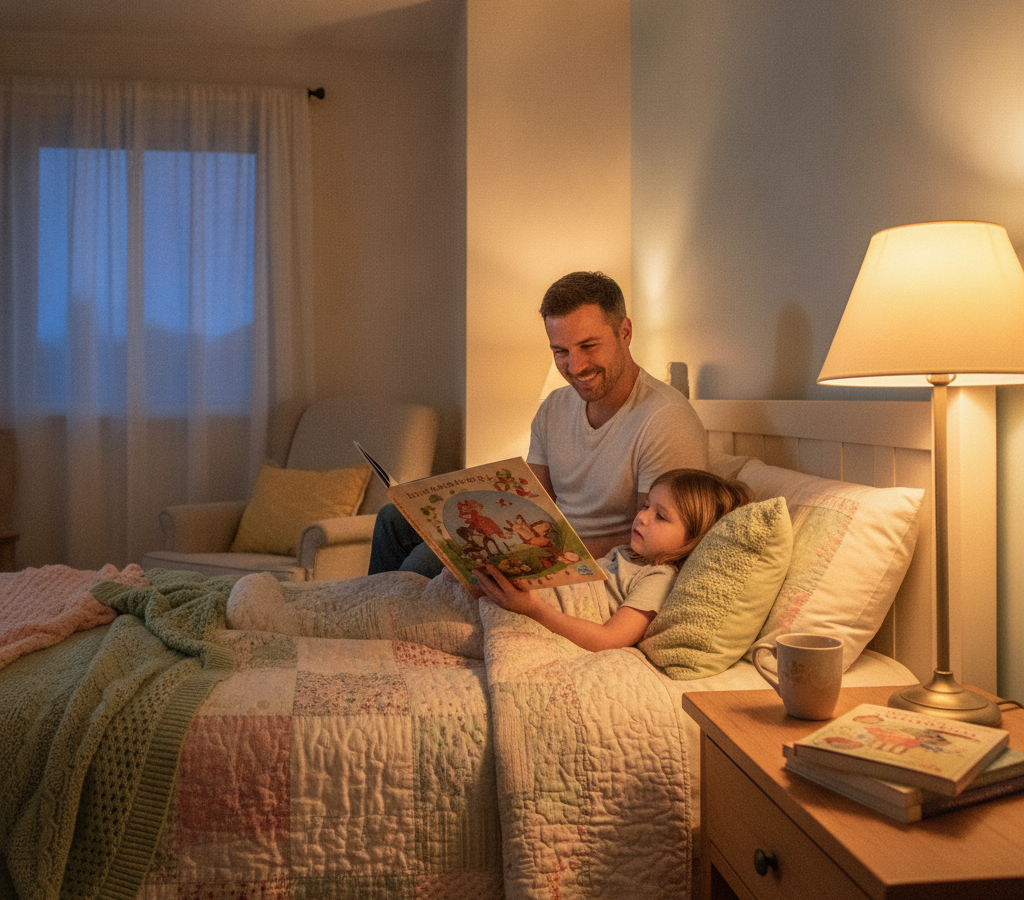
"One more story, please!" – parents know this phrase all too well. But how long should a bedtime story for children be so that it truly helps them fall asleep without dragging out the ritual? The answer depends on your child's age, how they're feeling that day, and their temperament. In this article, you'll learn what makes the right length, why it matters so much, and how to make the evening routine relaxed and loving.
Why the Length of the Story Matters So Much
Reading aloud before bedtime is far more than just a nice tradition. It signals to the child's brain: the day is over, now I can let go. For this signal to work, the story needs to create a certain atmosphere – calm, gentle, and predictable.
A story that is too short leaves the child unsatisfied and still alert. A story that is too long overstimulates them, keeps them awake, or means you both end up exhausted. The goal, therefore, is not a fixed number of minutes, but a story that is just long enough to guide the child into a relaxed, sleepy state.
Imagine your daughter Lena closing her eyes just as the heroine of the story takes her final adventure step – that is the perfect moment.
How Long Should a Bedtime Story for Children Be – By Age
Your child's age is the most important guide for the ideal story length. Here is a practical overview:
Babies and Toddlers (0–2 Years)
At this age, it is less about plot and more about sound and rhythm. Short, repetitive sentences and a soft, melodic voice – 2 to 5 minutes is entirely sufficient. Often a single picture book, or even just part of one, is enough.
Preschool Children (3–5 Years)
Three- to five-year-olds can already follow short stories and love clear beginnings, middles, and ends. A bedtime story at this age should last between 5 and 10 minutes – roughly equivalent to a story with one central experience and a calm winding-down.
Primary School Children (6–9 Years)
With the start of school comes greater stamina and imagination. Children this age can follow more complex storylines and enjoy characters who solve problems or learn something. 10 to 15 minutes is ideal – enough time for a little adventure, but not so much that the brain switches back into daytime mode.
Older Children (10+ Years)
For children aged ten and above, reading aloud often shifts toward chapter books. Here, a reading session can last 15 to 20 minutes, as long as the end of the chapter offers a natural resting point.
Quality Over Quantity: What Really Matters
The number of minutes alone is no guarantee of a good bedtime story. Much more important are pace, tone, and content. A story with too much action can keep your child wide awake even after just 5 minutes. Pay attention to the following points:
Calm storytelling pace: Speak more slowly than usual and pause at beautiful moments.
Repeating elements: Children love rituals. If the story always ends with the same sentence, this provides additional comfort.
No drama at the end: Conflict is fine, but the final minutes should be calm and resolution-focused.
Personalization: When your child is the main character, they listen more attentively and relax more deeply at the same time – because they feel safe and seen.
Speaking of personalization: with an app like Edory AI (edory.ai), you can create stories in which your child is the hero. You choose from eight school subjects – from mathematics to biology – and at the end there are even short learning questions. This way, you combine the bedtime ritual and playful learning in a natural way.
Common Mistakes in the Evening Routine – and How to Avoid Them
Many parents unconsciously do things that make falling asleep harder, even with a good story. Here are the most common pitfalls:
The Story Gets Longer and Longer
"Just five more minutes" can easily become twenty. Children test boundaries, and that is completely normal. Help yourself with a clear ritual: for example, always exactly one story, then lights out. If you keep the length consistent from the start, your child will quickly learn to accept it.
Screen Time Right Before the Story
If your child has been watching videos immediately before the bedtime story, their brain is in a different state of arousal. Plan a short transition period – brushing teeth, putting on pajamas, briefly reflecting on what was nice about the day – before you begin reading aloud.