 edory
edory
Over 60 percent of families already use digital technologies for playful learning and storytelling. Artificial intelligence is now taking storytelling to a completely new level. Parents suddenly face the question of how to use this innovation meaningfully for their child. Anyone who wants to understand how AI adapts stories to children and what principles are behind it will find clear answers and valuable guidance here.
Table of Contents
- AI Storytelling: Terms and Basic Principles
- How Artificial Intelligence Generates Stories
- Individual Application Examples for Families
- Benefits and Opportunities in Children's Daily Lives
- Risks, Data Protection, and Parental Controls
Key Findings
| Point | Details |
|---|---|
| Personalization | AI storytelling enables tailor-made stories that are adapted to children's interests and developmental stages. |
| Interactive Elements | Through interactive narrative structures, children are actively involved in the storytelling process, which increases learning motivation. |
| Educational Value | AI-integrated storytelling promotes cognitive abilities such as creativity, empathy, and critical thinking. |
| Parental Control Necessary | Parents should monitor the use of AI-driven stories to ensure age-appropriateness and data protection. |
AI Storytelling: Terms and Basic Principles
Artificial intelligence is increasingly revolutionizing the way we tell stories. Since the term artificial intelligence was coined by John McCarthy in 1955, it describes the ability of machines to solve tasks that normally require human intelligence de.wikipedia.org. In the context of storytelling, this means that AI systems can now generate complex narrative structures while considering emotional and educational elements.
AI-supported storytelling uses modern technologies to create stories that captivate children in a completely new way. According to imh.at, AI tools can generate texts, images, and videos that evoke emotions and remain in memory. For parents, this means a unique opportunity to create personalized and interactive stories that are perfectly tailored to their children's interests and developmental stages.
The basic principles of AI storytelling are based on several key elements:
Here is an overview of the most important basic principles of AI storytelling:
| Principle | Description |
|---|---|
| Personalization | Adaptation to interests and age |
| Interactivity | Inclusion of the reader in the plot |
| Dynamic Content | Stories develop in real-time |
| Educational Value | Learning objectives integrated into entertaining narratives |
- Personalization: Adapting the story to the child's age, interests, and learning objectives
- Interactivity: Involving the reader in the narrative structure
- Dynamic Content: Generation of stories that develop in real-time
- Educational Value: Integration of learning objectives into entertaining narratives
For parents, AI storytelling offers an exciting opportunity to combine education and entertainment. The educational value of storytelling for children shows how important creative narrative formats are for children's development. The technology enables the creation of stories that not only entertain but also specifically promote competencies such as creativity, empathy, and critical thinking.
How Artificial Intelligence Generates Stories
The process of story generation through artificial intelligence is a fascinating technology that uses complex algorithmic methods. According to research by the Goethe Institute, AI systems can generate stories by being trained on a variety of texts and creating new content from them. The algorithm 'Edison' is an excellent example, trained on 3,000 bestsellers and able to provide authors with feedback on readability and plot arcs.
The process of AI story generation is based on several key technologies:
- Machine Learning: Analysis of text patterns and structures
- Natural Language Processing: Understanding of context and semantics
- Neural Networks: Generation of coherent and creative text sequences
- Data Training: Use of extensive text corpora as a learning foundation
For parents and educators, this technology offers exciting opportunities to create interactive stories for children. AI can not only generate stories but also adapt them to the individual needs and developmental stages of children, making each story unique and educational.
The challenge lies in finding a balance between technical precision and creative storytelling. Modern AI systems are already capable of generating stories that are not only grammatically correct but also emotionally engaging and substantively meaningful. This opens new dimensions of digital storytelling that combine education and entertainment in innovative ways.
Individual Application Examples for Families
Artificial intelligence opens up completely new possibilities for families to tell stories together. Smodin.io confirms that an AI story generator can help families create creative stories together by generating complete narratives based on just a few details. This not only promotes creativity but also strengthens family cohesion.
Here are some concrete application examples for AI-supported storytelling in families:
- Shared Evening Rituals: Development of personalized bedtime stories
- Learning Support: Creation of age-appropriate educational stories
- Family Chronicle: Documentation of family stories with AI support
- Creative Game Nights: Interactive stories as family entertainment
For parents, multi-generational stories offer a wonderful way to keep traditions and memories alive. AI technologies enable families to preserve family stories while creating new, exciting narratives that inspire children and have educational value at the same time.
The technology allows families to generate stories that are perfectly tailored to the individual needs and interests of each family member.
 From fantastical adventures to educational tales, AI-supported storytelling becomes a creative tool that brings families together and creates shared moments.
Benefits and Opportunities in Children's Daily Lives
Artificial intelligence offers children a variety of developmental opportunities in daily learning and play. According to the Goethe Institute, the use of AI in storytelling can help children unfold their creativity and discover new forms of expression. Through interactive stories, children can learn playfully and improve their language skills.
The main benefits of AI in children's daily lives include:
- Personalized Learning: Adaptation of content to individual learning needs
- Language Development: Expansion of vocabulary and communication skills
- Creative Stimulation: Promotion of imagination and problem-solving abilities
- Emotional Intelligence: Development of empathy through interactive storytelling
Learning Through Experience demonstrates how significant creative learning approaches are for children. According to IMH research, AI-supported storytelling enables child-friendly presentation of complex topics and thus promotes children's interest and understanding.
The technological possibilities are impressive: AI can generate stories that are perfectly tailored to a child's developmental stage and interests. It dynamically adjusts the difficulty level, topics, and language, so children are always challenged yet not overwhelmed.
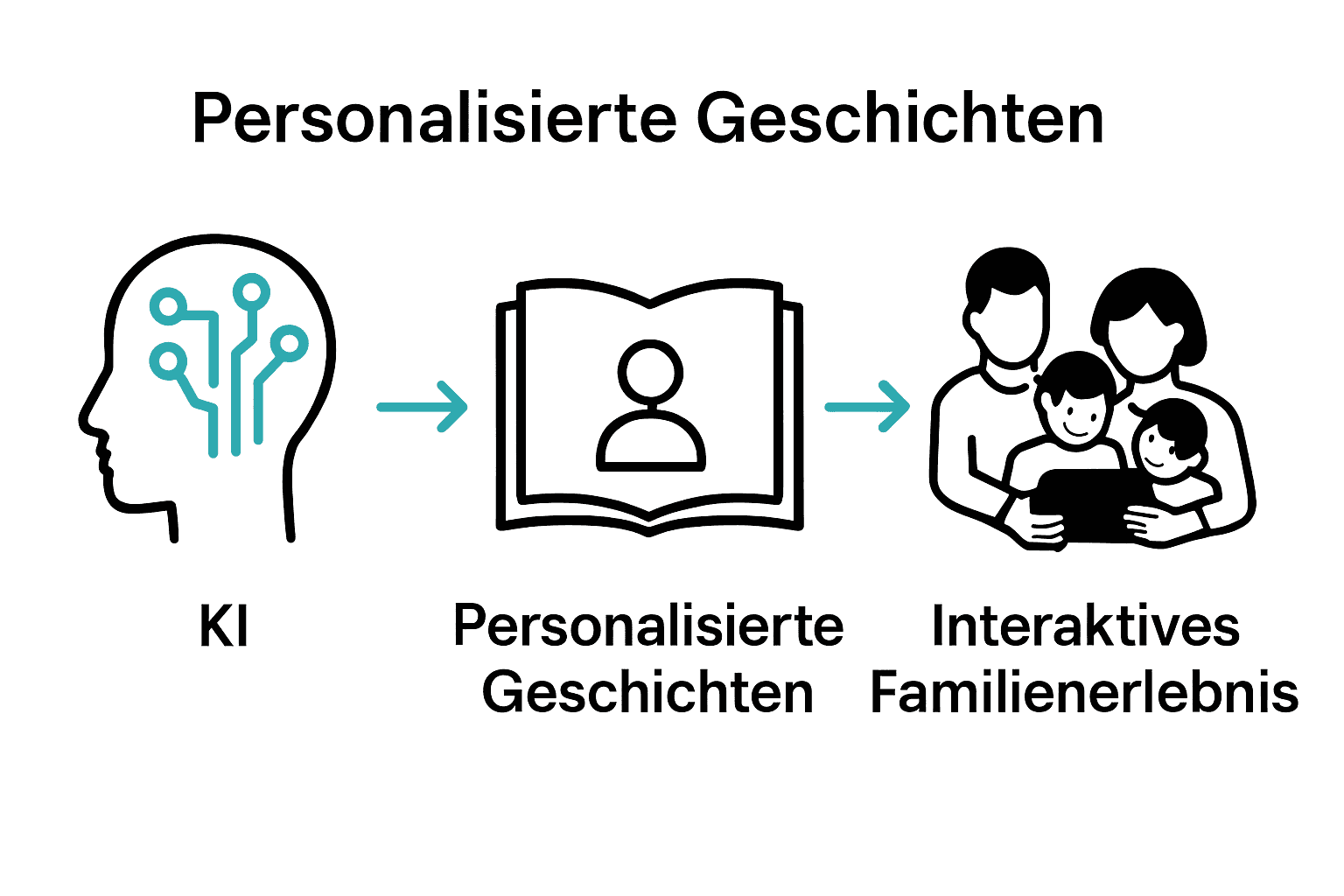 This makes AI a powerful tool for holistic education and entertainment.
Risks, Data Protection, and Parental Controls
Using AI in storytelling for children requires a careful and responsible approach. According to Goethe Institute recommendations, it is crucial to monitor the quality and content of generated stories to ensure they are appropriate for children. Parents should actively accompany and control the use of such tools.
Important safety aspects for parents include:
- Content Filtering: Checking generated stories for age-appropriateness
- Data Protection: Controlling data use and storage
- Time Management: Limiting the duration of use of digital storytelling tools
- Interactive Engagement: Experiencing and discussing stories together
Child Safety on the Internet is a central topic for modern parents. According to IMH, data protection and security are central aspects when using AI in storytelling. Parents must educate themselves about how AI tools work and ensure that no sensitive data about their children is disclosed.
The keys to safe use lie in an active parental role: open communication, regular review of content, and setting clear usage guidelines. AI storytelling can be a valuable educational tool as long as it is used responsibly and under parental supervision.
Discover Personalized AI Storytelling for Your Family
Many parents face the challenge of offering their children exciting and educational stories every day that are tailored to their interests and developmental stages. This is the problem that the concept of AI-supported storytelling addresses, promising personalized, interactive, and educationally valuable narratives that promote creativity and enrich shared family moments. At the same time, safety, data protection, and continuous parental control are important aspects to consider.
With Edory AI, you get an innovative solution that fulfills exactly these wishes. Our platform offers new stories daily that are automatically tailored to your child's age and preferences using cutting-edge AI technology. Immerse yourself in the world of Uncategorized – Edory AI – Educational Children's Stories and discover how easy it is to combine learning and fun. Start now at edory.ai and give your family unique stories full of imagination and education.
Frequently Asked Questions
What is AI-Supported Storytelling?
AI-supported storytelling uses artificial intelligence to create individual, interactive, and dynamic stories that are tailored to children's interests and developmental stages.
What Benefits Does AI Storytelling Offer for Children?
AI storytelling promotes children's creativity, language skills, and emotional intelligence. It enables personalized learning and offers exciting, educational content.
How is Artificial Intelligence Used in Story Generation?
Artificial intelligence uses techniques such as machine learning and natural language processing to create stories based on a variety of texts that can adapt dynamically.
What Safety Measures Should Parents Take When Using AI Tools in Storytelling?
Parents should check content for age-appropriateness, respect data protection policies, limit the duration of tool use, and actively accompany their children's experiences.
Recommendations
- Storytelling in Family Life: What is it and Why is it Important? – Edory AI – Educational Children's Stories
- Storytelling for Parents: Understanding and Experiencing – Edory AI – Educational Children's Stories
- Edory – Blog – Edory AI – Educational Children's Stories
- Reducing Stress in Children: Practical Steps for Parents