 edory
edory
Almost every third child in Germany reads stories regularly, which do far more than provide mere entertainment. Good children's stories not only promote imagination and language, but also help children understand important values and discover their feelings. Those who know the characteristics of outstanding narratives make a conscious choice for child development and ensure that reading aloud becomes a special experience.
Table of Contents
- Definition and Core Features of Good Children's Stories
- Different Types of Children's Stories at a Glance
- Typical Content and Narrative Structures
- Ensuring Educational Value and Age-Appropriateness
- Common Mistakes and How to Avoid Them
Key Takeaways
| Point | Details |
|---|---|
| Age-Appropriateness | Children's stories should consider the developmental stages of children and address their needs. |
| Emotional Depth and Authenticity | Stories must be emotionally moving and authentic to take children seriously and promote their imagination. |
| Educational Content Without Moralizing | Narratives should contain educational elements without appearing preachy, to enable positive learning. |
| Avoiding Typical Mistakes | Authors should avoid stereotypes and excessive simplification to develop realistic and diverse characters. |
Definition and Core Features of Good Children's Stories
A good children's story is more than just simple entertainment. According to the Encyclopedia of Fairy Tales, it's about creating a narrative that not only entertains but also stimulates child development and imagination.
According to Children's and Young Adult Literature, children's stories must meet some core features. They should:
- Be age-appropriate and consider the child's developmental stages
- Feel authentic and not be infantilized or oversimplified
- Possess emotional depth that truly touches children
- Contain educational elements without appearing preachy
The most important challenge is finding a balance between entertainment and educational value. An outstanding children's story takes children seriously, respects their intelligence, and simultaneously opens doors to new worlds of imagination.
Different Types of Children's Stories at a Glance
The world of children's stories is surprisingly diverse. According to Children's and Young Adult Literature, there are various genres that appeal to different interests and developmental stages of children.
Here is an overview of the main types of children's stories and their characteristics:
| Genre | Main Features | Goal and Effect |
|---|---|---|
| Fairy Tales | Magical elementsnMoral lesson | Promoting imaginationnValue transmission |
| Fables | Animal charactersnClear moral core | Teaching ethicsnStimulating critical thinking |
| Sagas | Historical referencenLegendary events | Cultural understandingnIdentity strengthening |
| Legends | Mythical/religious motifsnExaggerations | Teaching role modelsnTradition awareness |
| Modern Stories | Contemporary topicsnRealistic characters | Life-related problem-solvingnShowing diversity |
Traditional Story Forms
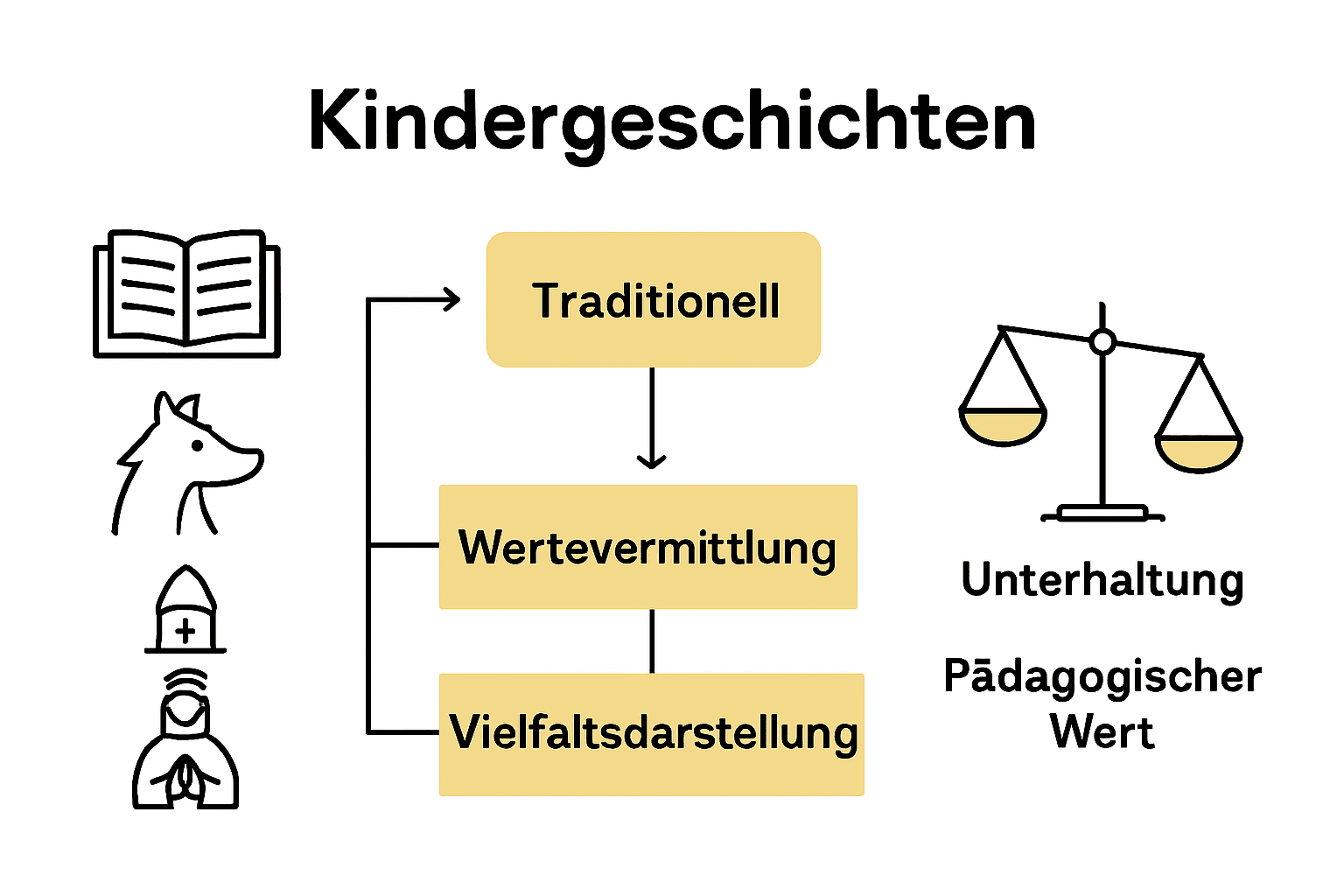
Classical forms include:
- Fairy Tales: Magical stories with moral lessons
- Fables: Animal stories with clear ethical messages
- Sagas: Legendary narratives about historical events
- Legends: Stories with mythological or religious backgrounds
The Encyclopedia of Fairy Tales emphasizes that these narrative forms not only entertain but also convey important cultural and social values.
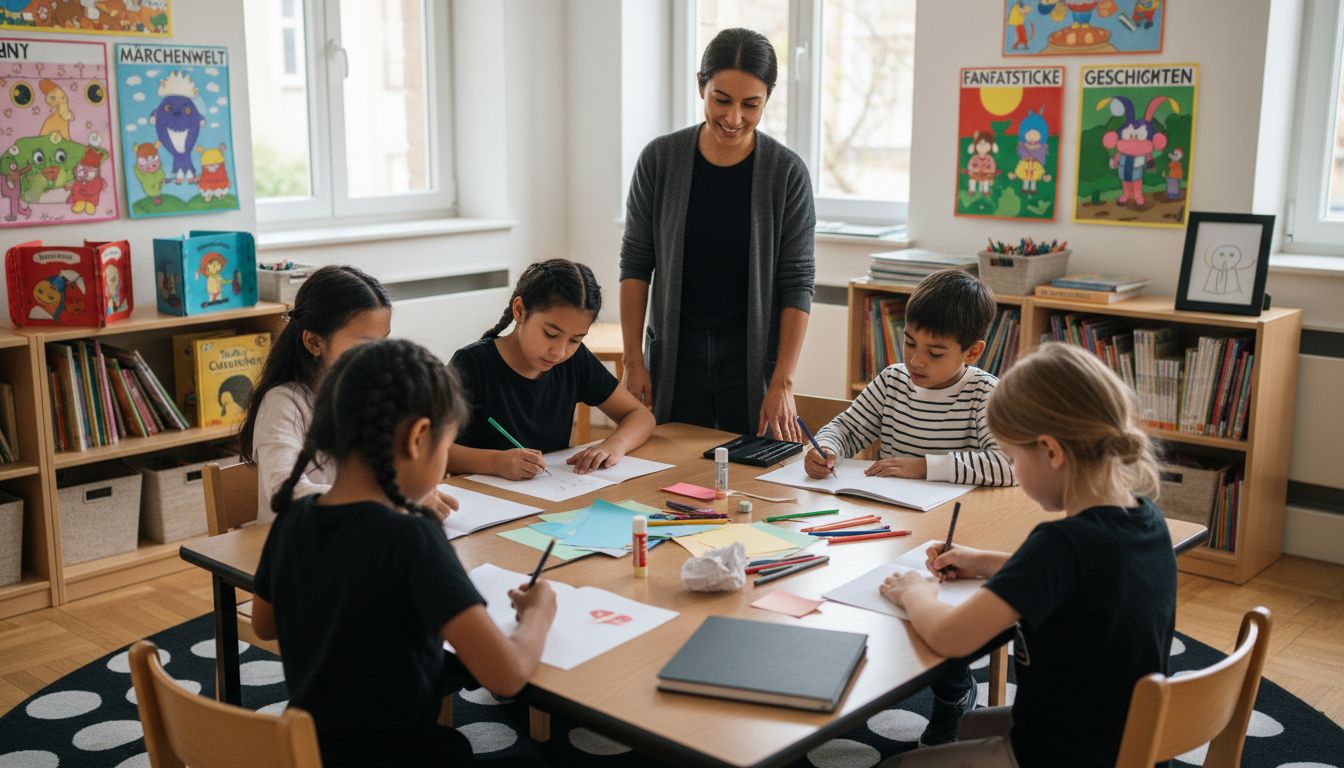
In addition to these traditional forms, increasingly modern children's stories are emerging that address current topics and challenges.
 Selecting age-appropriate stories helps parents find the right story for their child – an art that requires more finesse than one might initially think.
Typical Content and Narrative Structures
Children's stories often follow certain narrative patterns that appeal to children emotionally while supporting important developmental goals. According to Grimm's Fairy Tales, these are primarily clear moral structures with distinct good-versus-evil contrasts.
Characteristic Narrative Structures
The typical content encompasses several central elements:
- Hero's Journey: A main character overcomes challenges
- Moral Message: Lessons about kindness, courage, and honesty
- Magical Twists: Surprising events that create tension
- Just Reward: Good characters are rewarded at the end
Interestingly, a scientific study from ArXiv shows that children's stories often exhibit gender-specific patterns. Male characters are depicted more frequently and associated with qualities like authority, while female figures tend to take caring roles.
Modern Children's Stories develop these traditional structures further and create more nuanced characters that better represent children in their complexity and diversity.
Ensuring Educational Value and Age-Appropriateness
The art of developing a children's story that is both entertaining and educational requires deep understanding and finesse. According to Children's and Young Adult Literature, stories should engage young readers seriously and consider their individual developmental stages.
Strategies for Age-Appropriate Stories
When developing pedagogically valuable children's stories, the following aspects are crucial:
- Linguistic Complexity: Adapt to age level
- Thematic Relevance: Include life-world experiences
- Emotional Accessibility: Present feelings authentically
- Developmental Psychology Perspective: Consider comprehension horizon
As Phaidra emphasizes, good children's books aim not only to entertain but also to convey general life information, scientific content, and moral values. They should help children better understand complex society.
Modern Approaches today combine traditional pedagogical principles with interactive and inclusive narrative strategies to address children holistically and promote their development.
Common Mistakes and How to Avoid Them
When writing children's stories, numerous pitfalls lurk that can compromise the quality and effectiveness of the narrative. Children's and Young Adult Literature explicitly warns against infantilizing or trivializing themes that do not do justice to young readers.
Typical Mistakes in Children's Stories
Here are the most common pitfalls:
- Excessive Simplification: Presenting complex feelings and situations too superficially
- Stereotypical Characters: One-dimensional figures without depth and development
- Lack of Age-Appropriateness: Language or topics that over- or under-challenge
- Missing Authenticity: Constructed situations that don't feel real
An interesting study from ArXiv shows that gender-specific stereotypes in children's stories are particularly problematic. Authors should therefore pay attention to balanced and diverse character representation.
Professional Approaches require sensitivity, creativity, and a deep understanding of children's developmental stages. The art lies in telling complex topics in an understandable and engaging way without preaching or oversimplifying.
Discover the Future of Personalized Children's Stories
Writing children's stories that are both age-appropriate and educationally valuable presents parents with great challenges. In this article, you've learned how important it is to find authentic and emotionally moving narratives that truly appeal to children. And this is exactly where Edory.ai comes in. Our innovative platform allows parents to create new and individually customized stories daily that are tailored to their children's needs and interests.
Would you like to playfully promote your children's imagination while drawing on a selection of trustworthy and educational content? Visit Uncategorized – Edory AI – Educational Children's Stories now and discover how easily you can create the perfect balance between entertainment and education with Edory. Take the opportunity to get creative right away and secure new adventures for your child daily, customized for their development. For more information, visit Edory.ai. Start today combining education and fun meaningfully.
Frequently Asked Questions
What are the core features of a good children's story?
A good children's story should be age-appropriate, authentic, emotionally profound, and educational without appearing preachy.
What types of children's stories are there?
There are various genres such as fairy tales, fables, sagas, and legends, each offering different themes and messages.
How can I ensure that a children's story is educationally valuable?
Pay attention to the linguistic complexity, thematic relevance, and emotional accessibility of the story to ensure it corresponds to children's developmental stages.
What typical mistakes should be avoided when writing children's stories?
Common mistakes are excessive simplification, stereotypical characters, lack of age-appropriateness, and missing authenticity.
Recommendations
- Fantasy Stories for Kindergarten: Telling Stories Creatively – Edory AI – Educational Children's Stories
- What Makes a Good Story? Understanding and Explaining – Edory AI – Educational Children's Stories
- Understanding Age-Appropriate Stories: Meaning and Effect – Edory AI – Educational Children's Stories
- Learning Storytelling for Parents: Inspire and Support Children – Edory AI – Educational Children's Stories
- What is a Comfort Cloth? Understanding for Parenting and Play