 edory
edory
The tablet on the living room table is becoming a gateway to a new learning world for many parents in Germany. Digital children's books offer far more than classic reading hours, as they combine multimedia content and interactive elements in personalized stories. Especially for preschool children, this opens up new ways to learn playfully and actively immerse themselves in narratives. In the following article, parents will learn how digital children's books support individual learning and what opportunities these innovative formats hold for early childhood education.
Table of Contents
- Digital Children's Book: Definition and Misconceptions
- Variants of Digital Children's Books and Their Special Features
- How Personalization and Interactivity Work
- Using Digital Children's Books for Support in Daycare Centers and Families
- Legal Foundations and Data Protection in Children's Book Apps
- Risks, Costs and Quality Criteria for Parents
Key Insights
| Point | Details |
|---|---|
| Digital children's books expand educational opportunities | They offer interactive and multimodal experiences that support learning. |
| Variety of formats | Different digital book variants offer specific benefits for child development. |
| Personalization promotes engagement | Individual customizations increase children's motivation and language development. |
| Important selection criteria for parents | Data protection, educational value, and cost transparency are crucial when purchasing digital books. |
Digital Children's Book: Definition and Misconceptions
Digital children's books are far more than just electronic versions of traditional print media. They represent a complex multimedia experience that includes multimodal digital combinations of text, image, sound, and interactive elements.
These innovative media formats differ fundamentally from classic printed books through their dynamic interaction possibilities. Important features of digital children's books include:
- Interactive elements that actively involve children
- Multimedia content with sound, animation, and text
- Adaptable storytelling
- Playful learning elements
- Direct interaction with book content
A common misconception is the assumption that digital children's books should replace traditional books. In reality, it's about opening new educational opportunities and offering children a complementary learning experience.
Digital children's books are not a replacement, but a complement to classic book culture.
The educational perspective emphasizes that these digital media require specific ways of reception. Parents and educators must learn to accompany these formats meaningfully and age-appropriately.
Pro Tip: Choose digital children's books that combine interaction and education playfully and can be explored together with your child.
Variants of Digital Children's Books and Their Special Features
Digital children's books today present themselves in an impressive variety of formats that go far beyond traditional reading media. Different digital book variants include varying approaches to interactivity and multimedia.
The most important variants of digital children's books are:
- eBooks with static illustrations
- Living Books with animated elements
- Interactive picture book apps with game elements
- Personalized stories with individual characters
- Educational children's books with pedagogical additional features
Each variant offers specific benefits for child development. Interactive apps, for example, enable direct involvement of the child in the narrative, while personalized books increase identification with the story.
Below you will find a comparison of the most important forms of digital children's books and their educational added value:
| Variant | Degree of Interactivity | Educational Added Value |
|---|---|---|
| eBook | Low, mostly static | Promotes classic reading |
| Living Book | Animated elements, medium | Supports attention and comprehension |
| Picture book app | High, numerous game elements | Awakens playful learning motivation |
| Personalized story | Variable, with personal data | Strengthens identification and self-image |
| Educational children's book | Very high, often adaptive | Specifically promotes skills and knowledge |
Digital children's books are not a one-size-fits-all solution, but individual educational resources.
The educational effectiveness varies depending on the format. It is important to make a conscious selection that considers the child's developmental stage and interests.
Pro Tip: Choose digital children's books that playfully combine learning and entertainment and spark your child's curiosity.
How Personalization and Interactivity Work
Personalized digital children's books are revolutionizing the way children experience and learn from stories. Interactive educational technologies enable a customized reading experience that puts the child directly at the center of the narrative.
The most important mechanisms of personalization include:
- Adapting character names to the child
- Integration of personal avatar options
- Dynamic text adaptation based on reading level
- Individualized story lines
- Reactive learning content based on child interests
Through these interactive elements, children's attention and motivation are significantly increased. The technology makes it possible to create stories that adapt in real time to the child's needs and reactions.
Personalization turns passive reading into an active learning experience.
Educational research shows that such individualized formats are not only entertaining but also effective for learning. They promote language development, reading comprehension, and cognitive flexibility.
Pro Tip: Choose digital children's books that offer a balance between personalization and educational added value.
Using Digital Children's Books for Support in Daycare Centers and Families
Digital children's books offer innovative opportunities for language promotion in both childcare facilities and family contexts. Digital picture books in educational contexts can be strategically used for language development and educational support.
The most important areas of application include:
- Playful language promotion
- Interactive learning experiences
- Individual educational support
- Multilingual communication promotion
- Motivating learning incentives
In daycare centers, pedagogical professionals can use digital children's books to specifically support language learning processes. The technology makes it possible to design stories dynamically and flexibly, actively involving children in the learning process.
Digital children's books are not a replacement, but a valuable complement to traditional educational media.
Families can use these digital resources to create shared reading experiences and individually support their children's language development. The technology provides flexible learning opportunities that adapt to children's needs and interests.

Pro Tip: Integrate digital children's books as an additional, interactive educational tool and not as the sole learning resource.
Legal Foundations and Data Protection in Children's Book Apps
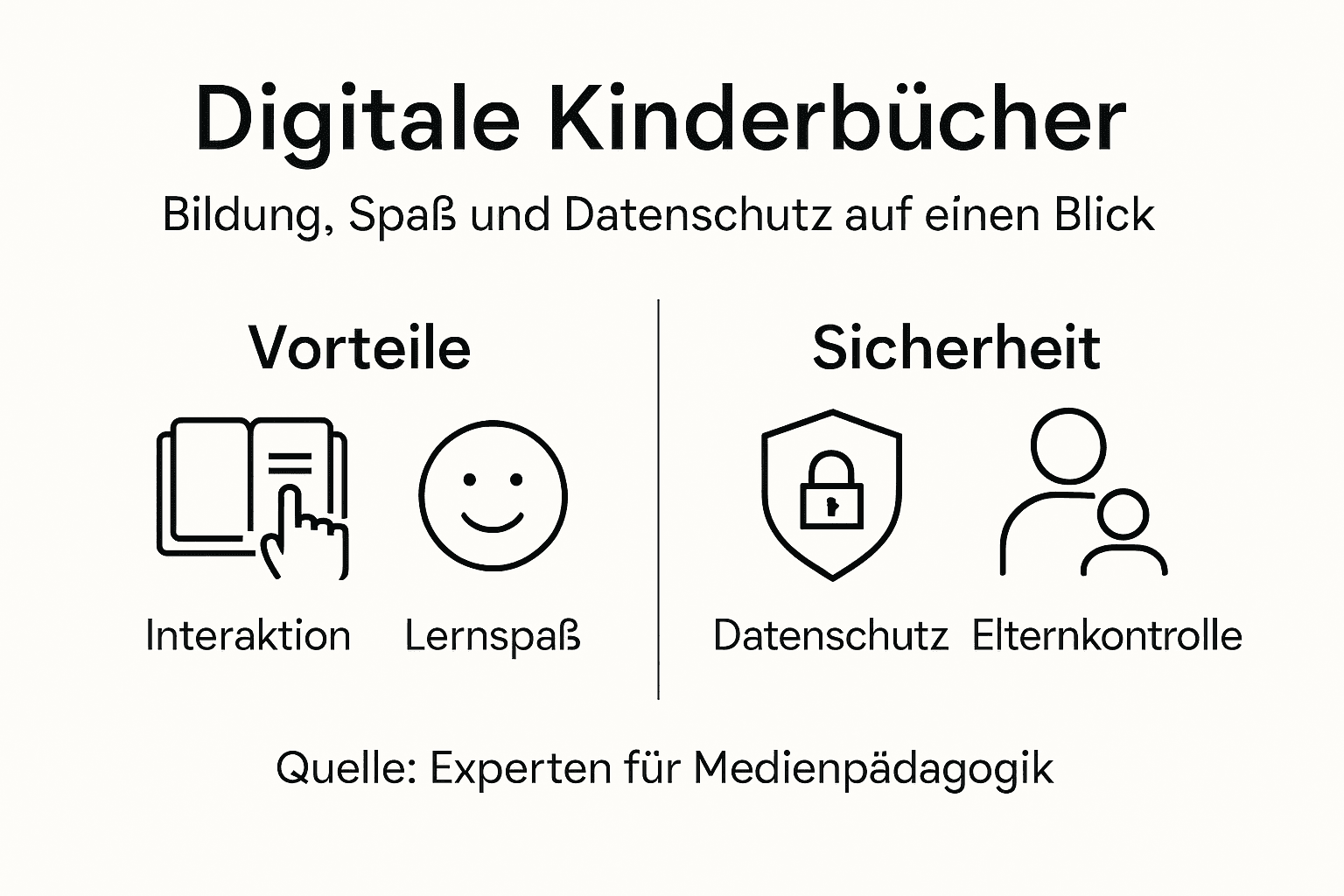
Protecting children in digital media requires complex legal frameworks and careful data protection strategies. Legal aspects of media literacy play a crucial role in the development and use of children's book apps.
The most important legal protection measures include:
- Transparent data protection policies
- Age-appropriate access restrictions
- Encryption of personal data
- Consent management for parents
- Protection against commercial advertising
Particularly important is ensuring that children's book apps do not collect sensitive personal information or share it without parental consent. Educational institutions and parents must carefully review data protection policies.
Data protection in children's apps means more than just legal compliance - it's about protecting children's privacy.
Legal requirements vary depending on the federal state and must be continuously adapted to new digital challenges. Parents and educators should always obtain up-to-date information about data protection standards.
Pro Tip: Regularly check the data protection settings of children's book apps and inform yourself about data usage practices.
Risks, Costs and Quality Criteria for Parents
Digital children's books offer fascinating possibilities but also involve potential challenges. Selection criteria for digital children's books require careful analysis of risks, costs, and educational quality.
The most important quality criteria include:
- Age-appropriate content
- Educational value
- Data protection standards
- User friendliness
- Transparent cost transparency
- Interactive learning elements
Particular risks that parents should be aware of are hidden costs, inappropriate advertising, and excessive screen time. A conscious selection of digital children's books requires continuous attention and guidance.
Quality over quantity - not every digital children's book app is suitable for children.
For responsible use, parents must carefully review data protection policies, limit screen time, and critically question the educational quality of apps.
This overview shows central criteria for selecting safe and high-quality children's book apps for parents:
| Selection Criterion | Why It Matters | What to Pay Special Attention To? |
|---|---|---|
| Data Protection | Protecting children's privacy | Transparent settings, no data sharing |
| Advertising | Avoid distraction and manipulation | Choose apps without third-party advertising |
| Cost Transparency | No unexpected expenses | Clear information about in-app purchases |
| Educational Value | Promoting relevant skills | Content recommended by experts |
Pro Tip: Use trial versions and parent reviews to verify the quality of digital children's books before purchasing.
Individual Stories for More Education and Safety in Digital Children's Books
Digital children's books open up exciting learning opportunities and at the same time require a conscious selection that combines education, fun, and data protection. Parents and educators are looking for safe offerings that provide interactive and personalized stories without endangering children's privacy. This is exactly where Edory.ai comes in, combining innovative AI technology with pedagogical principles for customized narratives that are tailored to your child's needs and interests.
Discover in our category Uncategorized – Edory AI – Educational Children's Stories how easy and safe it is to generate new stories daily. Take the opportunity for playful language promotion and individual learning experiences with the future platform of Edory.ai. Start now and make the world of digital children's books an enriching experience for your child.
Frequently Asked Questions
What are digital children's books?
Digital children's books are multimedia formats that combine text, images, sound, and interactive elements to provide an enriched reading experience for children.