 edory
edory
Edutainment mixes learning with fun and transforms knowledge into an adventure for children. Research shows that edutainment significantly promotes social development and motivation – children learn up to 40 percent more effectively through playful methods. It sounds like a dream for parents where the children's room suddenly becomes a classroom. But instead of endless screen time, edutainment brings the whole family to the table and makes learning a shared, vibrant experience.
Table of Contents
- What does edutainment mean for children and families?
- Benefits of edutainment in children's everyday lives
- Practical examples of edutainment at home and on the go
- Tips for parents: Using edutainment strategically
Summary
| Takeaway | Explanation |
|---|---|
| Edutainment links learning and fun. | It promotes learning motivation by teaching education in a playful way. |
| Parents should actively accompany edutainment. | Learning together strengthens the connection and promotes learning success. |
| Check the quality of edutainment offers. | Careful selection ensures educational added value and fun in learning. |
| Combine digital and analog media. | A balanced approach improves children's educational journey. |
| Edutainment promotes social skills. | Children develop teamwork, communication, and empathy through interactive experiences. |
What does edutainment mean for children and families?
Edutainment connects two important worlds for children: learning and fun. It is an innovative method that seamlessly blends education and entertainment to provide children with a motivating and entertaining learning experience. Research by UNICEF shows that edutainment is a powerful strategy for reaching children in their existing environments and conveying important topics that may not be fully covered in schools or at home.
The importance of edutainment for families
For families, edutainment is more than just a form of entertainment. It is an interactive approach that brings parents and children together and promotes shared learning. Research by the US Department of Family Services emphasizes that strong family involvement is crucial for healthy child development. Edutainment offers exactly this opportunity: it creates moments of shared discovery where parents and children can learn, play, and grow together.
Edutainment enables children to explore complex concepts in a playful and accessible way. Whether through interactive learning games, digital applications, or creative activities – this method makes education an exciting adventure. Children develop not only academic skills but also important soft skills such as problem-solving, creativity, and critical thinking.
Technology and edutainment
Modern technologies play a crucial role in the development of edutainment. Experts from American University Online emphasize that digital media and interactive technologies are revolutionizing edutainment. Learning platforms, educational apps, and smart toys can convey complex learning concepts in entertaining and engaging ways.
For families, this means an opportunity to redefine education. Edutainment overcomes traditional learning barriers by packaging knowledge into exciting stories, games, and interactive experiences. It motivates children to be curious, take on challenges, and learn with joy. At the same time, it provides parents with a valuable tool to actively support and accompany their children's educational journey.
In summary, edutainment is more than a trend – it is a transformative educational philosophy that seamlessly connects learning and fun and helps children discover their potential in a joyful and engaged way.
Benefits of edutainment in children's everyday lives
Edutainment revolutionizes the way children learn and develop. It is not just about entertainment, but about a holistic educational experience that seamlessly combines fun and knowledge. According to Wikipedia, this method aims to increase learning motivation and make learning more efficient.
To give you as parents a quick overview of the benefits of edutainment compared to traditional learning methods, here is a tabular comparison of both approaches.
| Feature | Edutainment | Traditional learning methods |
|---|---|---|
| Motivation | High through playful elements | Often low, driven by obligation |
| Learning readiness | Promoted through fun and interactivity | Can decline due to rigid structures |
| Social development | Promotes teamwork and communication | Usually individual focus |
| Technology use | Strong: apps, digital games, multimedia | Low or traditional |
| Parent-child interaction | Learning together as an experience | Often less actively shared |
| Adaptability | Customizable to individual learning types | Less flexible |
| Connection of theory & practice | Through creative activities and real examples | Often theory-heavy |
Motivation and learning readiness
The central secret of edutainment's success lies in its ability to motivate children. Traditional learning methods can often be tedious, while edutainment transforms learning into an exciting adventure. Research shows that entertaining educational media can effect social behavioral changes. Children are not just passively entertained but actively engaged in learning processes.
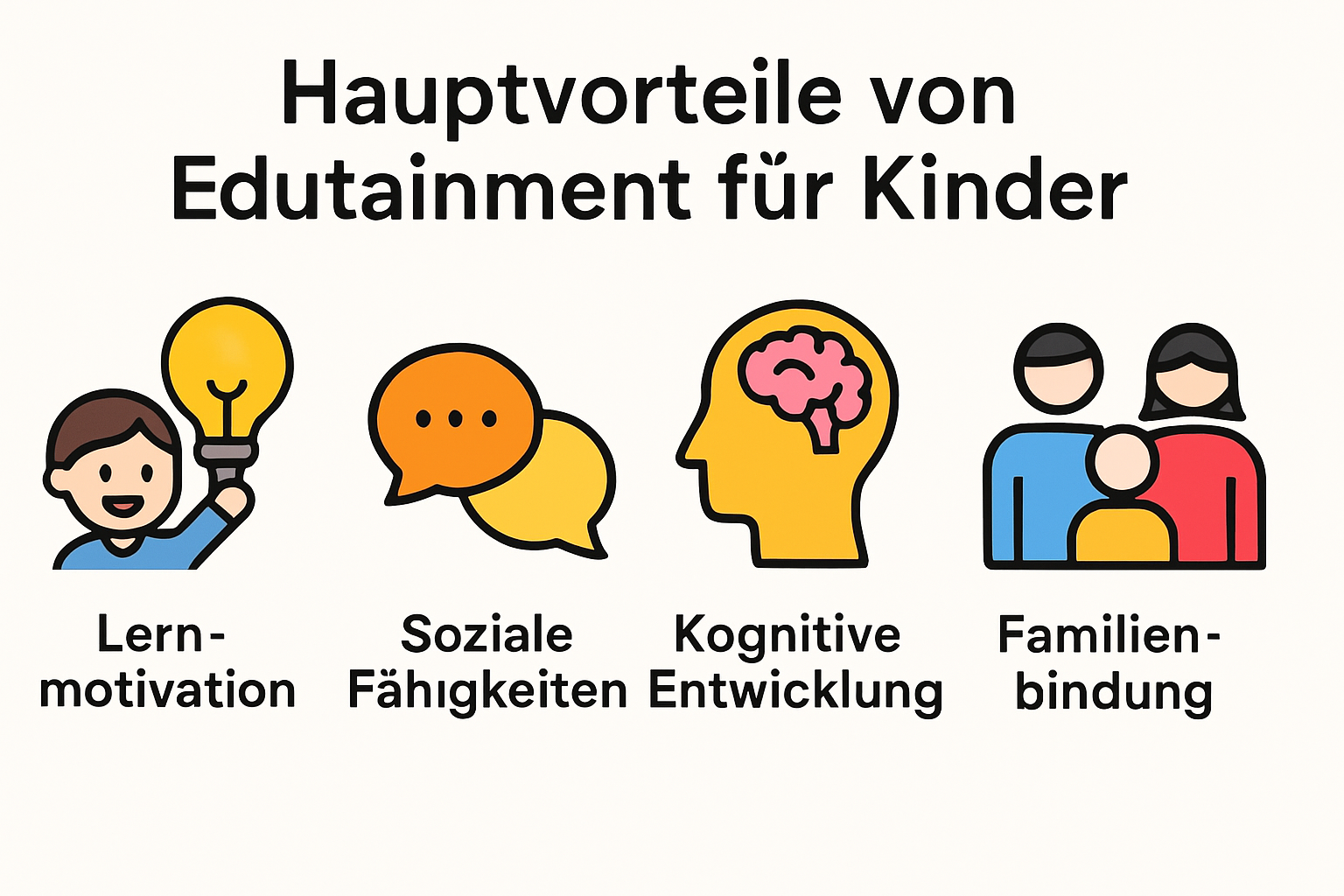
Through playful elements such as interactive games, videos, and digital applications, complex concepts become accessible and understandable. Children not only develop subject-specific competencies but also important soft skills such as problem-solving, creativity, and critical thinking. Intrinsic motivation is increased, which leads to better knowledge retention.
Cognitive and social development
Scientific studies show that gamified learning videos can significantly improve children's motivation and learning success. Edutainment not only promotes cognitive abilities but also supports socio-emotional development. Children learn teamwork, communication, and empathy through interactive learning experiences.
The variety of edutainment formats makes it possible to address different learning styles. Whether auditory, visual, or kinesthetic learners – there is a suitable method for everyone. Digital learning games, interactive stories, and creative tasks help children acquire knowledge in a way that matches their individual needs.
Technology as a learning accelerator
Modern technologies play a key role in the edutainment landscape. Educational apps, smart toys, and interactive platforms transform learning into a dynamic and exciting experience. Children can explore complex topics such as mathematics, science, or languages in a way that is both entertaining and educational.
For parents, edutainment means a valuable opportunity to actively accompany their children's educational journey. It creates spaces for shared learning, discovery, and growth. Edutainment overcomes traditional learning barriers and shows children that education is not a duty but an exciting adventure.
In summary, edutainment is more than a passing trend. It is a transformative educational philosophy that helps children discover and develop their potential in a joyful, engaged, and sustainable way.
Practical examples of edutainment at home and on the go
Edutainment offers families a wealth of creative opportunities to combine learning and fun. Whether at home or on the go – there are numerous ways to make education playful and entertaining.
Digital learning worlds
According to American University, there are diverse edutainment methods that perfectly combine learning and play. Online platforms like CoolMath4Kids or Scratch enable children to learn interactively directly from home. These digital resources make complex topics like mathematics and programming playfully accessible.
Interactive apps and learning games can help children develop new skills. Mathematical concepts, language skills, or scientific basics are taught through playful challenges. Children learn almost incidentally and with visible joy.
Interactive discovery journeys
The National Science Teaching Association recommends innovative technologies like Google Expeditions. This app offers augmented and virtual reality experiences that allow children to interactively explore scientific concepts. Imagine your children walking through virtual museums, exploring volcanoes, or traveling through the solar system – all from the living room.
Such virtual adventures not only expand knowledge but also awaken children's curiosity and imagination. They learn playfully about geography, history, science, and cultures.
Analog edutainment activities
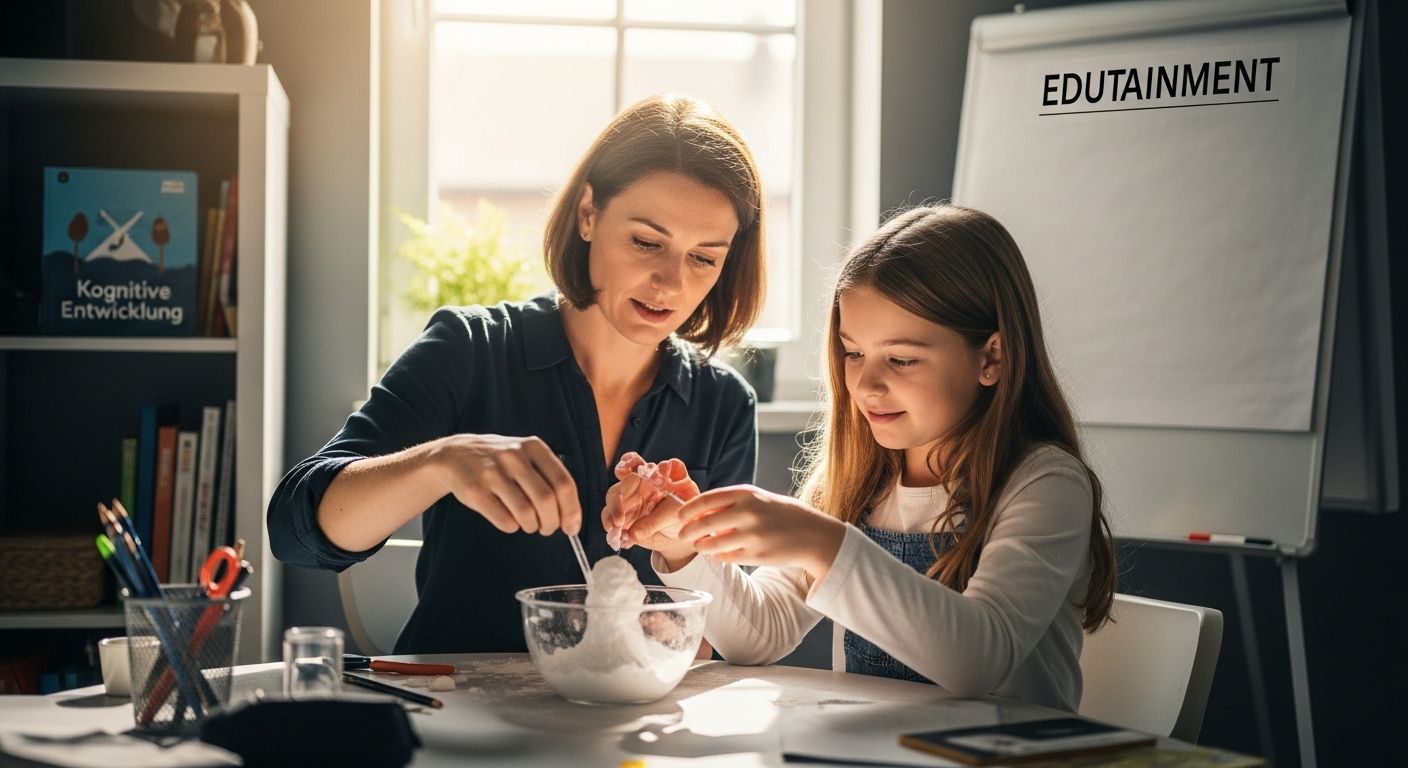
Not only digital media offer edutainment opportunities. Classic board games like chess or puzzles promote cognitive competencies. Creative craft activities can train mathematical and spatial skills. Cooking with children teaches mathematics through measurement and quantity.
Everyday situations can also be transformed into learning moments. Shopping becomes a mathematics lesson, gardening becomes a biology lesson. What is important is the playful, positive approach that motivates children and makes learning an exciting adventure.
Edutainment means removing education from the traditional school context and integrating it into everyday life. It is about making learning a natural, joyful process that inspires children to discover and understand their world. Whether digital or analog – the possibilities are almost limitless and can be individually adapted to each child's interests and needs.
The core message remains: learning can be fun. And that is exactly the essence of edutainment.
Tips for parents: Using edutainment strategically
Edutainment offers parents a unique opportunity to actively and playfully support their children's education. However, to make the most of the benefits, a targeted and conscious approach is needed.
Quality over quantity
The Foundation for Media Education emphasizes the importance of careful media selection for children. Not every learning game or app is automatically valuable. Parents should carefully examine edutainment offers and pay attention to the following criteria:
To help you as parents make