 edory
edory
Every second child in Germany finds stories particularly exciting when they are tailored to their own interests. Parents know how important it is to playfully promote language and creativity, but choosing the right stories often feels challenging. This guide shows what matters when selecting educational, personalized stories and how you can specifically strengthen your preschooler's imagination.
Table of Contents
- Step 1: Define Your Child's Interests and Learning Goals
- Step 2: Determine the Appropriate Age Level
- Step 3: Selectively Filter Themes and Fairy Tale Types
- Step 4: Use the Personalization Features of the Edory App
- Step 5: Check the Suitability and Impact of Your Selection
Summary
| Important Point | Explanation |
|---|---|
| 1. Consider Individual Interests | Understand your child's passions to select suitable stories. |
| 2. Choose Age-Appropriate Stories | Make sure stories match your child's developmental stage. |
| 3. Use a Variety of Themes | Select stories from different genres to promote creativity and understanding. |
| 4. Use Personalization Features | Use apps to tailor stories specifically to your child's interests. |
| 5. Check Impact and Suitability | Analyze how your child responds to stories to optimize your selection. |
Step 1: Define Your Child's Interests and Learning Goals
Choosing the right stories for your child begins with a deep understanding of their individual interests and learning goals. Every child has unique preferences and developmental stages that must be considered when selecting stories. Individual interests of the child play a crucial role in motivating learning processes.
Observe your child carefully to discover their passions. What topics fascinate them particularly? Do they love animals, space, fairy tales, or adventure stories? Write down these preferences and look for stories that connect to these interests. Learning goals should be clearly formulated and suited to their developmental stage so stories not only entertain but are also educationally valuable.
A targeted selection means finding stories that both spark your child's imagination and support their cognitive and emotional development. Make sure to choose stories that are challenging but not overwhelming.
Pro Tip: Keep a small notebook where you write down your child's reactions and favorite moments from different stories to continuously refine their interests.
Step 2: Determine the Appropriate Age Level
When selecting children's stories, considering the age level is crucial for a successful reading experience. Children's and young adult literature is differentiated by age groups to meet language and cognitive development needs. Each age group has specific needs and comprehension abilities that must be considered when selecting stories.
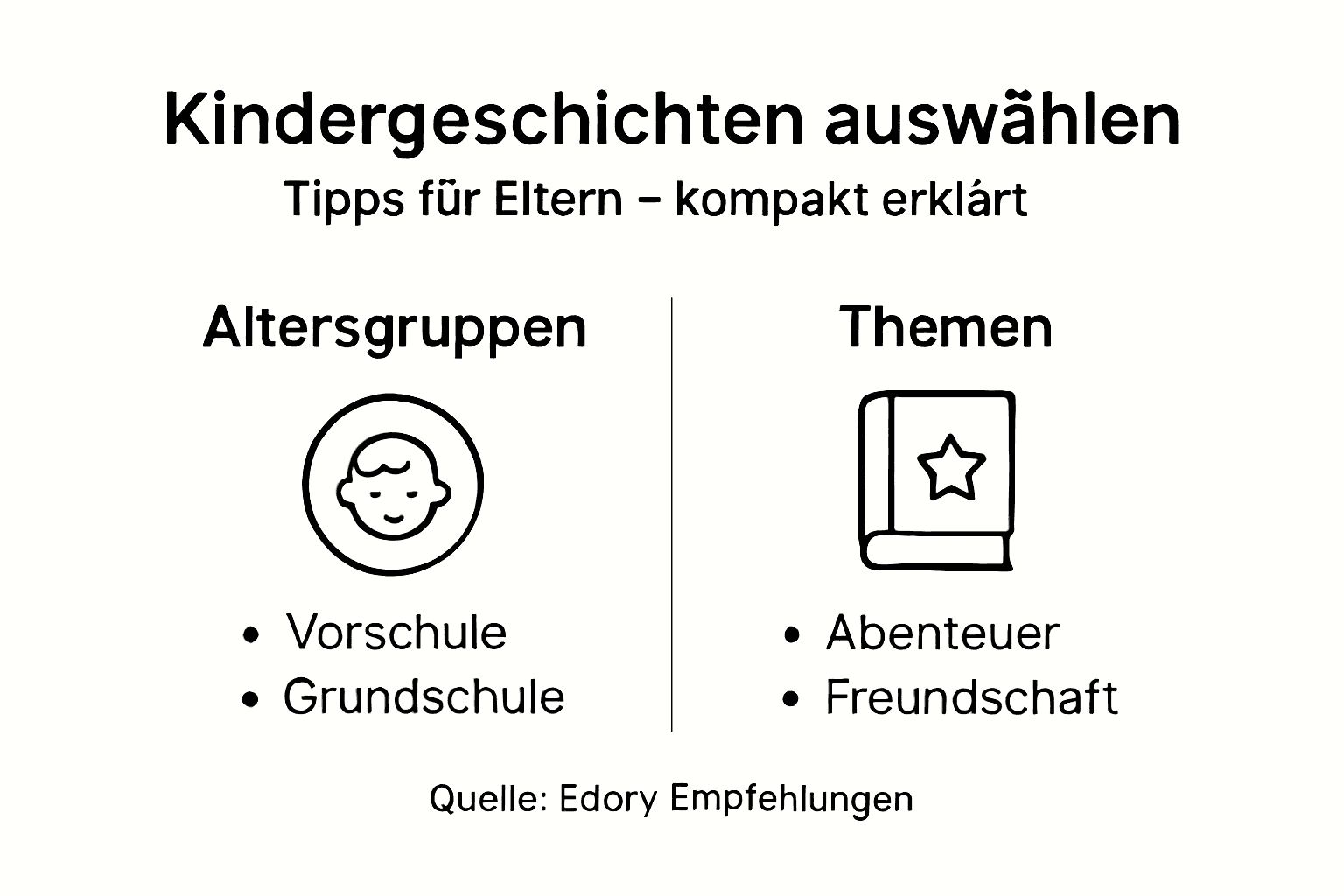
Observe your child's developmental stage carefully. For preschoolers, short stories with simple language and many pictures are suitable, while elementary school children can already understand more complex plots and longer texts. Stories should be adapted to the age to promote interest and understanding. Pay attention to vocabulary, sentence length, and plot complexity.

A targeted selection means finding stories that neither under- nor overwhelm your child. Let your child help in the selection and observe their reactions. This way you'll find stories that optimally support their development and foster a love of reading.
Pro Tip: Visit children's bookstores or libraries and let your child discover books that match their age level.
Here's an overview of how stories can be selected by age group:
| Age Group | Language Level and Length | Recommended Themes |
|---|---|---|
| Preschoolers | Simple language, many pictures | Animals, friendship, fairy tales |
| Elementary School Children | Longer texts, more complex plots | Adventure, community, values |
| Teenagers | Complex language, multiple layers | Identity, diversity, challenges |
Step 3: Selectively Filter Themes and Fairy Tale Types
Targeted selection of children's stories requires a systematic approach to filtering themes and fairy tale types. The Aarne–Thompson–Uther Index offers a classification system for categorizing fairy tale types that helps parents with selection. This scientific approach helps you find stories that are developmentally appropriate and substantively valuable.
Use theme lists from reading promotion institutions to filter stories by focuses such as friendship, adventure, or values. Make sure to select stories that not only entertain but also convey important messages. Themes like courage, teamwork, imagination, and problem-solving work particularly well for children.
An important aspect is the variety of fairy tale types. Alternate between classic fairy tales, modern stories, and cross-cultural narratives. This broadens your child's horizons and promotes understanding and creativity.
Pro Tip: Keep a diary of your child's favorite stories and note which themes and fairy tale types are particularly fascinating to them.
Step 4: Use the Personalization Features of the Edory App
The Edory App offers innovative ways to tailor children's stories specifically to your child's individual needs and interests. Personalized recommendation systems like StoryGraph show how technology can revolutionize reading recommendations. The app enables you to select stories by age, preferences, learning goals, and developmental stage.
Use the personalization features by first filling out your child's profile in detail. Enter information such as age, interests, favorite themes, and reading abilities. The app's intelligent algorithms then suggest customized stories that are both entertaining and educational. You can also set your own preferences and learning goals individually.
The personalization features allow you to filter, rate, and save stories. This creates an individual reading canon that dynamically adapts to your child's developmental progress.
Pro Tip: Use the app's recommendation feature regularly and update your child's profile to always get suitable stories.
Step 5: Check the Suitability and Impact of Your Selection
Selecting children's stories goes beyond simply reading. It is crucial to carefully evaluate the impact and educational quality of stories. Children's stories should address deep themes that not only entertain but also inspire reflection.
Carefully observe how your child responds to the selected stories. Important indicators are attention, emotional resonance, and understanding. Stories can serve as creative learning media by encouraging your child to retell or reenact the story. Pay attention to whether the story raises questions, promotes empathy, and opens new perspectives.
Document your child's reactions and developmental progress. Regularly reflect on whether the chosen stories match your child's interests, developmental stage, and learning goals. Continuous adjustment ensures optimal reading development.
Pro Tip: Have a brief conversation with your child after each story to understand their thoughts and feelings and to capture the impact of the story.
The following criteria help assess the impact of children's stories:
| Assessment Criterion | Significance for the Child | Observable Signs |
|---|---|---|
| Attention | Promotes concentration | Enthusiastic listening, questions about the plot |
| Emotional Resonance | Strengthens empathy | Laughter, suspense, participation |
| Understanding | Facilitates learning progress | Correct retelling, logical thinking along |
| Creativity | Inspires own ideas | Desire to reenact the story |
Find the Perfect Stories for Your Child with Edory
Choosing suitable children's stories is often a challenge because it must consider many factors such as interests, age level, and learning goals. You only achieve this goal if stories not only entertain but also promote your child's development and imagination. This is exactly where Edory comes in: Our innovative platform offers you the opportunity to discover and create personalized stories that are perfectly tailored to your child's preferences and developmental stage. This makes story selection easier, more targeted, and enriches your family life with daily new, lovingly crafted experiences.
Take advantage of Edory's benefits and discover on our page Uncategorized – Edory AI – Educational Children's Stories how AI-based stories can playfully support your child. Start now at https://edory.ai and experience an easy way of personalized reading promotion. Don't miss the chance to delight your child with exactly the stories they really need and deserve!
Frequently Asked Questions
How can I consider my child's interests when selecting stories?
It is important to observe and write down your child's preferences. Ask your child about their favorite topics and select stories that address these interests.
How do I determine the appropriate age level for stories?
Pay attention to your child's developmental stages and language abilities. Choose stories appropriate for your child's age, such as short, simple stories for preschoolers.
What themes are best suited for different age groups of children?
Consider the needs of each age group: Preschoolers like pictures and simple stories, while elementary school children prefer adventure and more complex plots. Make sure the content is both entertaining and educational.
How can I determine if a story is suitable for my child?
Observe how your child responds to the story. Look for signs such as attention and emotional resonance to determine whether the story captures their interest and contributes to learning.
What should I do if stories don't achieve the desired educational goals?
Regularly reflect on the chosen stories and their impact on your child's development. Adjust the selection if stories don't match your child's interests or learning goals. Document progress to make targeted adjustments.
How can the Edory App help me select stories?
The Edory App allows you to filter stories by age, interests, and learning goals. Fill out your child's profile in detail to receive personalized recommendations that are perfectly suited to their needs.