 edory
edory
Every evening brings parents in Germany once again to the question of how they can sustainably strengthen their preschool child's imagination and language development. Deliberately selecting and reading personalized stories offers valuable support here, because the educational value of read-aloud stories lies in strengthening language development, reading motivation, and building cultural and social understanding. In this article, you will learn how to promote your child's learning and enthusiasm with individually tailored reading materials.
Table of Contents
- Step 1: Determine Your Child's Age and Interest Profile
- Step 2: Filter by Educational Value
- Step 3: Use App Personalization Features
- Step 4: Check Content Safety and Quality
- Step 5: Test the Read-Aloud Experience Together
Quick Overview
| Important Point | Explanation |
|---|---|
| 1. Understand age and interest profile | Consider your child's developmental stages and interests when selecting books. |
| 2. Check educational value | Ensure that stories promote your child's language and social development. |
| 3. Use personalization features | Customize stories based on your child's interests and age using apps. |
| 4. Check content for safety | Review content for age-appropriateness and educational relevance to ensure a safe reading experience. |
| 5. Make shared reading interactive | Actively participate in reading to strengthen bonding and promote language development. |
Step 1: Determine Your Child's Age and Interest Profile
Deliberately selecting read-aloud stories begins with a precise understanding of your child's individual age and interest profile. Every child has unique developmental stages and preferences that must be considered when selecting books.
To find suitable read-aloud material, you should systematically consider the following aspects:
- Identify age-appropriate topics
- Consider cognitive development level
- Analyze your child's personal interests
The pre-selection of age-appropriate stories depends significantly on developmental stages and comprehension level. Pay attention to the recommended age on book covers, which provides an important first reference point.
Children's interests are often diverse and dynamic. Observe closely which topics fascinate your child - whether dinosaurs, space, fairy tales, or adventure stories. These observations will help you select stories that guarantee attention and enthusiasm.
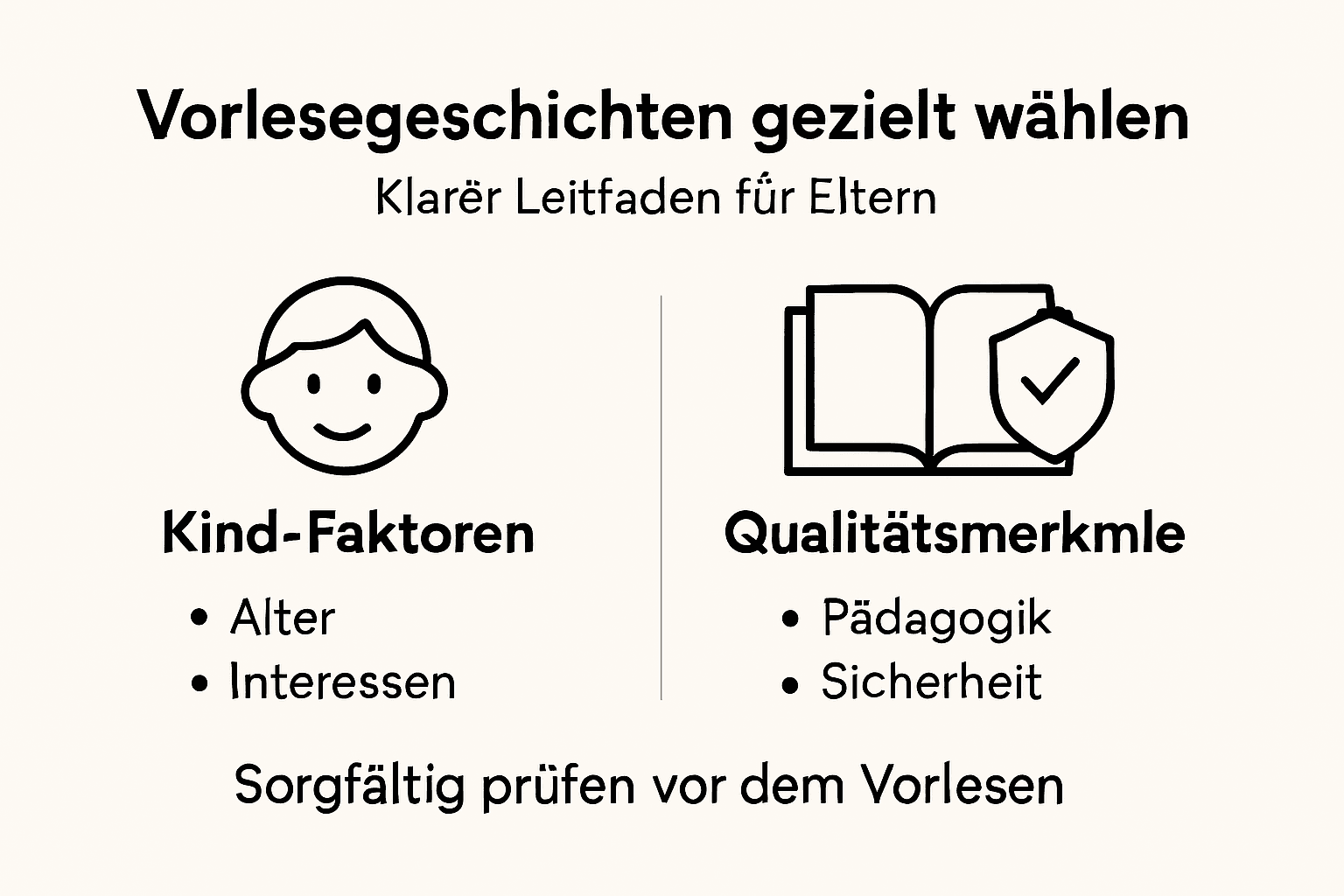
Below you will find a summary of typical interest profiles and their effects on book selection:
| Age Group | Typical Interests | Recommended Book Topics |
|---|---|---|
| 3-5 years | Animals, daily life, colors | Picture books, everyday adventures |
| 6-8 years | Fantasy, nature, friendship | Fairy tales, educational books, stories about togetherness |
| 9-12 years | Adventure, technology, morality | Detective stories, science fiction, social themes |
Children develop a deeper connection to books when they reflect their current life world and interests.
Pro Tip: Talk to your child about their favorite books and topics to develop an even more accurate understanding of their preferences.
Step 2: Filter by Educational Value
Selecting read-aloud stories goes far beyond simple entertainment. The educational value of a story significantly determines its effectiveness in children's development and education.
When making your selection, pay attention to the following educational core aspects:
- Promote language development
- Strengthen social competencies
- Support emotional intelligence
- Expand cultural understanding
The importance of dialogic reading lies in its ability to actively engage children in learning processes. Through targeted questions, shared interpretation, and interactive storytelling, stories become valuable educational tools.
When selecting, make sure that stories not only entertain but also:
- Offer age-appropriate challenges
- Convey moral concepts
- Stimulate creativity and imagination
Good read-aloud stories are like keys that open worlds of understanding for children.
Pro Tip: Read stories in advance and think about what conversation opportunities and learning chances might arise from them.
Step 3: Use App Personalization Features
Modern read-aloud applications offer parents today a variety of ways to design read-aloud experiences individually and precisely. With the right personalization features, you can tailor stories exactly to your child's needs and interests.
When using personalization features, pay attention to the following core aspects:
- Select age-appropriate content
- Adjust language settings
- Consider interests
- Use interactive elements
The variety of interactive children's book apps allows parents to design read-aloud experiences individually. You can use features such as language selection, difficulty level adjustment, and thematic pre-selection.
When personalizing, it is recommended to follow these steps:
- Check your child's profile settings
- Select age-appropriate content
- Explore interactive features
Personalized read-aloud applications turn the story experience into an individual adventure.
Pro Tip: Experiment with different personalization options and observe which settings excite your child the most.
This table shows how different personalization features in apps can improve the read-aloud experience:
| Feature | Benefit for Child | Parent Advantage |
|---|---|---|
| Language selection | Promotes language skills | Adaptation to home setting |
| Difficulty level | Appropriate challenge | Support for learning level |
| Topic search | Increases motivation | Efficient selection |
| Interactive elements | Strengthens creativity | Shared experiences |
Step 4: Check Content Safety and Quality
Parents must be especially careful when it comes to digital content for children. Careful review of read-aloud stories is crucial to ensure a safe and educational reading experience.
When conducting quality control, consider the following criteria:
- Age-appropriateness of content
- Educational relevance of the story
- Check language complexity
- Identify moral values
The systematic content review allows parents to comprehensively evaluate stories. This is not just about obvious dangers, but also about subtle educational aspects.
Pay special attention to:
- Violence-free depictions
- Positive character development
- Age-appropriate conflict contexts
- Constructive problem-solving
High-quality read-aloud stories are like keys to children's development - they open doors to new worlds of understanding.
Pro Tip: Read critical reviews and use parent portals to gain additional insights into the quality of read-aloud stories.

Step 5: Test the Read-Aloud Experience Together
Shared reading is more than just conveying stories - it is an interactive learning experience that promotes bonding, communication, and language development. The quality of the read-aloud experience depends significantly on your participation and interaction.
When jointly exploring stories, you should:
- Listen attentively
- Ask questions
- Share emotions
- Exchange personal interpretations
The interactive design of read-aloud sessions makes it possible to make stories lively and inviting. The goal is to actively involve children in the storytelling and stimulate their imagination.
Pay attention to the following aspects:
- Use facial expressions and gestures
- Use voice modulation
- Highlight significant moments
- Make guesses together
A successful read-aloud experience combines closeness, learning, and pure joy.
Pro Tip: Vary your reading technique and occasionally let your child bring their own ideas and interpretations into the story.
Discover Personal and Safe Read-Aloud Stories for Your Child
Deliberately selecting appropriate read-aloud stories often presents parents with the challenge of choosing between age-appropriate entertainment and genuine educational value. Understanding your child's individual interests and developmental stages as well as the safety and quality of content are key criteria for creating valuable learning moments. This is exactly where Edory comes in: Our innovative platform combines personalized children's books with safe and educational content for every age.
With Edory, you can easily generate stories that are perfectly tailored to your child's preferences. Our app uses intelligent personalization features and offers fresh, creative read-aloud stories daily that promote both language development and social competencies. Discover more inspiring titles in our Uncategorized – Edory AI – Educational Children's Stories category and experience read-aloud stories in a new way.
Start an exciting journey with us through individual story worlds that not only entertain but also educate. Visit edory.ai and create a safe read-aloud environment directly on your smartphone.
Frequently Asked Questions
How do I find the right age group for read-aloud stories?
To find the right age group for read-aloud stories, check the age recommendations on book covers. Make sure to match the content with your child's developmental stages and consider individual interests.