 edory
edory
Nearly every other family in Germany reads personalized stories and notices how strongly their children's enthusiasm grows. Especially at preschool age, these lovingly crafted stories shape everyday life and create unforgettable rituals. Parents who seek exciting and educational narratives lay the foundation for curiosity, imagination, and self-confidence. Here parents will find concrete tips to personalize favorite stories and rekindle the joy of learning with every reading session.
Table of Contents
- Step 1: Choose Appropriate Interests and Age Levels
- Step 2: Create Individual Characters and Names
- Step 3: Add Personal Experiences and Locations
- Step 4: Integrate Educational Elements Strategically
- Step 5: Test and Optimize the Story Together
Quick Overview
| Important Point | Explanation |
|---|---|
| 1. Choose Age-Appropriate Stories | Consider your child's age and interests to select appropriate stories that match their developmental stage. |
| 2. Create Individual Characters | Let your child participate in character design and choose meaningful names that have personal resonance. |
| 3. Add Personal Experiences | Integrate familiar locations and experiences to create emotional connection and identification with the story. |
| 4. Include Educational Elements | Combine playful learning with exciting narratives to foster curiosity and love of learning without being preachy. |
| 5. Optimize Story Together | Read the stories together and incorporate your child's feedback to further refine and adapt the narrative. |
Step 1: Choose Appropriate Interests and Age Levels
The key to the perfect personalized story is the targeted selection of themes and content that match exactly your child's developmental stage. Choosing age-appropriate stories helps parents find the right narrative content for their little ones.
When selecting interests, you should consider three key aspects: your child's age, their current preferences, and their emotional development stage. For children under three years old, short, picture-rich stories with simple plots are ideal. Preschoolers between three and six years old, however, already love more complex narratives with adventures and characters that touch them emotionally.
Make sure to choose stories that not only entertain but also gently educate. A fairy tale about friendship can promote social skills, while a story about a brave explorer strengthens curiosity and confidence. The perfect personalized story sparks interest, stimulates imagination, and matches exactly your child's developmental stage.
Pro Tip: Observe closely which topics excite your child and experiment with different storytelling styles and characters.
The following overview shows which content is particularly suitable for different age groups:
| Age Group | Recommended Topics | Storytelling Style |
|---|---|---|
| Under 3 Years | Animals, simple everyday experiences | Picture-rich, short sentences |
| 3-6 Years | Adventures, friendship, emotions | Exciting, with dialogue |
| 7-9 Years | Discoveries, problem-solving | Complex plot, more detailed emotions |
Step 2: Create Individual Characters and Names
Creating individual characters is about crafting a story in which your child truly sees themselves reflected. Finding the best children's book names can help develop authentic and meaningful character names.

Let your child actively participate in character design. Ask about their favorite colors, hobbies, or qualities they especially like. Perhaps your child wants a brave, curious character or a caring helper. The naming should not be random but have personal meaning. A name can symbolize strength, creativity, or warmth.
Make sure the character has dimensions that go beyond stereotypes. A brave hero can also be gentle, a princess can be a brilliant scientist. These multi-dimensional characters inspire children and expand their imagination.
Pro Tip: Take notes of your child's ideas and wishes for the character and let them actively participate in its creation.
This table offers inspiration for imaginative, multi-dimensional characters:
| Character Type | Positive Qualities | Combined Specialties |
|---|---|---|
| Hero/Heroine | Brave, thoughtful | Can also be reflective |
| Princess | Creative, curious | Scientifically interested |
| Explorer | Curious, adventurous | Sometimes shows caution |
Step 3: Add Personal Experiences and Locations
Incorporating personal experiences and familiar locations makes a story come alive and become meaningful. Exploring personalized stories can help you create authentic and emotionally touching narrative worlds.
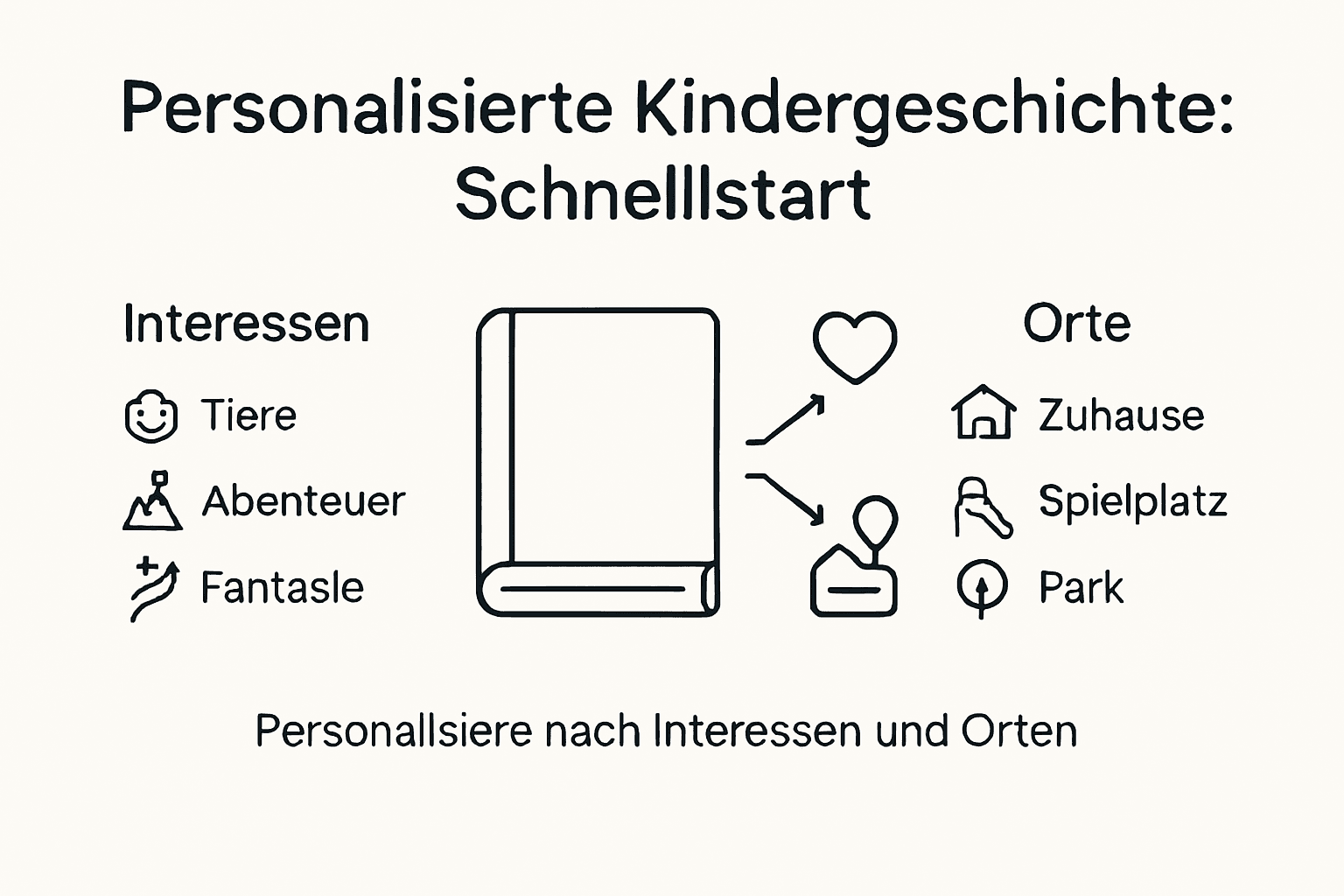
Include familiar environments such as your neighborhood playground, your child's favorite park, or even your child's room. These familiar spaces create immediate emotional connection to the narrative. Think together with your child about exciting moments from their life—a family hike, their first bike ride, or a special birthday celebration—that weave wonderfully into a story.
Make sure the experiences you include are not just nostalgic but also convey positive development or learning. A story about a first swimming lesson can teach courage and perseverance, or a family outing can illustrate teamwork and togetherness.
Pro Tip: Take photos or make notes of special experiences—they are real treasures for personalized stories.
Step 4: Integrate Educational Elements Strategically
Educational elements in children's stories should work like an invisible educational gift—playful and exciting. Discovering learning through games helps parents convey educational content in an entertaining way.
Choose learning goals that are age-appropriate and fascinating. For preschoolers, topics like basic number concepts, first scientific connections, or social skills are suitable. Transform mathematical challenges into exciting adventures—for example, your protagonist could count treasures or explore geometric shapes in a magical world. Integrate scientific basics through characters who make discoveries or solve puzzles.
Make sure the learning content doesn't seem preachy. It should be subtly woven into the plot as a natural part of the narrative. A story about friendship can teach empathy, a travel tale can convey geographic concepts. The goal is to awaken curiosity and create joy in learning—not to teach.
Pro Tip: Observe your child's reactions and playfully adapt the learning content to their interests.
Step 5: Test and Optimize the Story Together
The final phase of story creation is an interactive dialogue with your child. Applying child-friendly storytelling methods can help you develop a story that truly excites your child.
Read the story aloud together first and carefully observe your child's reactions. Pay attention to moments of excitement or boredom. Let your child actively give feedback—which scenes do they especially like, where would they wish for changes? Children are often surprisingly creative storytellers, and their ideas can enrich the story.
Be flexible with revisions. Perhaps your child wants a character designed differently or suggests a plot twist. These adjustments not only make the story more personal but also show your child that their opinion is valuable. The joint optimization not only strengthens your bond but makes the story experience a true team project.
Pro Tip: Make revising a playful ritual—with laughter, creativity, and mutual respect.
Discover Easy Ways to Create the Perfect Personalized Children's Story
The challenge in personalizing stories for children often lies in incorporating exactly the right interests, age levels, and experiences that truly captivate and nurture children. Your article makes clear how important it is to design individual characters and skillfully integrate educational elements to create child-friendly and exciting stories. These goals hit the heart of many parent wishes—to easily create personalized, imaginative, and educationally valuable stories.
At Edory AI, we understand these needs and rely on innovative AI technology so you can generate new stories tailored to your child every day. Our platform supports you in selecting age-appropriate content based on interests and turns storytelling into a playful shared experience. Benefit from the variety of topics and ease of use to optimally accompany children in learning and dreaming.
Start your adventure now on Edory AI – Educational Children's Stories and experience how simple personalized storytelling can be. Visit https://edory.ai and create a unique story for your child today with just a few clicks.
Frequently Asked Questions
How do I choose the right topics for my child's personalized story?
To choose the right topics, you should consider your child's age, preferences, and emotional development stage. Note which content appeals to your child and select topics that are both entertaining and educational.
What storytelling styles are suitable for different age groups?
For children under 3 years, picture-rich, short stories are ideal. For preschoolers between 3 and 6 years, exciting adventures and emotional dialogue can be integrated. Experiment with different styles and observe your child's reactions to find what works best.
How can I incorporate personal experiences into the story?
Incorporate personal experiences by including familiar locations or special events from your child's life. Think of exciting shared experiences, like a family outing or playground visit, and build the plot around them.
What educational elements should I include in the stories?
Choose educational content that might interest the child, such as simple numbers or basic scientific concepts. Transform these into exciting adventures, like counting treasures or discovering shapes in a fictional world.
How do I test the personalized story together with my child?
Read the story aloud together and observe your child's reactions. Encourage them to give feedback and express wishes for changes to make the story more engaging. This also strengthens your bond and makes the story a shared experience.
Recommendations
- 7 Tips for Creative Personalized Children's Stories – Edory AI – Educational Children's Stories
- Apply Child-Friendly Storytelling Methods Step by Step – Edory AI – Educational Children's Stories
- Fantasy Story for Kindergarten: Tell Stories Creatively – Edory AI – Educational Children's Stories
- Personalized Stories: Everything Parents Need to Know – Edory AI – Educational Children's Stories