 edory
edory
Surprisingly, children who are read to daily develop a vocabulary that is up to 60 percent larger than their peers. Especially in Germany, more and more parents are striving to give their preschool children an early strong linguistic start. Those who support language development from the beginning through personalized and education-oriented stories create an important foundation for lifelong communication skills and genuine joy in learning.
Table of Contents
- What is Language Development Through Reading Aloud?
- Forms of Reading Aloud and Their Effects
- Scientific Findings on Reading Aloud
- Personalized Stories as Language Support
- Avoiding Common Reading Aloud Mistakes
Key Findings
| Point | Details |
|---|---|
| Language Support Through Reading Aloud | Reading aloud significantly supports children's language development by expanding their vocabulary and understanding of sentence structures. |
| Interactive Reading Forms | Methods such as dialogical and interactive reading encourage children's active participation and strengthen their cognitive and social skills. |
| Long-term Benefits | Regular reading aloud leads to better academic performance and higher reading motivation later in life. |
| Personalized Stories | Stories tailored to the child increase learning motivation and support inclusive language development. |
What is Language Development Through Reading Aloud?
Language development through reading aloud describes a complex and dynamic process in which children systematically build their linguistic abilities through regular listening and interaction with stories. This process goes far beyond simply hearing words and encompasses profound cognitive and emotional development.
Scientific studies show that reading aloud has a decisive influence on language development. Language acquisition in childhood begins before birth and develops through various phases—from initial auditory perception to active speech production. Reading aloud supports this process by helping children understand new words, recognize grammatical structures, and grasp the semantics of language.
The benefits of reading aloud are diverse: children expand their vocabulary, develop an understanding of sentence structures, and learn to interpret stories. Psychological research confirms that early and regular reading aloud significantly improves children's reading ability and linguistic competence before school entry. This happens not only through hearing words, but through active interaction, asking questions, and jointly exploring stories.
Pro Tip: Choose books that spark your child's interest and talk with them about the story while reading to actively support their language development.
Forms of Reading Aloud and Their Effects
Reading aloud is not one-size-fits-all. There are various methods, each supporting different developmental goals in children. The classic form of reading aloud includes traditional storytelling, in which parents or caregivers read texts linearly and calmly while children listen.
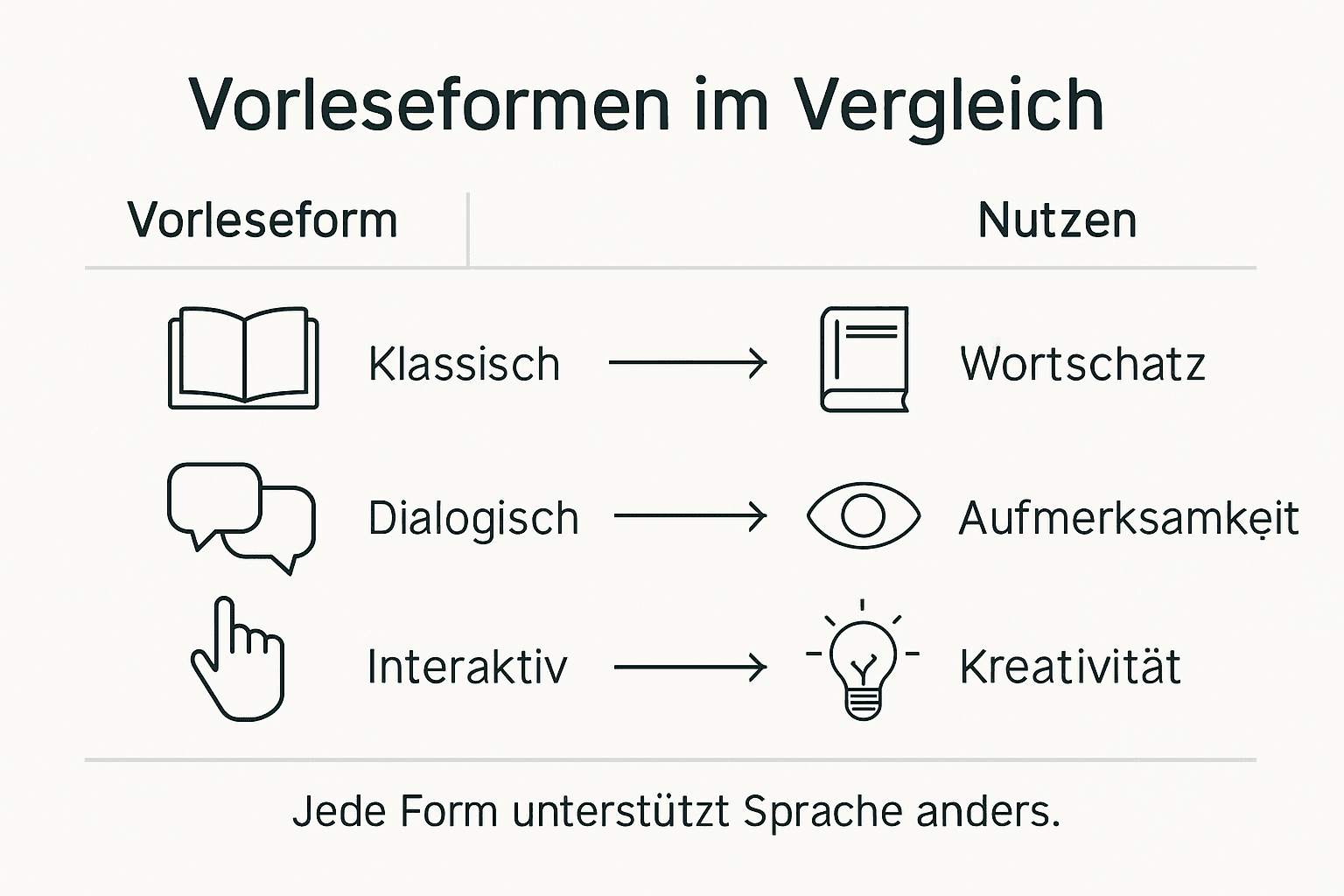
A more advanced method is dialogical reading aloud, in which interaction between the reader and child is central. Here, questions are asked, situations are explained, and the book's content is discussed together. This method promotes not only language competence but also cognitive development and social interaction.
Also particularly interesting is multilingual reading aloud, which specifically supports language development and intercultural competence. Through parallel or alternating reading in different languages, children are sensitized not only linguistically but also culturally. This form of reading aloud helps break down language barriers early and awakens joy in language learning.
Another important form of reading aloud is interactive reading, in which children are actively involved in the stories. Here, sounds are imitated, movements are performed, or images are jointly interpreted. This method turns reading aloud into a multisensory experience and increases children's motivation and attention.
Below you will find a structured overview of the different forms of reading aloud and their specific benefits for child development:
| Form of Reading Aloud | Focus of Support | Typical Interaction | Additional Benefit |
|---|---|---|---|
| Classic Reading Aloud | Vocabulary and Grammar | Listening, Asking Questions | Strengthening Attention |
| Dialogical Reading Aloud | Language Competence and Thinking | Exchange, Questions, Discourse | Promoting Social Skills |
| Multilingual Reading Aloud | Cultural Sensitivity | Alternating Languages, Comparisons | Development of Intercultural Competence |
| Interactive Reading Aloud | Motivation and Creativity | Sounds, Movements, Images | Increasing Multisensory Experience |
Pro Tip: Vary your reading techniques and observe which method excites and benefits your child the most.
Scientific Findings on Reading Aloud
Scientific research over the past decades has impressively demonstrated the profound importance of reading aloud for child development. Neurobiological studies show that regular reading aloud not only influences language development but also positively affects children's brain structure.
Psychological research confirms that early and regular reading aloud promotes significantly larger vocabularies and better literacy skills in children. The quality of the home literacy environment plays a crucial role. Children who are read to early and frequently develop not only better language competence but also a deeper attachment to books and stories.

Furthermore, studies show that reading aloud accomplishes much more than language support alone. It strengthens social skills, increases empathy, and improves cognitive development. Through reading aloud, children learn not only new words but also develop a deeper understanding of emotional connections, problem-solving strategies, and social interactions.
Scientists have also found that the benefits of reading aloud have long-term effects. Children who are regularly read to later show better academic performance, higher reading motivation, and a deeper understanding of complex narrative structures.
The following table summarizes central scientific findings on the benefits of reading aloud for children:
| Field of Research | Key Finding | Long-term Effect |
|---|---|---|
| Neurobiology | Reading Aloud Promotes Brain Structure | Improved Cognitive Development |
| Psychology | Larger Vocabulary and Literacy | Higher Academic Performance |
| Social Development | More Empathy and Interaction | Deeper Understanding of Emotions |
| Reading Motivation | Positive Attitude Toward Books | Sustained Joy in Reading |
Pro Tip: Make reading aloud a daily routine and choose books that spark your child's curiosity and imagination.
Personalized Stories as Language Support
Personalized stories are a powerful tool for language development that offers much more than traditional learning methods. They adapt individually to the child's life world, interests, and developmental stage, thereby creating a unique learning environment.
Language support programs show that personalized materials such as hand puppets and context-based narrative frameworks increase children's attention and actively involve them in the language learning process. By using stories that reflect the child's own life world, learning becomes an emotionally meaningful and motivating experience.
The concept of personalized language support goes beyond simple word repetition. Multilingual approaches demonstrate how individually tailored stories not only promote language competence but also develop cultural sensitivity and communication skills. Children playfully learn new words, grammatical structures, and social interaction patterns in a context that speaks directly to them.
Personalized stories are particularly valuable for children with diverse language backgrounds. They enable inclusive language support that emphasizes individual strengths and removes learning barriers. By incorporating personal experiences, names, or local references, stories become a powerful instrument of language development.
Pro Tip: Create personalized stories that inspire your child's imagination while playfully integrating new language elements.
Avoiding Common Reading Aloud Mistakes
Reading aloud is an art that requires more than simply reading words from a page. Often, parents and caregivers unconsciously make mistakes that can impair the quality and impact of reading aloud.
Correct reading techniques begin with careful preparation of the text. Common mistakes include reading individual words instead of word groups, ignoring punctuation, and monotone delivery. These mistakes can significantly impair the child's attention and text comprehension.
Professional reading experts recommend consciously varying pace and emphasis. Reading that is too fast or too monotonous can bore children and reduce their concentration. Instead, readers should focus on lively presentation that builds suspense and conveys the story's emotions.
Another critical aspect is the pronunciation and interpretation of the text. Avoid arbitrarily changing or simplifying words. Children learn through precise language and need a correct linguistic model. Also pay attention to your body language and facial expressions, which can make the story lively and inviting.
Pro Tip: Practice reading aloud beforehand and record yourself to improve your reading technique.
Actively Support Language Development Through Reading Aloud with Edory
The article clearly demonstrates how important regular reading aloud is for children's language development and cognitive support. Parents often face the challenge of finding individual stories that are precisely tailored to their child's interests and developmental level. Personalized addressing and the use of different reading techniques play a major role here. Those who want to actively strengthen their child's language competence should rely on motivating and age-appropriate content that playfully conveys new words and structures.
This is where Edory.ai comes in as an innovative platform for personalized children's stories. The app allows parents to generate new fascinating stories daily that are precisely tailored to their child's age and preferences. This transforms reading aloud into an interactive experience that not only promotes language development but also sparks creativity and increases reading motivation. Learn more about appropriate reading techniques and find useful tips in our Uncategorized – Edory AI – Educational Children's Stories. Take the opportunity and accompany your child with customized stories on their journey to confident language competence. Discover the possibilities now at Edory.ai and start today!
Frequently Asked Questions
How Does Reading Aloud Support Language Development in Children?
Reading aloud supports language development by expanding vocabulary, improving grammar knowledge, and promoting understanding of complex sentence structures. Children learn through active exchange and listening to stories, which strengthens their language skills.
Which Forms of Reading Aloud Are Particularly Effective?
Classic, dialogical, multilingual, and interactive reading aloud are different methods, each focusing on different aspects of language development. Dialogical reading promotes interaction, while interactive reading actively involves children.
How Can I Make Reading Aloud More Varied for My Child?
Vary your reading techniques by asking questions, imitating sounds, or telling stories dramatically. Choose books that appeal to your child's interests to increase motivation.
Why Are Personalized Stories Important for Language Support?
Personalized stories address children's individual interests and experiences. They create emotional connections and promote language development through reference to their own life world, which facilitates learning.