 edory
edory
A children's book that is not only read aloud, but actually experienced by the child themselves? In classic books, names and families often don't appear at all. But the difference is enormous: Personalized children's books can demonstrably significantly boost children's self-esteem and multiply reading motivation many times over. Who would have thought that a simple book could transform family life so intensely?
Table of Contents
- What is a personalized children's book for the family?
- Why is a personalized children's book important for children?
- How does a personalized children's book affect reading ability?
- What topics and content are included in personalized children's books?
- How can families experience personalized children's books together?
Quick Summary
| Takeaway | Explanation |
|---|---|
| Personalized books strengthen self-esteem | By being included in the story, children experience affirmation and appreciation of their individual experiences. |
| Reading motivation is increased through identification | Children read more actively when they recognize themselves as the main character, which increases their attention. |
| Promoting language development through appropriate content | Through personalized stories, children learn new words and sentence structures that are tailored to their understanding. |
| Family bonding through shared reading experience | Personalized books enable parents and children to have shared conversations about emotions and experiences. |
| Interactive elements promote cognitive abilities | Children develop critical thinking and imagination by actively interacting with the narrative. |
What is a personalized children's book for the family?
A personalized children's book for the family is an innovative reading experience that is specifically tailored to the individual needs and characteristics of a child. These special books go far beyond traditional children's books by directly involving the child in the plot and reflecting their own life reality.
The following table provides a compact overview of the key features that distinguish personalized children's books from traditional children's books and are highlighted according to the article.
| Feature | Personalized Children's Books | Traditional Children's Books |
|---|---|---|
| Child Integration | Child is integrated as the main character in the plot | Child usually remains a passive listener |
| Adaptation to Individual Values | Book content and character traits are adapted to the child | Generic characters and stories |
| Family Structures | Consideration of the family and its backgrounds | Families rarely play a central role |
| Identification Potential | Very high – own life reality is reflected | Low – little connection to own life sphere |
| Contribution to Identity Development | Strengthens self-esteem and emotional bonding | Hardly any influence on identity formation |
The Special Features of Personalized Children's Books
Personalized children's books differ fundamentally from standard children's books through their unique adaptability. According to Humanium, such books are crucial for children's identity development because they directly reflect their personal experiences and life worlds.
The most important features include:
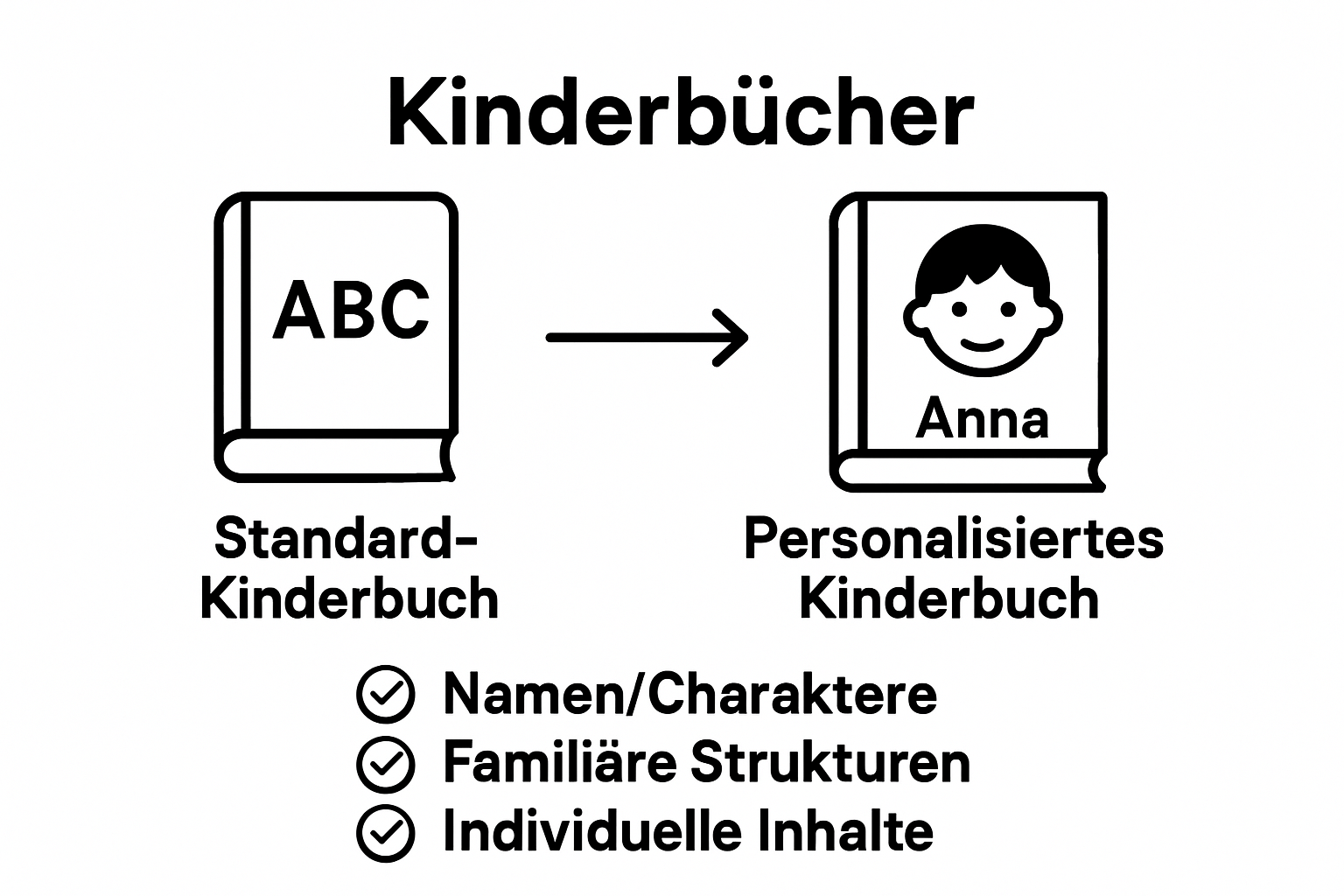
- Integration of the child's name into the main character
- Adaptation of character traits to the individual child
- Consideration of family structures and backgrounds
Importance for Families and Childhood Development
Personalized children's books have a profound psychological component. They not only strengthen reading motivation, but also promote self-esteem and emotional bonding within the family. Children experience themselves as active protagonists in their own story, which inspires their creativity and imagination.
The direct identification with the book character creates a special connection to the reading material. The child is no longer just a passive listener, but an active participant in an individually designed narrative. This form of personalized reading can support language development, empathy, and reading competence in a playful way.
Why is a personalized children's book important for children?
Personalized children's books play a crucial role in children's emotional and cognitive development. They go far beyond traditional reading materials and offer a unique opportunity to address and promote children individually.
Emotional Development and Identity Formation
According to research findings from the American Psychological Association, personalized books can significantly boost children's self-esteem. The direct involvement of the child in the narrative creates important psychological effects:
- Strengthening self-confidence
- Promotion of self-perception
- Emotional validation of individual experiences
Cognitive Promotion and Learning Impulses
The individualized book form offers more than just a story. It becomes an interactive learning tool that stimulates various cognitive abilities simultaneously. Through personalized books, children develop:
- Improved language competence
- Increased reading motivation
- Enhanced concentration ability
Bonding and Communication in the Family
Personalized children's books create a special bridge between parents and children. They enable shared reading experiences that go beyond simply reading aloud. The story becomes an occasion for conversation, a moment of connection, and a space for shared discovery.
By providing the opportunity to reflect individual family structures, cultural backgrounds, and personal experiences, these books become a valuable tool for family communication and mutual understanding.
How does a personalized children's book affect reading ability?
Personalized children's books are more than just entertaining reading material - they are a powerful pedagogical tool for promoting and developing children's reading abilities. They differ fundamentally from traditional books through their individual customization and interactive nature.
Motivation and Reading Engagement
According to research findings on interactive storytelling technology, personalized books significantly increase reading interest in children. When children recognize themselves as the main character, an unprecedented motivation to read is created:
- Increased attention while reading
- Stronger emotional attachment to the book content
- Voluntary and self-initiated reading behavior
Language Development and Vocabulary Expansion
The individual design of personalized books provides optimal conditions for language development. Children encounter words and phrases that are directly tailored to their life world and understanding level. This leads to:
- Better word recognition
- Context-based language learning
- Natural grammar acquisition
Cognitive Learning Processes and Text Comprehension
Personalized books activate multiple cognitive processes simultaneously. They challenge children not only to read, but also to interpret, reflect, and make connections to their own life world. This holistic approach promotes:
- Critical text comprehension
- Mental imagination
- Analytical reading competence
Through direct identification with the book character, reading processes are transformed from a passive into an active, participatory experience. In this way, children develop not only technical reading skills, but also a deeper understanding of language and narration.
What topics and content are included in personalized children's books?
Personalized children's books offer an impressive range of topics that are specifically tailored to the individual needs, developmental stages, and interests of children. They go far beyond traditional narratives and enable a profound, individual engagement with various life situations.
Emotional and Social Development Topics
According to research on children's literature, personalized books can convey sensitive topics in an age-appropriate manner. They address central aspects of emotional development such as:
- Coping with feelings like fear and sadness
- Managing changes in the family
- Development of empathy and understanding
Life-World and Family Narratives
The books reflect the child's individual family structures and life situations. The following thematic areas can be covered:
- Various family constellations
- Cultural backgrounds and traditions
- Sibling relationships and friendships
Pedagogical and Educational Content
Personalized children's books combine entertainment with targeted education. They playfully integrate educational elements such as:
- First mathematical concepts
- Language development promotion
- Basic moral values and behaviors
By directly addressing and involving the child, these topics are perceived not as instruction, but as an exciting, individual experience.
This table provides a clear overview of the thematic focuses that are addressed in personalized children's books according to the article and their respective emphases.
| Topic Area | Focal Points |
|---|---|
| Emotional and Social Development | Coping with feelings, managing changes, development of empathy |
| Life-World and Family Narratives | Various family constellations, cultural backgrounds,
🦉
📱 Now Available
Ready for the First Adventure?Get Edory AI for free and start today with personalized children's stories your child will love. ⭐⭐⭐⭐⭐ Over 1,000+ happy families · Start for free |