 edory
edory
Storytelling in family life sounds at first like bedtime fairy tales and funny anecdotes at the kitchen table. But pay attention. Studies show that children who regularly hear stories develop significantly better communication skills and even have a larger vocabulary. Many believe that storytelling is just entertainment, but in fact storytelling is a secret superpower with which children can develop empathy, togetherness and identity – and parents can create incomparably strong bonds.
Table of Contents
- What is Storytelling in Family Life?
- Why Is Storytelling Important for Children's Development?
- How Does Storytelling Work in Family Life?
- Key Aspects of Storytelling for Families
- Practical Examples of Storytelling in Everyday Life
Quick Summary
| Takeaway | Explanation |
|---|---|
| Storytelling strengthens emotional bonds | By sharing stories, family members can develop a stronger emotional connection. |
| Cognitive abilities are promoted | Children expand their vocabulary and improve communication skills through active listening and retelling stories. |
| Authenticity is crucial | Stories should be told honestly and vividly to create a deeper connection between family members. |
| Use interactive storytelling forms | Families should actively involve all members in storytelling to promote shared experiences. |
| Use everyday moments for storytelling | Shared activities like eating or car rides are excellent opportunities to share stories and create memories. |
What is Storytelling in Family Life?
Storytelling in family life is a powerful communication method that is much more than just telling stories. It is a living practice in which family members share and pass on experiences, values and emotions through narrative storytelling.
The Definition of Family Storytelling
Storytelling in a family context means consciously and interactively constructing stories that not only entertain, but also educate and connect. Family narratives serve as emotional bridges between generations and help create shared identities. These stories can include everyday experiences, family traditions, personal challenges or success stories.
The most important aspects of storytelling in family life include:
- Strengthening emotional bonds between family members
- Passing on cultural and family heritage
- Developing shared understanding and empathy
Significance for Family Development
Through intentional storytelling, families can build deeper bonds. Children not only learn communication skills, but also develop an understanding of their family history and identity. Our storytelling tips for parents show how important narrative practices are for children's development.
Storytelling in family life works best when it is authentic, interactive and age-appropriate. It's not about perfect storytelling, but about genuine, meaningful communication that brings family members closer together and creates shared memories.
Why Is Storytelling Important for Children's Development?
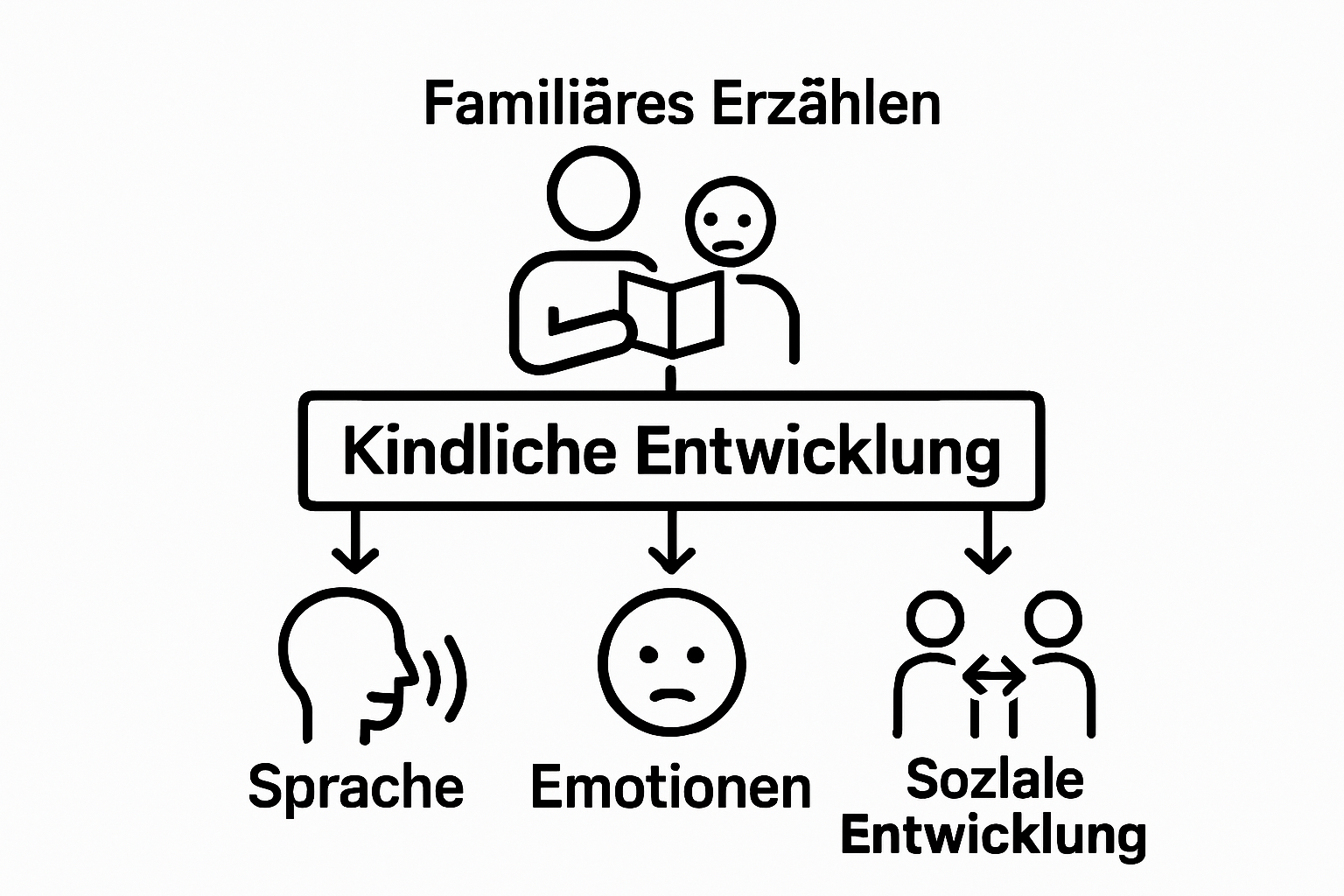
Storytelling is far more than just an entertaining activity – it is a crucial mechanism for children's holistic development. Through targeted storytelling, cognitive, emotional and social competencies are promoted in a playful and sustainable way.
Language and Cognitive Development
Stories are powerful instruments for language development. Children expand their vocabulary through listening and retelling, improve their grammar skills and learn complex language structures. Scientific studies show that children who regularly hear stories develop better communication skills.
The most important cognitive benefits of storytelling include:
- Expansion of vocabulary
- Improvement of language comprehension
- Strengthening of logical thinking
- Promotion of concentration ability
Emotional and Social Intelligence
Storytelling helps children understand and interpret complex emotions. Through stories, they learn empathy, compassion and social interaction patterns. They develop a deeper understanding of different perspectives and learn to recognize and name feelings.
Stories provide children with a safe space to explore difficult topics and develop emotional competencies. Our storytelling tips for parents support families in making this process effective.
Storytelling is thus far more than a form of entertainment – it is an essential tool for children's holistic development that playfully conveys knowledge, stimulates imagination and strengthens social bonds.
The following table provides an overview of the most important cognitive, emotional and social benefits of storytelling for children.
| Area of Development | Specifically Promoted Skill | Brief Explanation |
|---|---|---|
| Language Development | Vocabulary & Language Comprehension | Children learn new terms and more complex sentences. |
| Cognitive Development | Logical Thinking & Concentration | Listening and storytelling promote analytical skills. |
| Emotional Intelligence | Empathy & Emotional Expression | Stories help recognize one's own and others' feelings. |
| Social Intelligence | Social Interaction & Perspective Taking | Children learn to understand different opinions and viewpoints. |
| Cultural Identity Formation | Understanding of Family and Cultural Heritage | Narratives convey values and belonging. |
How Does Storytelling Work in Family Life?
Storytelling in family life is a dynamic form of interaction that can be designed consciously and creatively. It's about not viewing stories as rigid narratives, but as living communication tools that bring family members closer together.
Narrative Strategies and Methods
There are various approaches to successful family storytelling. Central is the creation of an open, appreciative communication atmosphere. Family psychological research shows that interactive and empathetic storytelling approaches are particularly effective.
Important strategies for successful family storytelling:
- Active listening and involving all family members
- Authenticity and honesty in storytelling
- Age-appropriate adaptation of stories
- Space for questions and personal interpretation
Practical Implementation in Everyday Life
Storytelling can be integrated into various family rituals. This can be shared meals, car rides, bedtimes or weekend activities. Our storytelling tips for parents provide additional inspiration for creative storytelling moments.
It is important to present stories not as instruction, but as a shared experience. Family members should be encouraged to bring their own perspectives and interactively develop stories further. This creates a living dialogue that is much more than a linear narrative.
Storytelling in family life works best when lived naturally, spontaneously and emotionally authentically – as a shared journey of understanding and connection.
Key Aspects of Storytelling for Families
Storytelling is more than just a narrative technique – it is a complex communication tool that helps families deepen relationships, transfer knowledge and strengthen emotional bonds. It requires understanding, creativity and a conscious approach.
Basic Elements of Successful Family Storytelling
Every successful family story is based on specific core components. What makes a good story depends on several factors. Key are authenticity, emotional depth and the ability to inspire and touch listeners.
The essential elements include:
- Clear and understandable narrative structure
- Emotional resonance
- Personal and authentic perspective
- Space for interaction and reflection
Challenges and Solutions
Storytelling in families is not always easy. Different generations, individual communication styles and personal experiences can present challenges. For toddlers, storytelling requires special attention and age-appropriate adaptation.
Important strategies for overcoming communication barriers:
- Active and empathetic listening
- Respectful treatment of different perspectives
- Openness to new forms of storytelling
- Patience and appreciation
Storytelling in families thrives on dynamism, creativity and the willingness to listen to one another and grow together.
The following table summarizes the most important elements of successful storytelling in the family context and briefly describes their significance.
| Element | Description |
|---|---|
| Clear Narrative Structure | The story follows an understandable and logical sequence. |
| Emotional Resonance | Narratives appeal to the feelings of the listeners. |
| Authentic Perspective | Personal experiences and honest presentations are central. |
| Interaction | Listeners are actively involved and can ask questions. |
| Reflection | Space for thinking and discussion is provided. |
Practical Examples of Storytelling in Everyday Life
Storytelling can be playfully and meaningfully integrated into various everyday situations. It's not about perfect storytelling, but about authentic moments of exchange and connection between family members.