 edory
edory
Every child develops their own unique preferences and talents that often shine through in daily life. If you want to deliberately promote learning and imagination, you quickly face the question of which stories really suit your preschooler. Individualizing topics and language to match your child's age and interests is crucial so that reading moments bring joy while supporting important developmental milestones.
Table of Contents
- Step 1: Define Your Child's Interests and Age Group
- Step 2: Choose Appropriate Topics and Educational Content
- Step 3: Create Individual Characters and Settings
- Step 4: Use Edory for Automated Story Creation
- Step 5: Review and Optimize the Story for Your Child
Quick Summary
| Key Point | Explanation |
|---|---|
| 1. Determine Interests and Age | Define your child's interests and age group to select appropriate stories. |
| 2. Strategically Select Educational Content | Choose stories that are both entertaining and educational to promote learning motivation. |
| 3. Create Individual Characters | Design vivid characters your child can identify with to build emotional connections. |
| 4. Use AI for Story Creation | Use AI tools like Edory to generate customized stories quickly and efficiently. |
| 5. Regularly Review Stories | Check generated stories for linguistic and educational appropriateness to ensure optimal learning outcomes. |
Step 1: Define Your Child's Interests and Age Group
The art of personalized stories begins with a deep understanding of your child's individual needs and developmental stages. A targeted approach helps you find exactly the right stories that are both entertaining and educational.
First, it's important to precisely determine your child's age group. Children go through rapid developmental phases where their cognitive and emotional abilities change quickly. Assessing children's interests requires careful observation and sensitivity to individual developmental steps.
To define your child's interests, I recommend the following systematic approach:
- Observe play behavior and reactions
- Pay attention to recurring themes in conversations
- Note favorite toys and activities
- Ask actively about preferences and wishes
It's crucial to consider the child's will in an age-appropriate way to create an individual and motivating storytelling experience.
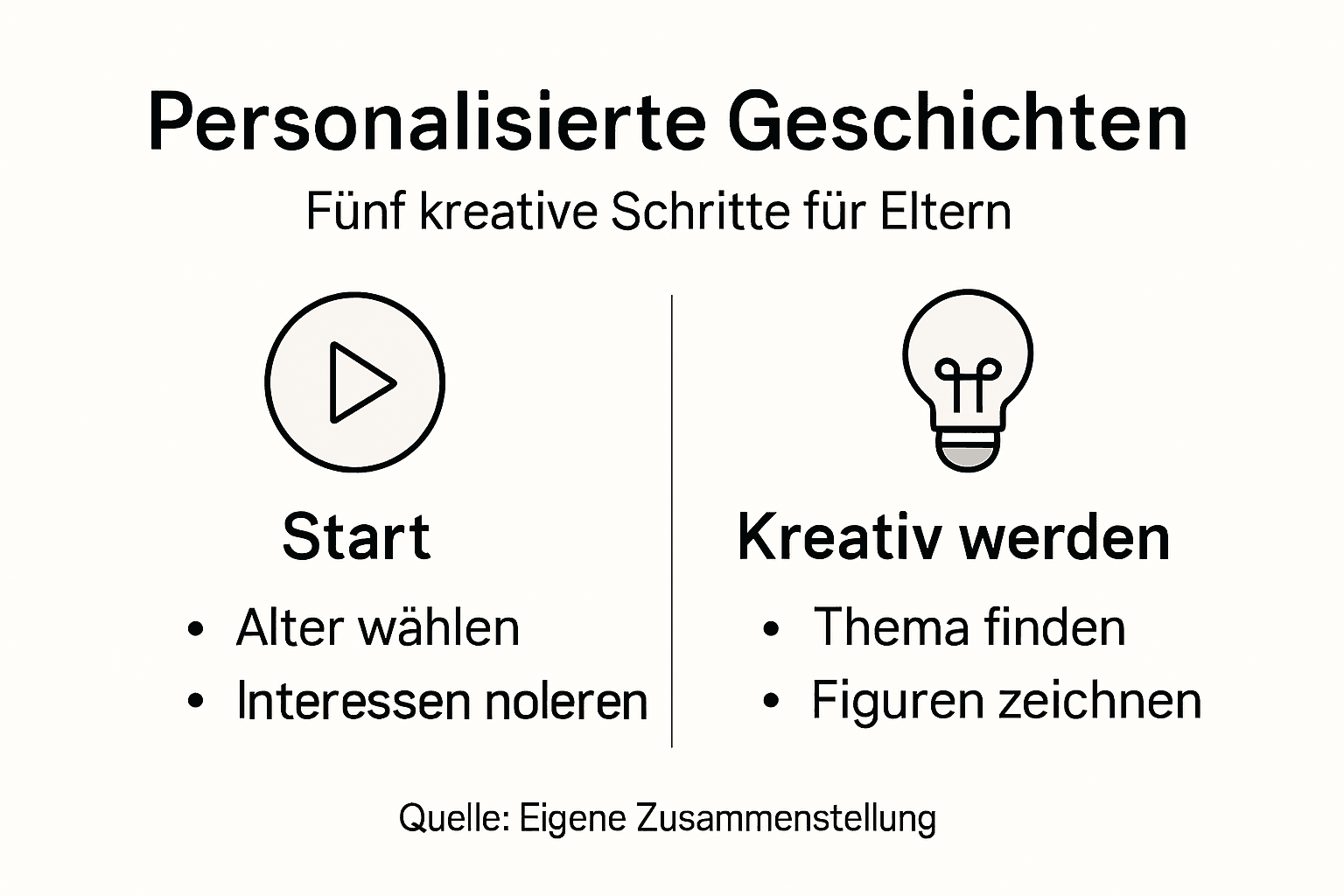
The age group determines not only the complexity of the story, but also its length, language, and thematic depth. A preschooler needs completely different narrative approaches than a school-age child.
Here you can see typical characteristics of different age groups for personalized children's stories:
| Age Group | Language Features | Topic Preferences | Learning Goals |
|---|---|---|---|
| Toddlers (2-4 yrs) | Very simple language | Animals, daily life, family | Vocabulary, emotion recognition |
| Preschoolers (5-6 yrs) | Vivid language | Nature, friendship, adventure | Social skills, basic knowledge |
| Elementary school children (7-9 yrs) | More complex sentences | Fantasy, science, morality | Problem solving, independence |
As the child grows older, their individual developmental stage becomes increasingly important when selecting stories.
Pro Tip: Keep a small notebook where you record your child's areas of interest and enthusiastic reactions – this will be invaluable when selecting stories.
Step 2: Choose Appropriate Topics and Educational Content
After determining your child's age group and interests, the next step is to strategically select stories that are both entertaining and educationally relevant. The right choice of topics can significantly support your child's learning process and development.
When selecting educational content, you should consider didactic principles that emphasize that learning content must be adapted to children's individual interests and experiences. This means stories should not only be informative but also spark your child's curiosity and motivation.
The following criteria help you with topic selection:
- Consider the child's age
- Include current interests
- Pay attention to developmental level
- Cover various educational areas
The Standing Conference of the Ministers of Education and Cultural Affairs recommends cross-curricular educational content that promotes important competencies. These include topics such as democratic education, media literacy, and intercultural understanding.
A good story not only conveys knowledge but also sparks imagination and enthusiasm for learning.
Pro Tip: Talk with your child about their favorite topics and use these as a starting point for story selection – this keeps you aligned with their interests and needs.
Step 3: Create Individual Characters and Settings
The heart of every personalized story consists of creative and vivid characters that touch your child emotionally and inspire them to engage. The art lies in creating figures that are more than mere fantasy creations.

When developing characters, you should consider pedagogical aspects of character design. It's important that figures are human, comprehensible, and age-appropriate. They should have qualities that children can identify with.
Pay attention to the following points when developing characters:
- Highlight individual strengths
- Build in realistic challenges
- Convey emotional depth
- Show positive development possibilities
The playful approach to character creation can greatly boost your creativity. Similar to live action role playing, it's about bringing figures to life together with your child.
Successful character design opens doors for children to new worlds of imagination and empathy.
Pro Tip: Let your child actively participate in character development – this turns the story into a shared creative adventure.
Step 4: Use Edory for Automated Story Creation
Using artificial intelligence for children's stories opens up entirely new possibilities for personalized storytelling. Edory enables you to generate tailor-made stories in seconds that perfectly match your child's interests and developmental stage.
With AI-powered learning systems, parents can now create creative and individual learning content. The technology helps generate stories that are not only entertaining but also pedagogically valuable. The algorithm takes into account the character traits you've previously defined, your child's age group, and areas of interest.
The advantages of automated story generation at a glance:
- Time savings in story creation
- Perfect adaptation to developmental level
- Unlimited creative possibilities
- Continuous story development
Automated learning systems enable dynamic content adaptation, making each story a unique experience.
Below is an overview of the advantages of AI-generated stories compared to traditional storybooks:
| Criterion | AI-Generated Stories | Traditional Storybooks |
|---|---|---|
| Adaptability | Individually configurable | Only limited customization |
| Currency | Always current content | Becomes outdated quickly |
| Creative Variety | Unlimited story variants | Limited selection |
| Interactive Possibilities | High child engagement | Usually passive reception |
The combination of parental creativity and AI support creates magical story moments.
Pro Tip: Experiment initially with different settings and topics to discover the full potential of AI-powered storytelling.
Step 5: Review and Optimize the Story for Your Child
Quality assurance of personalized stories is a crucial step to ensure that the generated story truly meets your child's needs and interests. Careful review guarantees an optimal learning experience.
In pedagogical content optimization, the goal is to critically analyze the story and make targeted adjustments. The focus is on aligning learning content with your child's individual developmental level and interests.
Pay attention to the following aspects when reviewing:
- Age-appropriateness of language
- Emotional accessibility of the story
- Pedagogical value
- Level of excitement and interest
Didactic trends recommend regular feedback loops to avoid over- or under-challenging your child and maintain their motivation.
The best story is one that inspires your child to think, dream, and learn.
Pro Tip: After each story session, have a brief conversation with your child to understand how the story resonated and which aspects particularly excited them.
Create Individual Children's Stories Effortlessly
Parents often face the challenge of finding personalized stories that perfectly match their child's interests and developmental stage. This article clearly addresses this problem with guidance on defining age-appropriate topics and characters as well as controlling content quality. This is exactly where Edory steps in and offers an innovative solution using artificial intelligence. The platform enables you to create creative and child-friendly stories daily that take all your defined aspects into account.
Discover on Uncategorized – Edory AI – Educational Children's Stories how easily you can create individual narrative worlds with Edory. Take the opportunity to enrich your parenting role with inspiring and educational stories. Don't wait any longer and convince yourself on edory.ai of the future of personalized storytelling.
Frequently Asked Questions
How do I define my child's interests for personalized stories?
To define your child's interests, observe their play behavior, pay attention to recurring themes in conversations, and note favorite toys. Keep this information in a notebook to strategically select appropriate stories.
Which age group is best suited for personalized stories?
Your child's age group greatly influences the complexity and topics of the stories. Make sure to choose stories according to age levels to optimize the learning experience and emotional appeal.