 edory
edory
Age-appropriate stories influence children much more strongly than many realize. Studies show that such stories specifically promote language development, creativity, and emotional intelligence. Many believe that any exciting story is enough. But the real difference only emerges when narratives are truly tailored to the child's age. Then reading aloud and listening suddenly become genuine developmental leaps.
Table of Contents
- What are age-appropriate stories?
- Why are age-appropriate stories important?
- How do age-appropriate stories affect children?
- Key Concepts of Age-Appropriate Stories
- Practical Examples of Age-Appropriate Stories
Quick Summary
| Takeaway | Explanation |
|---|---|
| Age-appropriate stories promote language development. | These stories support children's vocabulary acquisition and language comprehension. |
| Emotional intelligence is strengthened through stories. | Children learn to better understand and regulate their own emotions and those of others. |
| Simple, clear language is essential. | Age-appropriate stories use understandable language that makes learning easier for children. |
| Moral conflicts promote critical thinking. | Stories for older children convey more complex dilemmas that encourage reflection. |
| Visualization supports comprehension. | Pictures and picture book formats make it easier for toddlers to follow and grasp the story. |
What are age-appropriate stories?
Age-appropriate stories are specially developed narrative formats that are specifically tailored to the developmental stage, cognitive abilities, and emotional maturity of children in various age groups. These stories take into account not only the level of understanding, but also the interests and psychological needs of children in different developmental phases.
The Importance of Age Adjustment
Age-appropriate stories are about simplifying complex content so that it is understandable and engaging for children. According to research on childhood development, stories must meet certain criteria to effectively engage children:
- Simple, clear language
- Age-appropriate themes and conflicts
- Suitable characters and situations
Characteristics of Age-Appropriate Stories
Developing age-appropriate stories requires a deep understanding of children's developmental stages. For toddlers, this means short, image-rich narratives with simple plots. School-age children, on the other hand, need more complex narratives with moral challenges and character development. Our guide to creative storytelling offers further insights into this nuanced approach.
Age-appropriate stories differ not only in their complexity but also in their educational goals. They can convey learning experiences, promote emotional intelligence, and develop important social competencies. The art lies in seamlessly combining entertainment and education so that children experience stories not as instruction, but as exciting adventures.
Choosing the right story can be crucial for a child's language development, creativity, and emotional maturity. They are more than just entertainment – they are tools of education and development.
For better clarity, the following table summarizes the key differences and characteristics of age-appropriate stories for toddlers and preschoolers:
| Age Group | Language Features | Narrative Structure | Emotional/Social Aspects |
|---|---|---|---|
| Toddlers | Simple, repetitive language | Short, linear plots | Clear emotions, everyday context |
| Preschoolers | Somewhat more complex language | Simple conflict, fairy tale elements | First moral lessons, courage, friendship |
| School-age children (mentioned) | Differentiated, longer sentences | Complex dilemmas, character development | Reflection, perspective-taking |
Why are age-appropriate stories important?
Age-appropriate stories play a crucial role in children's development. They are far more than simple entertainment - they are powerful tools for education, communication, and emotional development. These narrative formats help children understand the world, unfold their creativity, and develop important social and cognitive skills.
Language and Cognitive Development
Stories that are precisely tailored to children's age and comprehension level specifically promote language competencies. According to scientific research, age-appropriate narratives support vocabulary acquisition, language comprehension, and communication skills. Children learn from these stories:
- New words and language structures
- Understanding narrative connections
- The ability to express their own thoughts and feelings
Emotional and Social Competencies
Through carefully selected, age-appropriate stories, children develop emotional intelligence and social competencies. In our guide on fairy tales and their significance, we show how stories help children develop empathy, understand moral concepts, and explore complex emotional worlds.
The significance of these stories lies in their ability to convey abstract concepts such as friendship, honesty, and compassion in a child-friendly way. They provide safe spaces where children can learn to take different perspectives and cope with emotional challenges.
Age-appropriate stories are thus central instruments of child development. They not only support learning but also strengthen personality development and help children understand and navigate the complex world around them.
The following table provides a quick overview of the most important educational goals of age-appropriate stories and their respective effects on children's development:
| Educational Goal | Effect on Development |
|---|---|
| Language Promotion | Vocabulary, language comprehension, expressive ability |
| Cognitive Stimulation | Logic, problem-solving, abstract thinking |
| Emotional Intelligence | Recognizing and regulating emotions |
| Social Competence | Empathy, perspective-taking, social rules |
| Moral Understanding | Reflection on values and conflicts |
How do age-appropriate stories affect children?
Age-appropriate stories unfold a complex and profound effect on child development. They are not merely a means of entertainment, but work like a subtle developmental instrument that influences children on various levels of their personality and cognitive abilities.
Cognitive Stimulation and Learning Effects
Scientific studies show that age-appropriate stories specifically stimulate children's cognitive processes. They promote brain development by helping children develop new thought patterns and understand complex relationships. Children learn from stories:
- Logical and abstract thinking
- Recognizing cause-and-effect relationships
- Developing various problem-solving strategies
Emotional and Social Development
Stories are emotional learning spaces where children learn to understand and regulate feelings. Our guide for creative kindergarten stories illustrates how narratives help children process complex emotional experiences.
Through age-appropriate storytelling, children develop empathy, learn social norms, and acquire important emotional competencies. They recognize emotional nuances, practice perspective-taking, and learn to handle different social situations.
The effect of stories goes far beyond immediate entertainment. They are a complex developmental instrument that empowers children to understand the world, unfold their creativity, and build socio-emotional competencies. Each story is an opportunity for children to understand the world a little better.
Key Concepts of Age-Appropriate Stories
Age-appropriate stories are based on complex educational and psychological principles that ensure narratives are precisely tailored to children's developmental stage and comprehension abilities. These concepts form the foundation for effective and meaningful narrative experiences.
Development-Specific Narrative Structures
Scientific research shows that age-appropriate stories must achieve a precise balance between complexity and comprehensibility. The narrative structures vary depending on the developmental stage and include:
- Simple, linear plot sequences for younger children
- More complex storylines with moral dilemmas for older children
- Increasing narrative understanding and reflective ability
Emotional and Cognitive Adaptability
The central key concepts of age-appropriate stories take into account the emotional maturity and cognitive development of children. Our Edory Blog offers deeper insights into these complex educational mechanisms.
The selection of characters, the complexity of conflicts, and the linguistic design must be precisely tailored to the respective age group. For preschoolers, this means simple, clear characters with unambiguous emotions, while school-age children can already understand more differentiated psychological nuances.
Key concepts of age-appropriate stories are more than just a didactic tool. They are a bridge between children's experience and complex reality, gently introducing children to new insights and developmental stages.
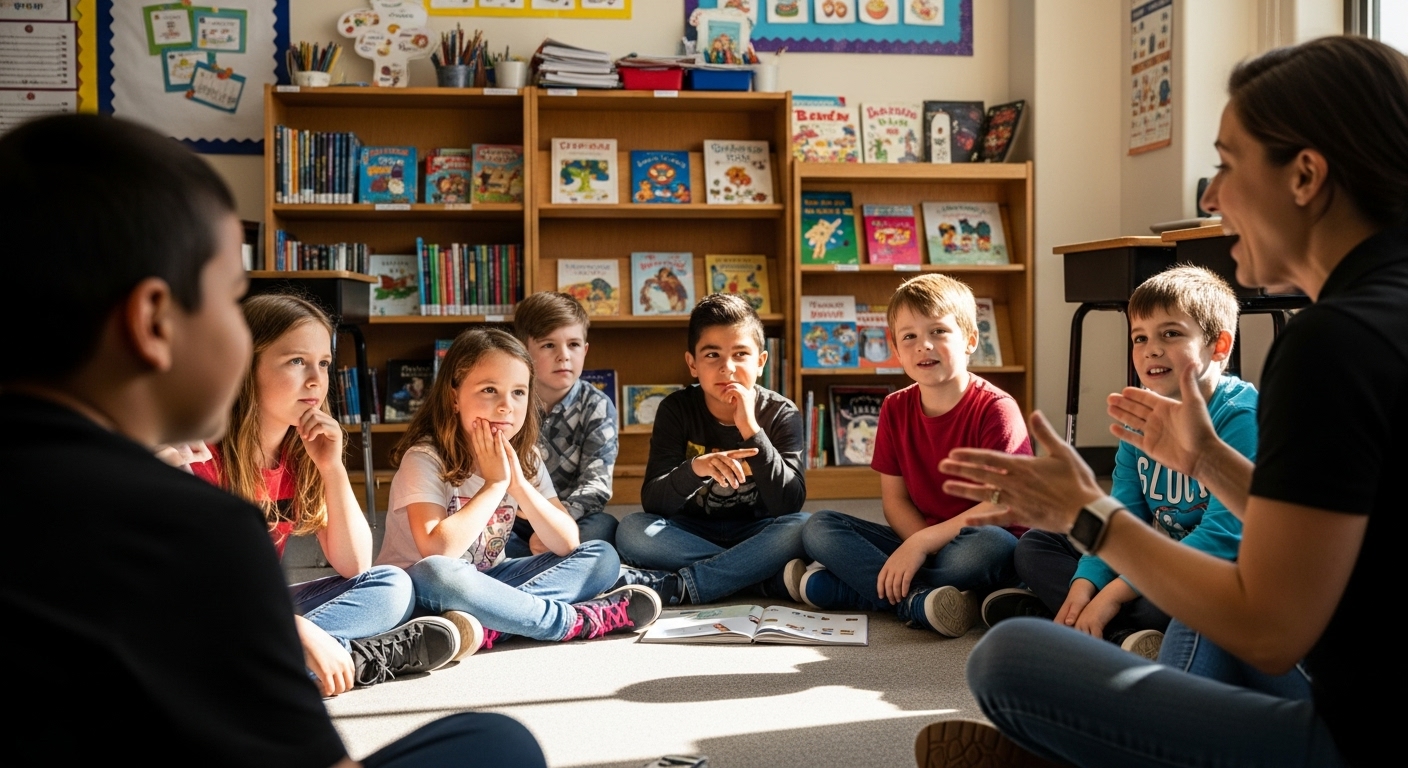
Practical Examples of Age-Appropriate Stories
Practical examples show how age-appropriate stories can be concretely implemented and what creative approaches parents and educators can use to provide children with meaningful narrative experiences. These examples illustrate the practical application of pedagogical principles in various developmental phases.
Stories for Toddlers
The German Society for Child-Oriented Family Therapy recommends narratives with simple, clear structures for toddlers. Typical features include:
- Short, repetitive plot sequences
- Clear visual support through pictures
- Simple language with repetitions
A concrete example would be a story about a child's daily routine, where each activity is visually represented and accompanied by language. This way, toddlers learn everyday structures and language rhythms.
Stories for Preschoolers
In our guide for stories from around the world, we show how preschoolers understand more complex narrative structures. Stories for this age group are characterized by:
- Simple