 edory
edory
Age-appropriate educational stories bring more than just fun to the children's room. They help children understand seemingly complicated topics with ease and promote playful learning. And here's the surprising part. Studies show that narrative methods measurably improve children's memory performance and strengthen social competencies. Many expect dry lessons, but stories in particular turn learning into a real adventure for children that they want to help shape themselves.
Table of Contents
- What are age-appropriate educational stories?
- Why are educational stories important for children?
- How do age-appropriate stories promote development?
- Key concepts of age-appropriate educational stories
- Application examples and effects in everyday life
Quick Overview
| Takeaway | Explanation |
|---|---|
| Educational stories make learning playful. | They convey complex knowledge in an entertaining way, allowing children to learn with enthusiasm. |
| Emotional connection promotes understanding. | Children identify with characters and process learning content more intensively. |
| Narrative structures support development. | Stories promote creative thinking and social competencies through experience-based learning. |
| Parents can create education-oriented interactions. | Shared storytelling strengthens bonding and supports the learning process in family contexts. |
| Educational stories are suitable for daycare centers and schools. | They make it easier to explain complex topics and promote social learning. |
What are age-appropriate educational stories?
Age-appropriate educational stories are special narrative formats designed to convey complex learning content to children in a playful and age-appropriate manner. They fundamentally differ from traditional teaching methods by conveying knowledge through engaging narrative structures and emotional connections.
The basic idea behind educational stories
The core idea of age-appropriate educational stories lies in their ability to make learning an entertaining and accessible experience. Pedagogical experts emphasize that these stories are more than simple entertainment. They function as complex learning tools that combine the following central aspects:
- Age-appropriate complexity
- Emotional engagement
- Playful knowledge transfer
- Individual development support
These stories take into account the specific cognitive and emotional developmental stages of children and adapt content, language, and narrative structure accordingly.
Characteristics of genuine educational stories
Genuine age-appropriate educational stories are characterized by several essential features. They are not only entertaining but also deliberately constructed to support learning processes. A central element is the narrative structure, which helps children understand complex concepts.
The stories often integrate the following elements:
- Interactive storytelling elements
- Clear moral or educational messages
- Characters with whom children can identify
- Visual and linguistic stimuli
Through these deliberately applied design elements, educational stories become powerful instruments of knowledge transfer. They enable children to grasp abstract concepts without feeling like they are in a learning environment.
Below you will find an overview table that summarizes the most important characteristics of genuine age-appropriate educational stories and helps to quickly recognize their pedagogical value.
| Feature | Description |
|---|---|
| Narrative structure | Clear, understandable narrative arcs make it easier to understand complex topics. |
| Emotional engagement | Children identify with characters and process content more intensively. |
| Interactive elements | Stories encourage active listening, questions, or co-creation. |
| Age-appropriate language style | Language and content are adapted to the respective developmental stage. |
| Clear messages | Moral or educational content is subtly and vividly embedded. |
For parents and educators, age-appropriate educational stories offer a unique opportunity to introduce children to complex topics - playfully, respectfully, and in a development-promoting way.
Why are educational stories important for children?
Educational stories play a crucial role in the cognitive and emotional development of children. They are far more than simple entertainment and function as powerful instruments of knowledge transfer that allow for playful and sustainable learning.
Emotional and cognitive development
The importance of educational stories lies in their unique ability to make complex information accessible. Pedagogical research shows that stories not only entertain but also support central developmental processes:
- Language competency development
- Promote emotional intelligence
- Stimulate creative thinking
- Expand social competencies
Through narrative structures, children learn to understand relationships and grasp abstract concepts. The emotional connection to characters enables deeper processing of learning content.
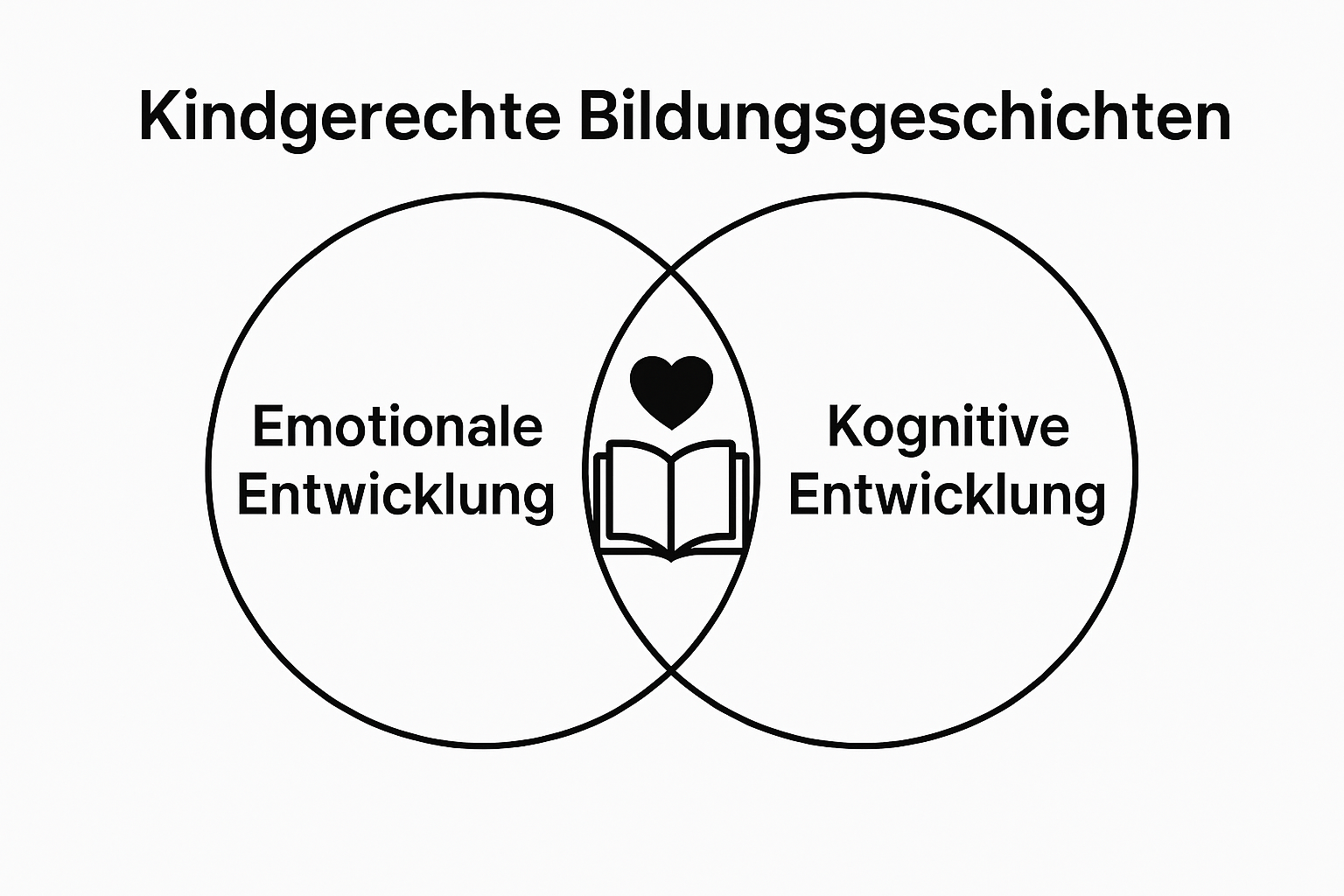
Below you will see a table that contrasts central aspects of cognitive and emotional support through educational stories.
| Support area | Cognitive development | Emotional/Social development |
|---|---|---|
| Result | Improved logical thinking and problem solving | Strengthening of empathy and social competence |
| Method | Listening, retelling, structuring information | Identification with characters, perspective taking |
| Effect | Higher concentration, better memory performance | Better understanding and naming of feelings, constructive conflict behavior |
| Learning form | Active and experience-based knowledge acquisition | Emotional bonding and safe exploration of social situations |
Psychological and pedagogical significance
Educational stories help children understand the world and develop their own identity. They offer safe spaces in which children can explore complex feelings and situations.
The narrative structure helps children take different perspectives and develop empathy. Through identification with protagonists, they learn social norms, problem-solving strategies, and moral values in a non-preachy manner.
Particularly valuable are storytelling methods that actively involve children in the learning process. They enable an individual and self-determined engagement with educational content.
The positive effect of educational stories goes far beyond the immediate learning effect. They create trust, motivate learning, and help children develop joy in discovering and understanding.
How do age-appropriate stories promote development?
Age-appropriate stories are not only entertainment but powerful development tools that deliberately and playfully support several aspects of a child's personality development.
Cognitive development support
Scientific research shows that narrative structures play a crucial role in children's cognitive development. Stories help children understand complex relationships and expand their mental abilities:
- Train logical thinking
- Develop problem-solving competencies
- Increase concentration ability
- Improve memory performance
By listening to and retelling stories, children learn to structure information and follow abstract lines of thought. Narrative logic helps them recognize and interpret causal relationships.
Emotional and social competencies
Educational stories function as emotional learning spaces. They enable children to explore various feelings and social situations without being directly exposed. The narrative structure provides a safe framework for developing empathy, perspective-taking, and emotional intelligence.
Through identification with characters, children learn:
- To recognize and name feelings
- To understand different perspectives
- To manage conflict situations constructively
- To recognize social interaction patterns
Interactive storytelling methods furthermore enable active engagement with learning content. Children are not merely passive recipients but active shapers of their educational journey.
The holistic effect of age-appropriate stories goes far beyond traditional teaching methods. They create emotional resonance spaces where children not only absorb knowledge but actively shape and interpret it.
Key concepts of age-appropriate educational stories
Age-appropriate educational stories are based on complex pedagogical principles that go far beyond simple entertainment. They are carefully constructed narrative instruments that support learning and development holistically.
Narrative structures and learning design
Pedagogical research shows that the structure of a story is crucial to its effectiveness. Age-appropriate educational stories are characterized by specific design elements:
- Age-appropriate complexity
- Clear emotional arcs
- Identification figures
- Interactive storytelling elements
The narrative architecture is designed not to lecture children but to invite them to think actively and explore. Through balanced dramatic arcs and understandable storylines, complex learning content is conveyed playfully.
Pedagogical mechanisms of action
Educational stories function according to specific pedagogical principles. They transform learning from abstract instruction into an emotional, experiential process. Central to this are:
- Contextual embedding of knowledge
- Emotional appeal
- Implicit value formation
- Self-discovery learning
Through identification with characters, children experience learning content not as external instruction but as personal experience. Interactive storytelling methods expand this approach by making children active participants in their educational journey.
The key concepts of age-appropriate educational stories aim to make learning a holistic, emotionally grounded experience. They respect each child's individuality and create spaces for curiosity, joy of discovery, and self-determined understanding.
Application examples and effects in everyday life
Age-appropriate educational stories transcend traditional teaching methods and unfold their effects in various everyday situations. They are flexible instruments that support learning and development in different contexts.
Family learning spaces
Pedagogical studies clarify how educational stories can positively influence family dynamics. They function as bridges between parents and children and create shared experience spaces:
- Shared storytelling and listening
- Promotion of communication
- Conflict resolution through narrative examples