 edory
edory
Stories surround us every day, they captivate hearts and minds, and they are much more than mere entertainment. Surprisingly, regular reading aloud has been proven to improve children's vocabulary and emotional development in multiple ways. Because a truly good story can not only convey knowledge, but also create strong family bonds and often remains in memory for a lifetime.
Table of Contents
- What is a Good Story? Fundamentals and Definitions
- Why Are Stories Important for Children and Families?
- How Do the Elements of a Story Work?
- Key Concepts of a Captivating Narrative
- The Role of Emotions and Characters in Stories
Summary
| Takeaway | Explanation |
|---|---|
| Emotions spark interest | A good story generates emotions that captivate the reader and reinforce the message. |
| Structure is crucial | A clearly defined structure with beginning, middle, and end ensures smooth narrative flow. |
| Characters must be believable | Likeable and authentic characters make the story relatable and moving. |
| Conflicts drive the action | Exciting conflicts are the engine of a story and create development and dynamics. |
| Shared storytelling strengthens bonds | Families who share stories build emotional connections and traditions. |
What is a Good Story? Fundamentals and Definitions
Stories are more than just words on a piece of paper. They are powerful communication tools that evoke emotions, convey knowledge, and connect people. But what actually makes a good story?
To help clarify the essential components of a good story, the following table summarizes the core elements and their functions as described in the article:
| Element | Function / Significance |
|---|---|
| Plot | Clear, captivating sequence of events |
| Characters | Likeable and believable, enable identification |
| Emotional Component | Evokes feelings, creates emotional connection |
| Development/Transformation | Development of plot and/or characters, shows change |
| Structure | Beginning, middle, end for clear narrative flow |
| Conflict | Creates tension, drives the plot forward |
Core Elements of a Story
Every successful story consists of several essential components that work together to captivate listeners or readers. According to storytelling experts at Stanford Graduate School of Business, successful stories typically have the following basic characteristics:
- A clear and captivating plot
- Likeable and credible characters
- An emotional component
- A comprehensible development or transformation
The Emotional Dimension
The key to a good story lies in its ability to evoke emotions. People think not only in facts, but in stories. A powerful narrative creates an emotional connection that makes information vivid and memorable. Emotional resonance means that the story evokes feelings such as joy, sadness, hope, or surprise.
For children's stories, this means creating a world that children find both entertaining and educational. The story should spark curiosity, stimulate imagination, and offer subtle learning experiences.
Structural Elements
In addition to emotional depth, a good story requires a clear structure. According to narrative researchers at the University of Hamburg, this includes:
- A clear beginning that sparks interest
- An exciting development with conflicts or challenges
- A satisfying ending that conveys meaning or a lesson
The art of storytelling lies in combining these elements so that they form a coherent, captivating narrative. A truly great story stays in memory, inspires, and prompts reflection.
Why Are Stories Important for Children and Families?
Stories are more than just entertainment. They are a powerful tool for development, communication, and bonding within families. They play a crucial role in the emotional and intellectual development of children.
Emotional and Social Development
Stories provide children with a safe space to explore and understand complex emotions. Researchers at the University of Cambridge have shown that regularly hearing stories helps children develop empathy and better interpret social situations.
By experiencing characters and their challenges, children learn:
- To recognize and name feelings
- To practice perspective-taking
- To understand complex emotional states
- To develop compassion and understanding for others
Language and Cognitive Development
Stories are a natural learning space for language acquisition and cognitive development. When listening, children expand their vocabulary, improve their language comprehension, and train their concentration skills. Every story is an opportunity to learn new words and understand more complex sentence structures.
Furthermore, stories stimulate imagination. Children learn abstract thinking, logical reasoning, and creative problem-solving by immersing themselves in story worlds.
Family Connection and Tradition
Shared storytelling creates precious moments of closeness and strengthens family bonds. It is more than an activity—it is a form of communication that connects generations. Parents and children share emotions, experiences, and values through shared storytelling.
Interestingly, studies show that families who regularly share stories together build stronger emotional connections. These shared experiences create memories and traditions that children will carry with them throughout their lives.
This table provides an overview of the key ways stories support child development and family connection, as discussed in the article:
| Area | Impact of Stories |
|---|---|
| Emotional & Social Development | Promote empathy, understanding, perspective-taking, and compassion |
| Language & Cognitive Development | Expand vocabulary, improve language comprehension, train concentration & imagination |
| Family Connection & Tradition | Strengthen emotional bonds and create shared memories and traditions |

How Do the Elements of a Story Work?
A story is like a complex clockwork, where different elements work precisely together to create a captivating narrative. Each element has a specific function and contributes to the overall experience.
Conflict as the Heart of the Narrative
Conflict is the soul of every good story. It creates tension and drives the plot forward. Narratologists at Columbia University describe conflict as a central dynamic that challenges characters and enables development.
Conflicts can take various forms:
- Inner conflicts of the protagonist
- Conflicts between characters
- Conflicts with the environment or external circumstances
- Systemic or social challenges
Character Development and Dynamics
Characters are more than just figures. They are the carriers of the story, whose development and transformation convey meaning and depth to readers. Credible characters have strengths, weaknesses, desires, and inner conflicts.
Convincing character development includes:
- Clear motivation
- Personal challenges
- The ability to learn and change
- Emotional depth and authenticity
Narrative Structure and Tension Arc
The structure of a story typically follows a classic tension arc. It begins with exposition, escalates through complications and climaxes, and leads to a resolution. Each phase has a specific function in the overall narrative.
The typical tension arc includes:
- Exposition (introduction of the world and characters)
- Rising Action (escalation of conflicts)
- Climax (peak of tension)
- Falling Action
- Resolution
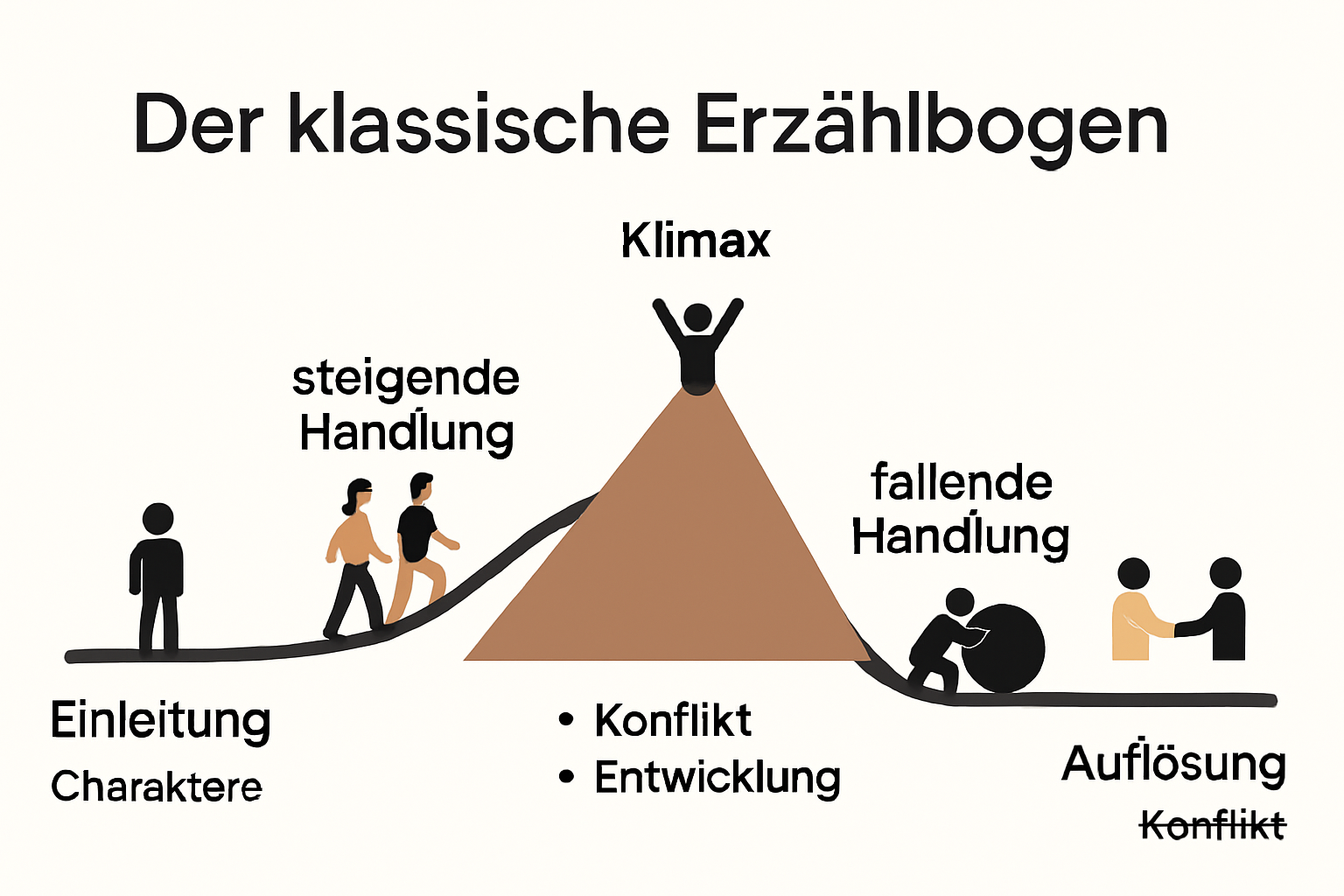
The art of storytelling lies in orchestrating these elements so they form a coherent, captivating narrative that touches readers emotionally and prompts reflection.
Key Concepts of a Captivating Narrative
Not every story captivates its audience equally. There are certain fundamental principles that distinguish an average story from an extraordinary one.
Emotional Connection and Authenticity
Emotional resonance is the heart of every compelling story. Narrative Psychology experts at Stanford University emphasize that stories work when they convey authentic human experiences.
The essential elements of an emotionally connecting story include:
- An honest and unvarnished portrayal of feelings
- Moments of vulnerability
- Surprising twists
- Universal human experiences
Dynamics and Development
A captivating story thrives on change and dynamics. Characters must undergo a development process that creates tension and interest. Transformation is the key to a compelling narrative.
Development typically includes:
- Inner conflicts of the protagonist