 edory
edory
Values are not just abstract concepts; they shape every moment in a child's life. Often people think that children learn values simply through words or rules. But the true surprise is that according to research, children absorb over 80 percent of their values through observation and direct experience. What parents model has far more impact than any explanation.
Table of Contents
- What does it mean to teach children values?
- Why are values important for children's development?
- How do values function in social interaction?
- What values are fundamental for growing up?
- Practical Approaches to Value Transmission in Daily Life
Brief Summary
| Takeaway | Explanation |
|---|---|
| Values are transmitted through role models. | Children adopt the behaviors of their parents and caregivers by observing them. |
| Consistency is key. | Values must be lived consistently in everyday life so that children understand and internalize them. |
| Open communication promotes understanding. | Values should be explained and discussed in conversations to enable deeper understanding in children. |
| Emotional intelligence grows through values. | Values help children regulate feelings and develop empathy, which strengthens their emotional intelligence. |
| Values require critical reflection. | Children should be encouraged to question values to promote reflected moral development. |
What Does It Mean to Teach Children Values?
Teaching values means much more than a simple instruction or admonition. It's about a complex process of emotional and moral education in which parents and caregivers impart fundamental ethical principles and social behaviors to children.
The Core of Value Transmission
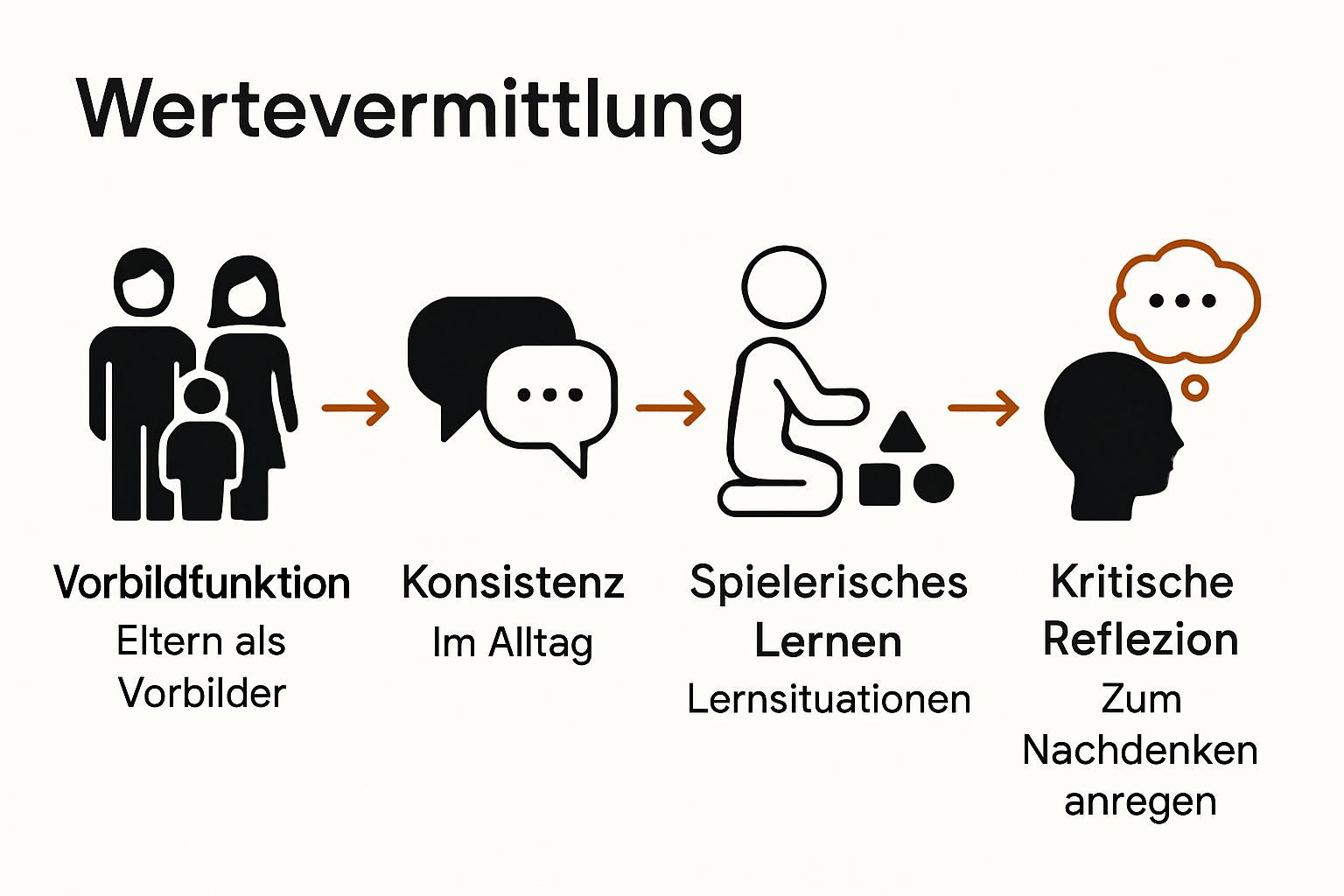
The transmission of values is a dynamic process that goes far beyond merely teaching abstract concepts. Children learn values not only through direct instruction but especially through observation and imitation of their parents and caregivers. They absorb behaviors, reactions, and attitudes from their immediate environment.
Several aspects play a crucial role in this:
- Role modeling: Children copy the behavior of their parents
- Consistency: Values must be lived in everyday life
- Open communication: Explaining and discussing moral situations
According to research from the National Institutes of Health, value transmission is a targeted process of parental education aimed at developing prosocial attitudes and ethical understanding.
Psychological Dimension of Value Transmission
Psychological research shows that values cannot simply be imposed but must be developed together. Children need space to make their own moral decisions and understand their consequences. Parents function as guides and supporters, not controllers.
The process of value transmission requires patience, empathy, and the understanding that each child is unique and takes different learning paths. It's important to convey to children why certain values matter, rather than presenting them as rigid rules.
Why Are Values Important for Children's Development?
Values form the invisible foundation on which children build their personality, social competence, and moral orientation. They are more than abstract concepts—they are the compass that helps children navigate a complex world and make responsible decisions.
The Emotional Foundation
The development of values is crucial for children's emotional intelligence. They learn to understand feelings, develop empathy, and interact respectfully with others. Values help children regulate their own emotions and recognize the feelings of others.
Central aspects of this emotional development include:
- Self-confidence: Clear values strengthen self-esteem
- Social competence: Understanding interpersonal relationships
- Emotional resilience: Coping with challenges and conflicts
According to research from Cambridge University, values form the foundation for emotional development and help children become positive global citizens.
Social and Moral Orientation
Values function as a social compass that helps children distinguish between right and wrong. They form the ethical foundation for decisions and social behavior. Through values, children learn respect, responsibility, fairness, and compassion—qualities that are essential in an increasingly complex and interconnected world.
The process of value transmission is not static but dynamic. Children should be encouraged to critically question and understand values rather than simply accepting them blindly. This promotes deeper, reflected moral development that goes beyond simple rule-following.
How Do Values Function in Social Interaction?
Social interactions are the living space in which values are not only transmitted but also lived, negotiated, and transformed. They are not rigid constructs but dynamic processes that unfold in conversations, relationships, and shared experiences.
Communication as a Value Channel
Values are primarily conveyed through communication. They manifest not only in words but also in tone of voice, body language, and nonverbal signals. Children decode these subtle messages and integrate them into their understanding of social norms.
Key elements of this communication dynamic include:
- Active listening: Shows respect and appreciation
- Authentic interaction: Credibility of value transmission
- Context-based explanations: Promoting understanding
According to research from the National Institutes of Health, value transmission is based on complex socialization practices in which children are actively involved in interpreting and adopting values.
Social Learning Processes
Children learn values not through instruction but through observation and imitation. They are highly sensitive social beings who constantly analyze the interactions around them. Group dynamics, whether in the family, among friends, or in educational institutions, play a crucial role in shaping values.
In this process, children develop a nuanced understanding of social rules and moral boundaries. They learn how values are interpreted and applied in different situations. This process is not linear but complex and individual.
What Values Are Fundamental for Growing Up?
The development of fundamental values is a crucial process that shapes children's personality and social competence. These values form the moral foundation on which children build their relationships, decisions, and worldview.
Core Values for Social Competence
Some values are universal and play a central role in healthy child development. They help shape interpersonal relationships and enable positive coexistence.
The most important core values include:
- Respect: Honoring other people and their boundaries
- Empathy: Ability to understand the feelings of others
- Honesty: Sincerity in communication and actions
- Responsibility: Taking responsibility for one's own actions
According to research from Harvard University, these values are crucial for children's social and emotional development.
Below is a breakdown of the core values described as fundamental for healthy child development. This table summarizes each key value and its practical significance, making it easier to grasp their unique roles.
| Core Value | Explanation |
|---|---|
| Respect | Appreciating others and honoring their boundaries |
| Empathy | Understanding and sharing other people's feelings |
| Honesty | Being truthful in communication and actions |
| Responsibility | Owning the consequences of one's actions |
Values as a Frame of Reference
Values function like an inner compass that helps children navigate complex social situations. They are more than moral rules—they are guidelines that help children make ethical decisions and overcome interpersonal challenges.
The transmission of these values does not happen through coercion but through modeling, explaining, and shared reflection. Children need space to understand, question, and integrate these values into their own personality.
Practical Approaches to Value Transmission in Daily Life
Value transmission is not a theoretical construct but a living process anchored in everyday situations. Parents and caregivers cannot just teach values but must actively model them and integrate them into family routines.
Everyday Situations as Learning Spaces
Every moment in family life offers an opportunity to transmit values. Whether during meals, playing, or conflicts—these situations are valuable learning experiences for children. What matters is not perfect instruction but authentic, consistent demonstration of values.
Practical strategies include:
- Reflected communication: Conversations about feelings and actions
- Joint problem-solving: Involving children in decision-making processes
- Positive reinforcement: Recognizing and appreciating valuable behavior
According to research from the National Association for the Education of Young Children, designing learning environments is crucial for value transmission.
The following table summarizes the main strategies for imparting values in daily family life. This helps clarify which approaches can be practically integrated into routines and their intended effect.
| Strategy | How It Works |
|---|---|
| Reflective Communication | Discussing feelings and actions openly |
| Joint Problem Solving | Involving kids in decision-making and conflict resolution |
| Positive Reinforcement | Acknowledging and encouraging valuable behavior |
| Role Modeling | Demonstrating values consistently through adult actions |
| Playful Learning | Using games, family activities, and stories to foster value learning |
Playful Learning and Role Modeling
Modeling values is more important than preaching. Children learn primarily through observation and imitation. When parents authentically practice respect, compassion, and honesty, children adopt these behaviors almost incidentally.
Shared activities such as family games, collaborative homework, or cooking together can be valuable learning experiences. The focus is not on perfect results but on the shared process and the values lived during it.
Rediscover Value Transmission: Engage Children with Personalized Stories
You want to teach your children values like respect, empathy,