 edory
edory
Children often have fears that are barely visible to adults. But what many are surprised to learn: Targeted stories can demonstrably reduce feelings of fear in children by up to 40 percent. You might think stories are only for entertainment, but they are a real tool for solving emotional challenges – and even strengthening the confidence of little ones more effectively than many traditional methods.
Table of Contents
- What Are Stories Against Fear and Why Are They Used?
- The Psychological Impact of Stories on Children
- How Stories Reduce Anxiety and Build Confidence
- Key Concepts About Childhood Fears and Coping
- Practical Applications of Stories in Family Time
Quick Summary
| Takeaway | Explanation |
|---|---|
| Stories help children cope with fear | Narratives provide a safe space to externalize and process fears. |
| Media promotes emotional resilience | Stories strengthen confidence and demonstrate coping strategies. |
| Individual customization is key | Each story should be tailored specifically to the child's needs. |
| Storytelling rituals strengthen family bonds | Shared story time promotes closeness and emotional security in the family. |
| Narratives activate cognitive processes | While listening, children develop empathy and improve self-reflection. |
What are Stories Against Fear and why are they used?
Stories against fear are special narrative tools designed to help children manage their emotional challenges in a gentle and compassionate way. They are more than simple stories – they are therapeutic instruments that help children understand, process, and overcome complex feelings.
The Psychology Behind Stories Against Fear
The basic idea of these special stories is based on the psychological insight that children can often better understand and process emotions when they are embedded in a narrative context. According to scientific research, therapeutic storytelling enables children to externalize problems and create a safe space to confront their fears.
These stories offer children several important benefits:
- They help make abstract feelings tangible
- They demonstrate coping strategies in a playful way
- They strengthen confidence and emotional resilience
How Stories Against Fear Work
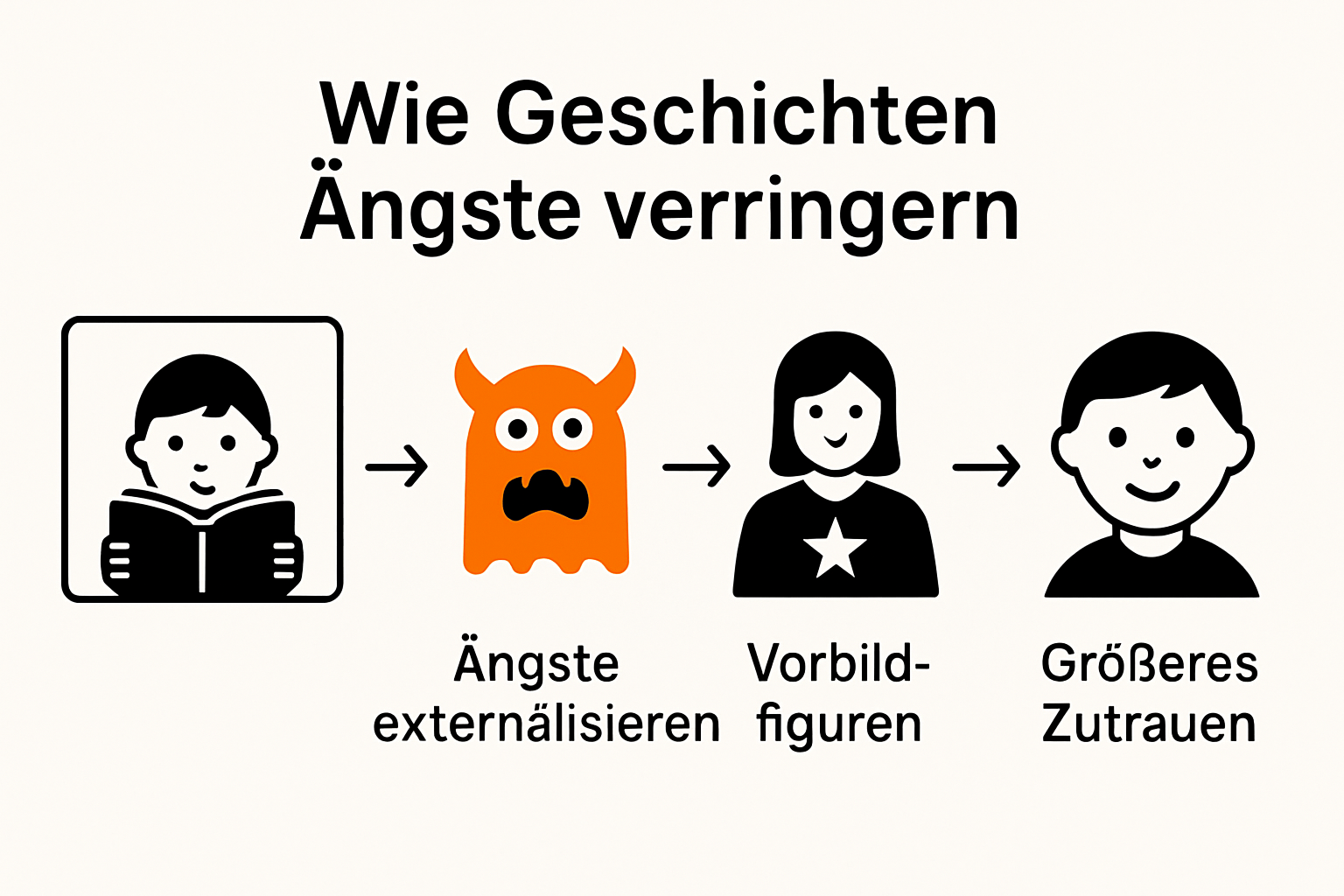
Stories against fear work through various psychological mechanisms. They create distance between the child and their fear by personifying the emotion in a story. In this way, a child can observe, understand, and learn how to cope with their feelings.
Through relatable characters and age-appropriate narratives, these stories help children visualize and manage their internal conflicts. They are not a magic solution, but a supportive tool that parents and therapists can use to help children with emotional development.
The crucial aspect is that each story should be individually tailored to the child's specific needs and fears. A universal approach does not work – all children are unique and require customized narrative support.
The Psychological Impact of Stories on Children
Stories are not just a means of entertainment, but a powerful psychological instrument that profoundly influences children's emotional and cognitive development. They act like an emotional mirror, helping children understand, process, and interpret complex feelings.
Emotional Development Through Narrative Experiences
Listening to and experiencing stories activates various psychological mechanisms in children. They enable safe distance from one's own feelings and help concretize abstract emotional states. Scientific research shows that narrative context significantly influences emotion processing in children.
The key psychological impact mechanisms include:
- Promoting empathy skills
- Developing emotional intelligence
- Improving self-reflection
Cognitive Stimulation Through Stories
Stories are more than emotional experiences. They are complex cognitive training units that stimulate the developing brain in multiple ways. By listening, children learn to understand causality, recognize logical connections, and construct mental models of the world.
Particularly interesting is the neural activation that occurs when listening to stories. Various brain areas are stimulated simultaneously, which not only promotes language development but also supports creativity and problem-solving abilities.
The quality of the story is crucial. Not every narrative has the same positive effect. Age-appropriate, empathetic, and constructive stories can permanently shape children's psychological development and help them better understand and cope with emotional challenges.
How Stories Reduce Anxiety and Build Confidence
Stories are more than simple entertainment – they are a therapeutic tool that helps children manage their inner fears while building self-confidence. Through carefully constructed narrative structures, children can learn to understand and master emotional challenges.
The Mechanism of Anxiety Reduction
When listening to stories, children experience a safe emotional space where they can view fears from a distance. Scientific research shows that targeted stories can significantly reduce fear and anxiety in children.
The key anxiety reduction strategies include:
- Externalization of fears through narrative metaphors
- Presentation of coping strategies through hero journeys
- Normalization of feelings through relatable characters
The following table provides a quick overview of the main mechanisms and benefits of using stories to reduce anxiety and build confidence in children, based strictly on the article content:
| Storytelling Mechanism | How It Works | Key Benefit for Children |
|---|---|---|
| Externalization of Anxiety | Embeds fears in narrative with relatable characters | Creates emotional distance |
| Presentation of Coping Strategies | Shows characters overcoming challenges | Models healthy emotion management |
| Normalization of Feelings | Portrays common fears as normal in stories | Reduces shame and stigma |
| Empowerment via Hero Models | Features characters mastering their fears | Strengthens self-confidence |
| Empathic/Supportive Interaction | Shared storytelling moments with caregivers | Deepens emotional connection |
Building Confidence Through Narrative Experiences
Stories offer children more than just an escape from reality. They are powerful tools for self-empowerment. By experiencing characters who overcome challenges, children develop belief in their own abilities.
Identifying with protagonists who overcome fears conveys an important message to children: difficulties are not insurmountable. They learn that courage is not the absence of fear, but taking action despite fear.
The quality and context of the story is crucial. Not every narrative has the same positive effect. Age-appropriate, empathetic stories can help children expand their emotional landscapes and develop a healthy self-image.
Key Concepts About Childhood Fears and Coping
Fears are a natural part of childhood development, but they must be accompanied professionally and sensitively. They arise from complex psychological and neurological processes and require deep understanding as well as targeted, supportive action from parents and caregivers.
Forms of Childhood Fears
Childhood fears manifest differently in various developmental stages. From separation anxiety in early childhood to social anxiety in school age, children experience a variety of emotional challenges. Research shows that an individual and age-appropriate approach is crucial for successful anxiety management.
Typical forms of childhood fears include:
- Separation anxiety in younger children
- Performance anxiety at school
- Social anxiety when interacting with peers
- Specific phobias such as fear of darkness or animals
To help readers quickly understand the most common types of childhood fears and their typical developmental stages, the following table organizes the key forms of childhood anxiety described in the article:
| Type of Childhood Fear | Typical Age/Phase | Description/Examples |
|---|---|---|
| Separation Anxiety | Early childhood | Fear of being away from caregivers |
| Performance Anxiety | School-age | Worries about grades, tests, or expectations |
| Social Anxiety | School-age | Discomfort around peers, group situations |
| Specific Phobias | Various ages | Fears of darkness, animals, etc. |
Strategies for Coping with Anxiety
Managing childhood fears requires a holistic approach that combines understanding, acceptance, and active support. It is important not to minimize fears but to take them seriously and work together to develop coping strategies.
Key aspects of anxiety management include:
- Open and non-judgmental communication about feelings
- Development of relaxation techniques
- Gradual exposure to anxiety triggers
- Strengthening confidence through positive reinfor