 edory
edory
Reading aloud sounds like a simple routine where you look at a book together. But surprisingly, it's true. Children who are read to daily demonstrably acquire a vocabulary that is 1.4 million words larger by the time they start school. Even more surprisingly, this growth spurt not only makes speaking easier, but sustainably shapes thinking and even social intelligence.
Table of Contents
- The Importance of Reading Aloud for Language Development
- Reading Aloud as a Key to Children's Cognitive Development
- The Role of Reading Aloud in Emotional and Social Development
- Reading Aloud as a Community Activity and Its Benefits
- Reading Aloud and Its Long-Term Effects on Education
Summary
| Takeaway | Explanation |
|---|---|
| Reading aloud promotes vocabulary | Children who are regularly read to develop a larger vocabulary and better language understanding. |
| Reading aloud strengthens emotional bonding | Reading together creates closeness and trust between parents and child, which is important for emotional security. |
| Reading aloud stimulates cognitive abilities | It promotes analytical thinking and concentration by teaching children to recognize and interpret connections. |
| Reading aloud supports educational preparation | Children who are read to frequently have better chances of school success and optimal preparation for the education system. |
| Make reading aloud an interactive activity | Active participation in reading aloud promotes communication and social competencies that are important for everyday life. |
The Importance of Reading Aloud for Language Development
Reading aloud is far more than a short-term form of entertainment. It is a crucial key to early childhood language development that has long-term effects on a child's intellectual and emotional development.
To clearly present the key differences and effects of the most important areas of reading aloud, this comparison table provides a quick overview of the cognitive, linguistic, emotional, and social benefits.
| Area | Central Benefit | Impact on the Child |
|---|---|---|
| Language Development | Vocabulary expansion | Easier communication, better understanding |
| Cognitive Development | Promotion of analytical thinking and concentration | Improved learning ability and creativity |
| Emotional Development | Strengthening of attachment and emotional security | Higher self-esteem, more empathy |
| Social Development | Development of communication and social competence | Better understanding of social relationships |
| Educational Preparation | Early text understanding and reading competence | Improved school success |
Vocabulary and Language Understanding
Through regular reading aloud, children playfully acquire new words and learn more complex sentence structures. Scientific research shows that children who are frequently read to develop a significantly larger vocabulary than their peers who lack this experience.
The main benefits for vocabulary acquisition include:
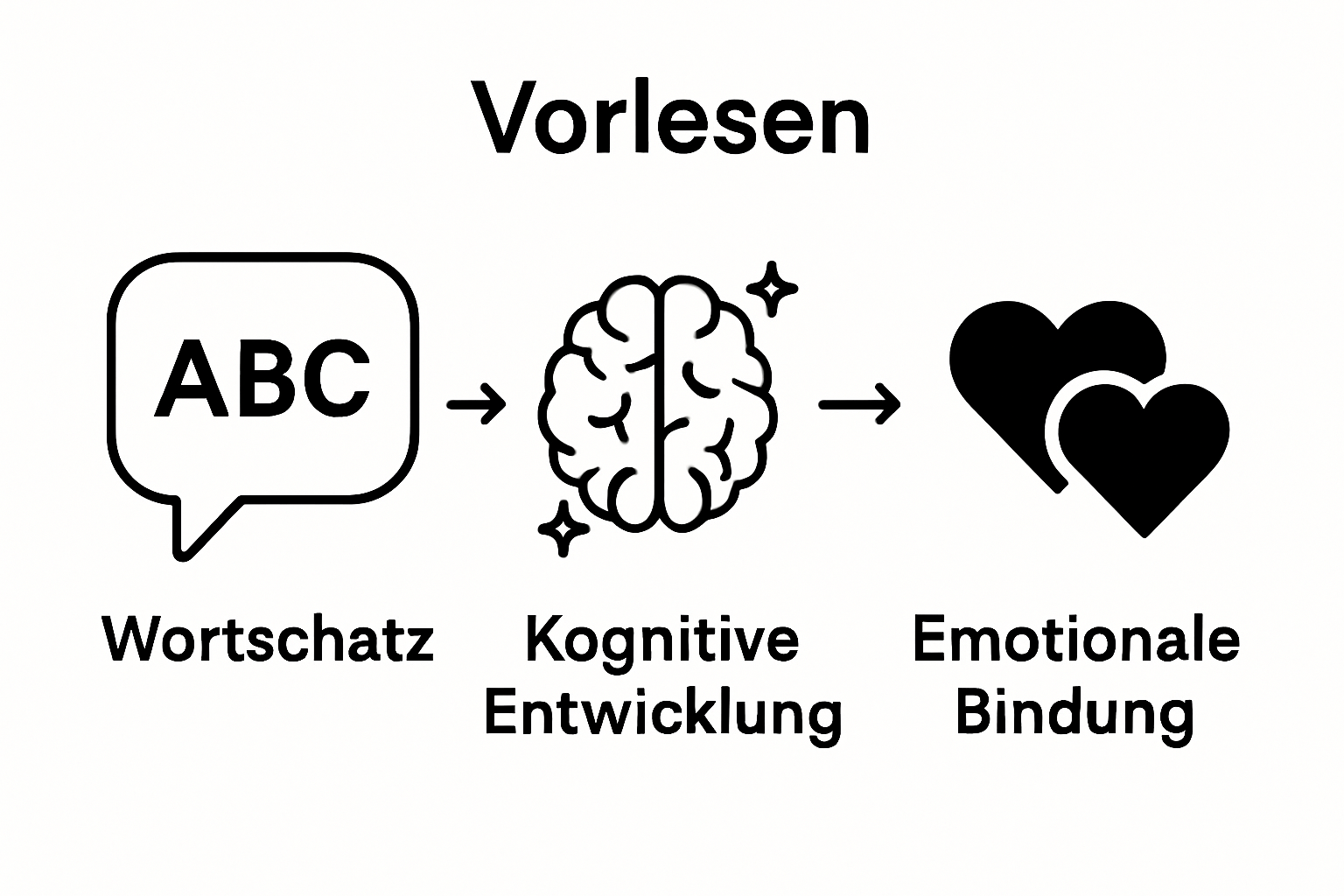
- Learning new terms in various contexts
- Improved language understanding through narrative structures
- Early development of communication skills
Cognitive Development and Imagination
Reading aloud stimulates not only language development but also promotes cognitive development. When parents read stories aloud, they stimulate the child's imagination while simultaneously supporting the development of concentration ability and imagination.
Children learn by listening to understand connections, interpret stories, and create mental images. These skills are fundamental for later analytical thinking and reading comprehension.
The emotional connection during reading aloud is just as important as the language learning effect. Direct contact, shared time, and caring attention not only strengthen the bond between parent and child but also create a positive association with reading and learning.
Reading Aloud as a Key to Children's Cognitive Development
Reading aloud is a powerful tool that goes far beyond mere listening. It is a complex process that fundamentally influences children's brain development and stimulates their cognitive abilities in multiple ways.
Neuroplasticity and Brain Development
Scientific research shows that regular reading aloud positively influences children's brain structures. While listening, new neural connections form that are crucial for cognitive development.
The main neurological benefits include:
- Strengthening connections between different brain regions
- Promotion of language processing
- Improvement of attention and concentration abilities
Development of Analytical Thinking Structures
Reading aloud trains children in logical and abstract thinking. Through listening, they learn to understand stories, recognize connections, and decipher complex narrative structures. These skills are fundamental for later scientific and critical thinking.
While listening, children develop mental models that help them structure, categorize, and interpret information. They learn to understand cause-and-effect relationships and draw logical conclusions.
The cognitive stimulation through reading aloud not only prepares children for school learning but also promotes their creativity and problem-solving competence. It is a playful way to develop complex mental abilities that are important throughout life.
This table provides a compact overview of the main neurological and cognitive effects supported by regular reading aloud.
| Neurological Benefit | Description |
|---|---|
| Strengthening neural connections | Formation of new connections between brain regions |
| Promotion of language processing | More efficient processing and storage of language |
| Improvement of attention | Longer concentration spans and more focused listening |
| Development of analytical thinking abilities | Better comprehension of relationships and logical structures |
The Role of Reading Aloud in Emotional and Social Development
Reading aloud is more than an activity - it is an emotional event that has profound effects on children's social and psychological development. It creates a safe space for closeness, trust, and mutual connection.
Attachment and Emotional Security
Scientific studies show that reading together significantly strengthens the parent-child bond. In these intimate moments, children develop a sense of emotional security and safety that is fundamental to their psychological development.
The main emotional benefits include:
- Building trust and security
- Development of empathy through narrative stories
- Strengthening self-esteem through positive interaction
Social Competencies and Communication Skills
Through stories, children learn to understand subtle social nuances. They develop skills such as perspective-taking, emotional intelligence, and conflict understanding. Every read-aloud story is an opportunity to explore complex human relationships and emotional worlds.
Listening trains not only language understanding but also the ability to interpret emotions and recognize non-verbal communication signals. Children learn to name, understand, and respond appropriately to feelings.
The shared reading experience creates a safe framework in which children can playfully explore social interactions and emotional reactions. It is a form of joint learning that goes far beyond the mere transmission of knowledge.
Reading Aloud as a Community Activity and Its Benefits
Reading aloud is a powerful shared experience that encompasses far more than simply conveying stories. It is an interactive process that brings families together, promotes communication, and creates shared learning moments.
Family Culture and Community Experience
Research findings emphasize that reading together offers a unique opportunity to develop family traditions and strengthen intergenerational connections. This activity creates a protected space for exchange, closeness, and mutual understanding.
The main aspects of the shared reading experience include:
- Strengthening family bonds
- Creating shared conversation topics
- Developing a positive reading culture
Interactive Learning Processes
Reading aloud is not a passive activity but a dynamic dialogue. Children are encouraged to ask questions, make predictions, and actively participate in the story. This interactive component transforms reading aloud from mere listening into a shared learning experience.
Through reading together, families develop not only language competencies but also important social skills such as active listening, empathy, and respectful communication. Every page of a book becomes a bridge between generations, a window to new perspectives, and a catalyst for deeper understanding.
The shared reading experience is more than an activity - it is a ritual that brings families together, shares knowledge, and creates a culture of joint learning and appreciation for stories.
Reading Aloud and Its Long-Term Effects on Education
Reading aloud is not a short-term activity but an investment in a child's future educational journey. It creates fundamental foundations for lifelong learning and academic success that extend far beyond the early childhood years.
Educational Preparation and School Success
Scientific research proves that children who are regularly read to have significantly better chances of school success. This early linguistic stimulation optimally prepares children for the challenges of the education system.
The key educational benefits include:
- Improved reading competence
- Higher concentration ability
- Better text understanding
Academic Competencies and Learning Strategies
Through regular reading aloud, children develop not only language skills but also important metacognitive strategies. They learn to structure information, think critically, and understand complex relationships.
The repeated experience of listening and understanding trains children in their ability to focus, filter information, and selectively acquire knowledge. These competencies are crucial for successful academic and later professional learning.
Reading aloud is thus more than a loving gesture - it is a scientifically based