 edory
edory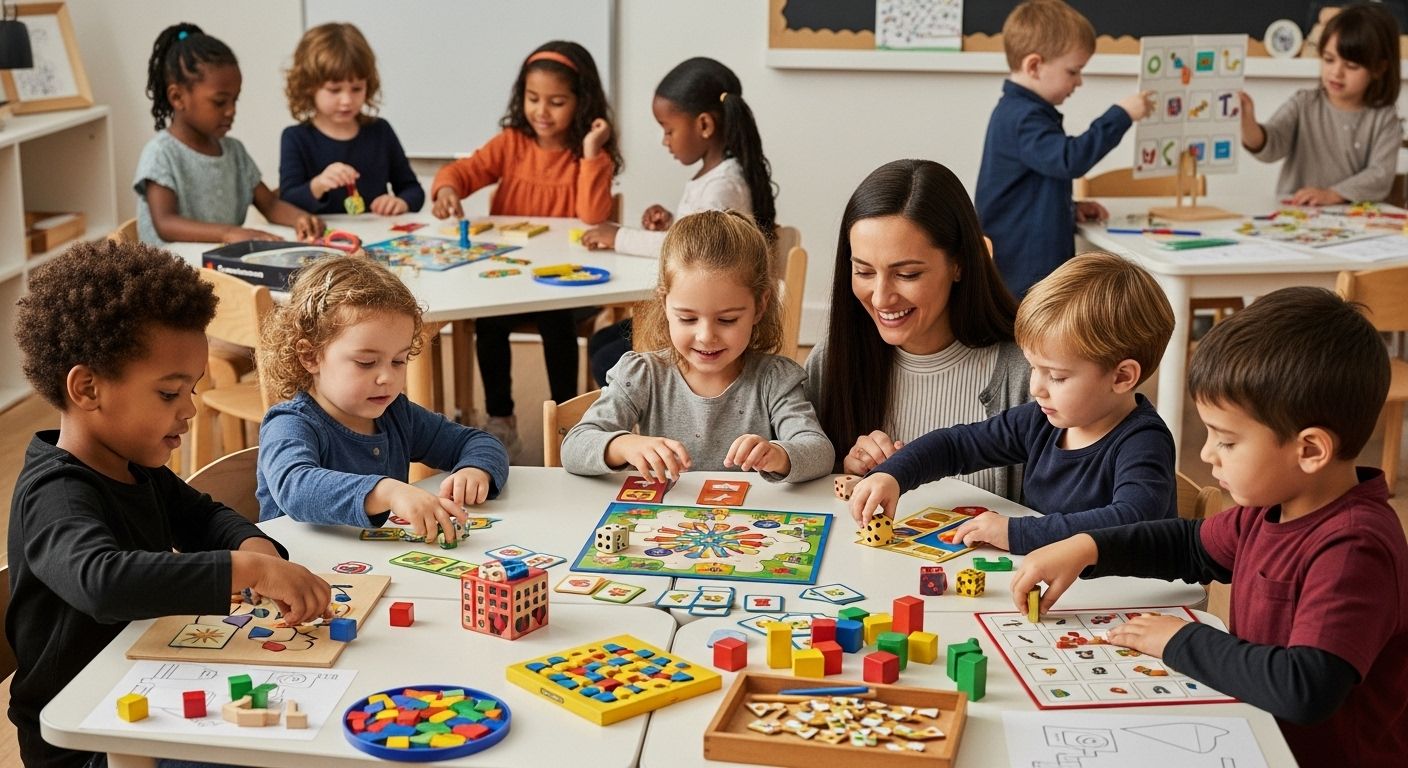
Preschoolers love discovering the world with all their senses. It's surprising how much their abilities benefit when they learn playfully. Studies show that targeted color or dice games significantly improve cognitive development and expand vocabulary. However, children make real progress not through strict practice, but while they laugh, experiment, and try new things together with others.
Table of Contents
- Recognizing and naming colors with color games
- Learning to count with simple dice games
- Understanding shapes through building and puzzle games
- Training memory with card and search games
- Promoting language skills with rhyme and story games
- Strengthening teamwork with group activities
- Developing creativity with craft and role-playing games
Quick Summary
| Takeaway | Explanation |
|---|---|
| Experience colors playfully | Color games promote recognition and naming of colors through interactive activities. |
| Learn counting through games | Dice games make counting visual and entertaining for preschoolers. |
| Spatial thinking through puzzles | Building and puzzle games strengthen understanding of shapes and spatial relationships. |
| Memory training with fun | Memory games improve concentration and retention through entertaining challenges. |
| Language skills through stories | Rhyme and story games expand vocabulary and promote communication skills. |
1: Recognizing and naming colors with color games
Color games are a fantastic way to introduce preschoolers playfully to learning and recognizing colors. In this important developmental phase, color perception and naming can be made playful and entertaining.
Early engagement with colors not only supports cognitive development but also promotes language development and visual discrimination abilities. Scientific research shows that children who learn with targeted color games achieve significantly better results in color perception.
Key benefits of color games for preschoolers include:
- Improvement of visual perception
- Expansion of vocabulary
- Strengthening of concentration ability
Parents can develop simple games that are fun for children while making color learning playful. It's important that activities are age-appropriate and motivating. Examples include sorting tasks with colored objects, memory games, or interactive color matching games.
A key strategy is to integrate everyday objects into color learning. Children learn best when they experience colors in a meaningful context. This means they shouldn't just learn colors abstractly, but should be able to discover and name them in their environment.
Creativity and playfulness are the key to successful color learning. The more fun children have discovering and naming colors, the more effective and lasting the learning process becomes. Parents should ensure positive learning experiences and encourage children without overwhelming them.
2: Learning to count with simple dice games
Dice games are a fantastic method to teach preschoolers counting in a playful and entertaining way. These simple games make mathematical basics accessible and exciting for children. Playful learning is the key to teaching numbers and counting concepts early and effectively.
Research shows that children who regularly learn with dice games develop significantly better mathematical basic competencies. The combination of movement, fun, and concentration makes this learning method particularly effective.
Key benefits of dice games for preschoolers include:
- Development of counting skills
- Improvement of concentration ability
- Promotion of logical thinking
Parents can use various simple dice games to practice counting. It's important to make games age-appropriate and motivating. Possible variations include dice races where children add up the dice numbers, or games where they move figures according to the dice number.
An effective strategy is to integrate dice games into daily life. Children learn best when mathematics appears not as a dry task but as an exciting adventure. This means numbers shouldn't just be learned abstractly but experienced in an entertaining context.
Patience and positive motivation are crucial when learning numbers. The more enjoyment children have with counting and dice games, the more natural and lasting their mathematical understanding becomes. Parents should encourage children to make mistakes and learn from them without overwhelming them.
3: Understanding shapes through building and puzzle games
Building and puzzle games are excellent ways to teach preschoolers understanding of geometric shapes and spatial relationships playfully. These activities not only support cognitive development but also make learning incredibly fun and interactive.
Scientific studies confirm that puzzle games significantly promote children's mental transformation and spatial perception. The complexity of shape perception is explored playfully through targeted games.
Main benefits of building and puzzle games for preschoolers:
- Development of spatial thinking
- Strengthening of fine motor skills
- Promotion of problem-solving abilities
Parents can use various strategies to support shape learning. It's important to choose age-appropriate and motivating materials. Wooden blocks, tangram puzzles, or simple geometric construction toys are excellent for introducing children to shapes.
The goal is to make shape learning not a dry exercise but an exciting discovery adventure. Children should enjoy recognizing, sorting, and reassembling shapes. Creativity and experimentation are the keys to successful shape understanding.
Interactive games where children compare, sort, and recombine shapes support not only mathematical thinking but also promote concentration and persistence. The more fun children have discovering shapes, the more natural and lasting their geometric understanding becomes.
4: Training memory with card and search games
Memory games are an extremely effective method to develop cognitive abilities playfully in preschoolers. They not only help improve concentration ability but also promote important mental processes such as attention and retention.
Scientific research demonstrates that targeted memory training significantly supports the development of working memory and executive functions in children. Memory can be trained like a muscle - the more it's exercised, the stronger it becomes.
Key benefits of card and search games for preschoolers include:
- Improvement of concentration ability
- Strengthening of short-term memory
- Promotion of visual perception
Parents can use various game variations to train memory. It's important to choose age-appropriate and motivating games. Classic memory games, hiding games, or card games with image pairs are excellent for introducing children playfully to memory exercises.
The goal is to make memory training not a dry exercise but an exciting discovery adventure. Children should enjoy remembering things, recognizing patterns, and understanding connections. Playful ease and positive motivation are crucial for successful memory training.
Interactive games where children need to remember and recognize images, shapes, or positions support not only cognitive learning but also make incredible fun. The more enjoyment children have with memory training, the more effective and lasting the learning process becomes.
5: Promoting language skills with rhyme and story games
Rhyme and story games play a central role in the language development of preschoolers. These playful activities not only help children expand their communication skills but make language learning an entertaining and creative process.
Scientific research shows that children who regularly participate in rhyme and story games make significantly better progress in vocabulary, narrative structure, and listening skills. Language develops best through active and joyful experience.
Key benefits of rhyme and story games for preschoolers include:
- Expansion of active vocabulary
- Improvement of pronunciation
- Promotion of communication ability
Parents can use various creative methods to make language games attractive. It's crucial to create a playful and positive learning atmosphere. Group rhyming, invented stories, role-playing, or songs with rhyme structures are excellent for motivating children to speak.
The goal is to make language learning not a dry exercise but an exciting communication adventure. Children should enjoy discovering new words, inventing stories, and communicating with each other. Creativity and playfulness are the keys to language development.
Interactive games where children invent rhymes, continue stories, or take on different roles support not only language development but also promote imagination and social skills. The more fun children have speaking and inventing stories, the more natural and comprehensive their language abilities develop.
6: Strengthening teamwork with group activities
Group activities play a crucial role in the social and emotional development of preschoolers. These shared experiences help children learn and refine basic social skills that are essential for their future success in school and life.
Research shows that group activities help children develop cooperation skills and learn social interactions. Teamwork is a key competency that can be established as early as the preschool years.
Key benefits of group activities for preschoolers include:
- Development of communication skills
- Strengthening of empathy
- Promotion of conflict resolution skills
Parents and educators can use various strategies to promote teamwork. It's important to choose age-appropriate and motivating group games. Shared building projects, role-playing, music activities, or cooperative movement games are excellent for encouraging children to work together.
The goal is to make group activities not a mandatory exercise but an exciting social adventure. Children should enjoy playing together, communicating, and mastering challenges as a team. Positive group experiences are the key to learning social skills.
Interactive games where children look out for each other, support one another, and reach goals together promote not only social skills but also make incredible fun. The more enjoyment children have playing together, the more naturally they develop teamwork and social intelligence.
7: Developing creativity with craft and role-playing games
Craft and role-playing games are wonderful methods to promote the creativity of preschoolers and support their development holistically. These activities allow children to live out their imagination, discover new skills, and explore the world in a playful and self-determined way.
Research results show that children develop a sense of pride and independence through creative activities. Creativity is more than just a pastime - it's an important developmental process.
Key benefits of craft and role-playing games for preschoolers include:
- Development of fine motor skills
- Strengthening of imagination
- Promotion of self-expression
Parents can use various materials and game ideas to stimulate creativity. It's important to give children freedom and space for their own discoveries. Clay, colored pencils, costumes, or everyday objects can be fantastic starting points for creative adventures.
The goal is to support creative processes rather than judge them. Children should enjoy experimenting, creating, and building their own world. The journey is the goal - not the perfect end result.
Interactive games where children invent stories, dress up, or create imaginative artworks support not only creative development but also promote confidence and emotional intelligence. The more fun children have playing and creating, the more naturally their unique creativity unfolds.
Below you will find a comprehensive overview table of the key content and benefits of the 7 learning games for preschoolers presented. This table summarizes the topics, respective learning objectives, and special benefits of each game type in a compact manner.
| Topic | Learning Goal | Key Benefits |
|---|---|---|
| Color games | Recognize and name colors | Visual perception, vocabulary expansion, focus |
| Dice games | Counting and number understanding | Mathematical basics, concentration, logic |
| Building & puzzle games | Recognize shapes, spatial thinking | Fine motor skills, problem-solving, creativity |
| Card & search games | Train retention and memory | Attention, short-term memory, visual skills |
| Rhyme & story games | Language development and communication | Vocabulary, expression, narrative skills |
| Group activities | Team
🦉
📱 Now Available
Ready for the First Adventure?Get Edory AI for free and start today with personalized children's stories your child will love. ⭐⭐⭐⭐⭐ Over 1,000+ happy families · Start for free |