 edory
edory
Every child discovers the world in their own way and develops very special interests in the process. For parents in Germany, it is a daily challenge to attentively accompany these diverse inclinations and foster them early on. Child development is a complex process in which experiences, environment, and individual personality play together perfectly. Those who want to understand how children's interests serve as guides for learning and personal growth will find practical insights here and valuable approaches for personalized stories that support reading and learning in a playful way.
Table of Contents
- What are children's interests and how do they develop?
- Types and developmental stages of children's interests
- The role of parents in fostering children's interests
- Personalized approaches: Edory.ai and individualized stories
- Opportunities and risks of digital content for preschool children
- Security and data protection aspects in children's apps
Key Findings
| Point | Details |
|---|---|
| Dynamic development of children's interests | Children's interests emerge through interactions between personal inclinations, environmental influences, and individual experiences. They are crucial for learning processes and personal growth. |
| Influence of parents and educators | Parents should observe attentively and provide diverse experiences to foster their children's individual interests. An appreciative attitude is decisive in this regard. |
| Personalized approaches in education | Individual stories can be specifically tailored to children's needs to support their development and promote their learning. |
| Opportunities and risks of digital content | Digital media offer both opportunities such as interactive learning and risks such as limitations in social interaction. Guided use is essential. |
What are children's interests and how do they develop?
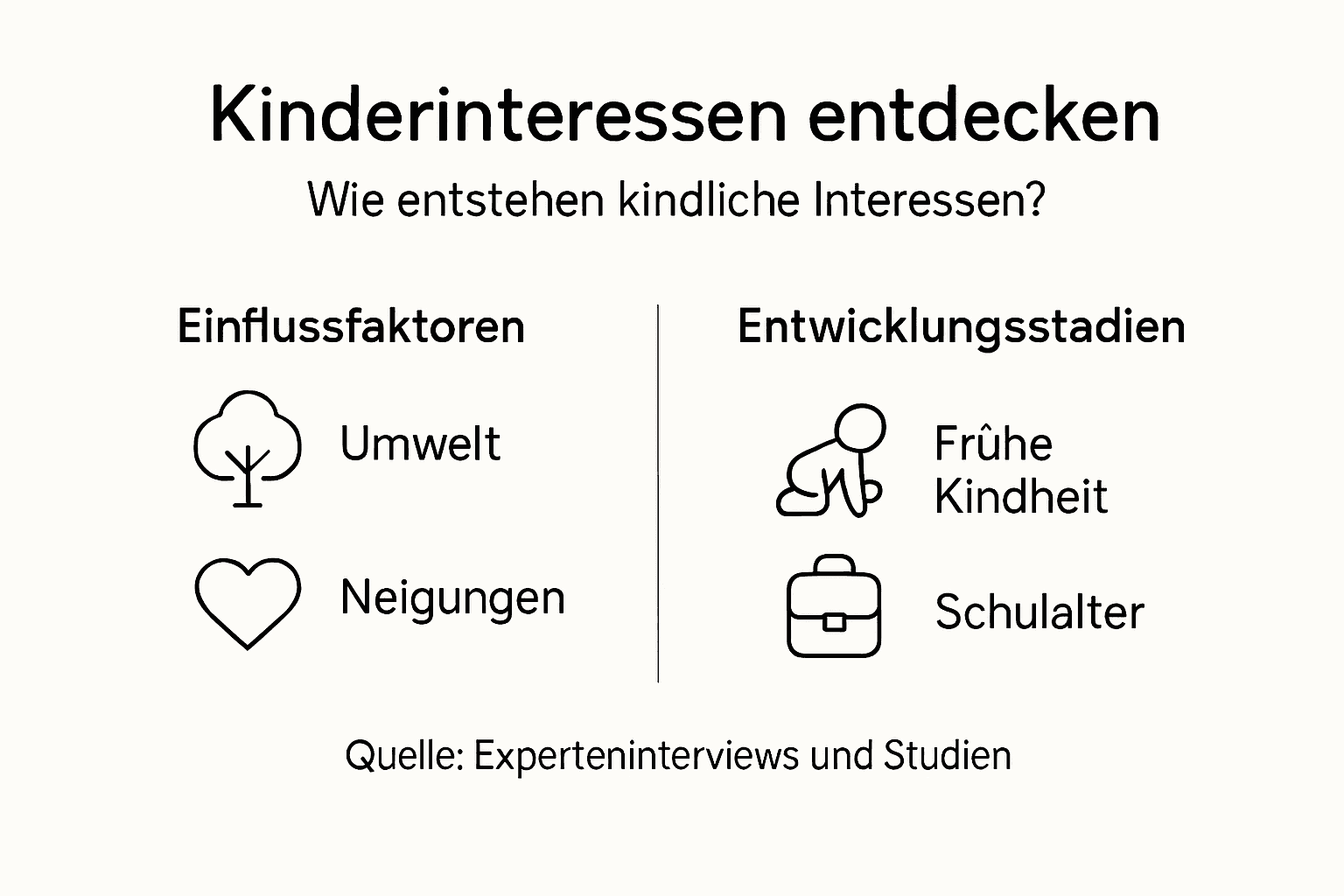
Children's interests are dynamic and individual developmental processes that are deeply rooted in the child's perception and world of experience. They do not develop by chance, but rather emerge through complex interactions between personal inclinations, environmental influences, and individual experiences. In the context of child development, interests are more than just fleeting preferences - they are guides for learning processes and personal growth.
Science shows that children's interests are closely linked to child developmental stages and social interactions. They form through active engagement with the environment, observation, imitation, and independent experimentation. A toddler who fascinatedly collects stones, for example, develops an interest in natural phenomena. Another child who enjoys inventing stories shows early creative inclinations.
It is important to understand that children's interests are not static, but continuously change. They are influenced by:
- Family environment
- Cultural contexts
- Educational experiences
- Individual personality traits
Research into children's interests also reveals that they are closely connected to the tension between dependency and autonomy. Parents and educators play a crucial role by giving children space to develop while simultaneously providing support.
Pro Tip: Observe your child carefully and document their changing interests to better understand their individual development and actively foster it.
Types and developmental stages of children's interests
Children's interests develop in various phases and manifest differently depending on age group and individual personality. Early childhood developmental stages show that these interests are dynamic and extremely complex. They range from sensory exploration in infancy to directed inclinations in the preschool years.
Science fundamentally distinguishes between different types of interests:
- Exploratory interests: Characteristic of infants and toddlers who discover their surroundings through touching, grasping, and exploring
- Creative interests: Manifest through role-playing, drawing, and imaginative activities
- Cognitive interests: Demonstrated through curiosity, questioning, and problem-solving behavior
- Social interests: Develop through interaction with peers and adults
Neurobiology clarifies that child development is a complex process in which neural connections are shaped by experiences and stimulation. These connections become stronger the more actively a child explores their environment and gathers new experiences.
The following table provides an overview of the developmental stages of children's interests and their typical characteristics:
| Developmental Stage | Typical Interests | Influencing Factors |
|---|---|---|
| Infancy | Sensory exploration | Family support |
| Toddlerhood | Exploratory learning | Environment and toy selection |
| Preschool age | Creative activities | Contact with peers |
| School age | Cognitive challenges | Educational institutions, media |
It is crucial to understand that every child is unique and develops their interests individually. Parents and caregivers can support this process by observing attentively, offering diverse stimuli, and valuing the child's curiosity.
Pro Tip: Document your child's changing interests in a journal to identify developmental patterns and enable targeted support.
The role of parents in fostering children's interests
Parents are the first and most important guides in the development of children's interests. Partnership cooperation between parents and educational institutions forms the foundation for comprehensive interest promotion. They must find a balance between guidance and freedom for children's discoveries.
The most important tasks for parents include:
- Careful observation of children's inclinations
- Providing diverse experiential spaces
- Encouraging and supporting individual interests
- Providing resources and materials strategically
- Offering positive reinforcement and emotional support
Scientific research shows that parental involvement sustainably strengthens children's sense of self-efficacy. What is crucial is an appreciative attitude that signals to the child that their interests matter. Parents should not judge curiosity, but rather understand it as an opportunity for development.

Authentic, open communication is the key. Children need parents who listen, take questions seriously, and explore interests together rather than directing them. The art lies in providing impulses without restricting the child's spirit of discovery.
Pro Tip: Have regular conversations with your child about their interests and plan activities together that playfully support them.
Personalized approaches: Edory.ai and individualized stories
Personalized stories are more than just entertainment - they are a powerful tool for individual education and development. AI-based learning path methods make it possible to tailor content precisely to the needs and interests of individual children.
The basic principles of personalized approaches include:
- Consideration of individual learning styles
- Adaptation to developmental stage and interests
- Flexible difficulty level adjustment
- Interactive and responsive design
- Motivation promotion through relevance
Scientific studies show that individualized stories help children better understand complex situations and specifically support their development. Edory.ai uses advanced algorithms to generate stories that not only entertain but also help children learn and grow.
The key lies in technology that dynamically adapts stories to age, interests, and learning goals. This enables unprecedented personalization of educational content that meets each child where they currently are.
Pro Tip: Experiment with different personalized stories and observe which ones captivate and motivate your children the most.
Opportunities and risks of digital content for preschool children
Digital media are a double-edged sword in early childhood development. The digital everyday life of children presents both remarkable opportunities and potential challenges for preschool children. Conscious and guided use is crucial.
The main opportunities of digital children's content include:
- Playful and interactive learning
- Early development of digital competencies
- Promotion of language skills
- Access to age-appropriate educational content
- Playful knowledge transfer
However, the risks are equally significant. Early media experiences can impact sleep behavior, concentration, and social development. Excessive media consumption can:
- Reduce social interaction skills
- Disrupt sleep rhythms
- Restrict physical activity
- Shorten attention spans
Parental guidance and conscious control are the key. Time limits, shared media use, and educationally valuable content help maximize opportunities and minimize risks.
The following table compares opportunities and risks of digital content for preschool children at a glance:
| Aspect | Opportunities of digital content | Risks of digital content |
|---|---|---|
| Learning & Development | Promotes creativity and language ability | Impact on concentration and sleep |
| Social Competence | Access to diverse educational offerings | Possible limitation of social interaction |
| Digital Competencies | Early understanding of technology | Risk of lack of physical movement |
| Media Control | Shared use strengthens parent-child bonding | Danger of overconsumption without control |
Pro Tip: Set clear media usage times and use digital content together with your child to foster their understanding and critical reflection.
Security and data protection aspects in children's apps
Parents face complex challenges regarding security and data protection when it comes to children's apps. Safe children's apps require careful examination of various aspects to optimally protect children.
Important security criteria for children's apps include:
- Complete ad-free experience
- No in-app purchases
- Clear privacy policies
- Age-appropriate content
- Child-safe user interface
- Limited communication features
Data protection is paramount. Parents should carefully check what data is collected, how it is used and protected. Online safety strategies help protect children from unwanted risks and create a positive digital experience.
Selecting an app requires more than a quick glance. Careful analysis of security settings, access permissions, and terms of use is essential to protect children from potential digital dangers.
Pro Tip: Install apps yourself first, test all features, and set strict usage restrictions before allowing your child to use the app.