 edory
edory
Surprisingly, almost 90 percent of all children develop their first value concepts through fairy tales. When a child listens captivated as Cinderella shows courage or the Frog Prince rewards honesty, abstract concepts suddenly become alive and tangible. Fairy tales are far more than entertainment. They make compassion, justice, and hope tangible in a completely natural way and thus lay an important foundation for emotional and social development.
Table of Contents
- What Conveying Fairy Tale Values Means
- Types and Examples of Important Values in Fairy Tales
- How Stories Convey Values Sustainably
- Age-Appropriate Adaptation of Fairy Tales and Values
- Digital Fairy Tale Apps: Opportunities and Risks
- Avoiding Mistakes When Conveying Values Through Fairy Tales
Key Takeaways
| Point | Details |
|---|---|
| Fairy Tales as Educational Tools | Fairy tales are powerful tools for conveying values and promoting the moral development of children. They foster understanding of complex ethical concepts in an accessible way. |
| Subtle Value Transmission | Values in fairy tales are not directly taught, but rather conveyed through symbolic actions and character development, ensuring that children discover the essential messages themselves. |
| Age-Appropriate Adaptation | The narrative strategy must be age-appropriate, as different developmental stages require different approaches to conveying moral values. |
| Opportunities in Digital Formats | Digital fairy tale apps offer new possibilities for interactive value transmission, however care must be taken that they do not replace personal interaction. |
What Conveying Fairy Tale Values Means
Fairy tales are more than just captivating stories. They are powerful tools for the moral and emotional development of children, conveying complex life lessons in a magical, accessible way. Through symbolic narratives and archetypal characters, fairy tales can help children understand fundamental human values such as compassion, courage, honesty, and respect.
The significance of fairy tale values lies in their ability to make abstract ethical concepts tangible. When a child hears the story of a brave hero who overcomes obstacles, they learn not just a narrative, but develop a deeper understanding of character strength and personal resilience. Educational content in fairy tales can help children grasp complex moral dilemmas on both an emotional and intellectual level.
Interestingly, fairy tales convey values in a subtle, non-preachy way. They present conflicts and their solutions through symbolic actions, so children perceive moral decisions not as prescriptions, but as natural courses of action. The characters in fairy tales face challenges that encourage children to develop empathy, respect differences, and see the good in people.
Through these narrative strategies, fairy tales convey universal values such as compassion, hope, and justice in a way that emotionally touches and inspires children. They are not just entertainment, but a subtle form of education that promotes moral development and helps children understand the complexity of human interactions and emotions.
Types and Examples of Important Values in Fairy Tales
Fairy tales offer a rich landscape of moral values reflected in various archetypes and characters. Fundamental values such as compassion, courage, honesty, and justice come alive and become understandable through symbolic narratives. An example is the classic hero who not only masters physical challenges but also passes inner moral tests.
One of the most important values in fairy tales is helpfulness. Fairy tales often show how important compassion and support are for human relationships. Characters who help those in need are typically rewarded, while selfish figures fail. This teaches children the message that generosity and empathy are central social virtues.
Another central value is honesty. Many fairy tales illustrate the consequences of dishonesty through characters who create difficulties through lies or deception. The narratives show that truthfulness and integrity lead to success and recognition in the long term. At the same time, children learn that mistakes are human and that regret and making amends are important moral concepts.
The value of hope and perseverance is also prominently featured in fairy tales. Protagonists overcome seemingly insurmountable obstacles through courage, cleverness, and endurance. These narrative structures teach children that challenges can be overcome when they have confidence in their own abilities and don't give up. Fairy tales are thus more than entertainment: they are powerful tools for moral education that convey complex ethical concepts in an accessible and emotionally moving way.

How Stories Convey Values Sustainably
Stories are more than just entertainment - they are powerful instruments for conveying values. Analyses show that fairy tales convey values such as honesty and cooperation, which can even influence long-term societal development. The narrative structure enables children to understand complex moral concepts emotionally and playfully.
The process of value transmission works through several psychological mechanisms. Children identify with protagonists, experience their moral decisions and consequences. They learn not through dry lectures, but through emotional experiences. Traditional values are creatively adapted by children to their own experiences, keeping the messages alive and relevant.
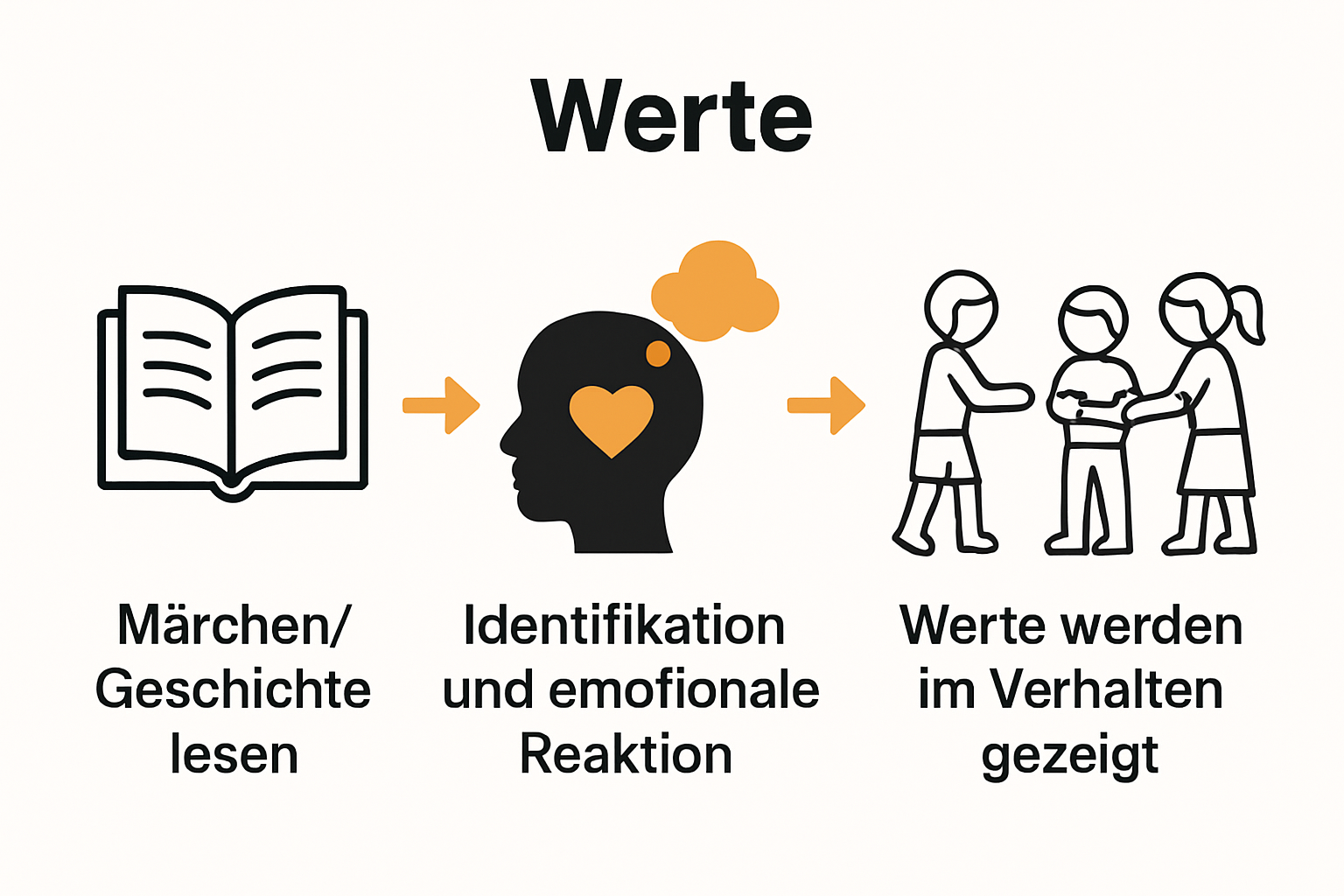
The sustainability of this value transmission is based on the power of imagination. When children hear stories, they activate their imagination and process moral dilemmas on a deeper, unconscious level. The symbolic actions of fairy tale characters become inner images that imprint deeply on emotional memory.
Important in this context is contextual transfer. Good stories translate abstract values into concrete actions. A hero who shows compassion becomes a role model for children. They learn not just the idea of helpfulness, but experience its emotional and social significance. This narrative approach makes values tangible, understandable, and most importantly, effective.
Age-Appropriate Adaptation of Fairy Tales and Values
The art of age-appropriate value transmission through fairy tales requires a sensitive and differentiated approach. Each developmental stage of children requires a specific narrative strategy that makes complex moral concepts understandable and accessible. Fairy tales told in modern ways mean more than traditional story transmission, they are dynamic educational tools.
For toddlers between two and four years old, stories are short, concrete, and emotionally immediate. Values such as kindness or sharing are conveyed through simple actions and clear characters. The narratives focus on basic moral messages without complex nested structures. Characters are clearly good or evil, so children can easily grasp the central messages.
Preschool children between four and six years old already need more nuanced narratives. Here, stories can explore more subtle moral dilemmas. Characters develop more depth, and values such as compassion, courage, and honesty are conveyed through more complicated plot lines. Children learn that moral decisions are not always black and white, but involve shades of gray and compromise.
In elementary school age, fairy tales can already address complex ethical concepts. Stories now feature multidimensional characters who make mistakes, learn, and grow. Values such as forgiveness, self-reflection, and social responsibility come to the foreground. The narrative structures enable children not only to understand moral concepts but also to emotionally process them and transfer them to their own life experiences.
Digital Fairy Tale Apps: Opportunities and Risks
Digital fairy tale apps represent a modern interface between traditional storytelling and technological innovation. The best apps for personalized children's stories offer new possibilities for interactive value transmission that go far beyond classic fairy tale books.
The opportunities offered by digital fairy tale apps are diverse. Personalized stories enable a more individual approach where children can directly identify with the characters. Interactive elements such as choice options or small puzzles promote active thinking processes and emotional involvement. Children learn moral concepts no longer passively, but through active decision-making and reflection.
At the same time, digital formats pose potential risks. Screen time must be carefully controlled to avoid replacing direct human interaction. Parents should view digital fairy tale apps as a supplement, not a replacement for reading together and having conversations. Important factors are child-friendly designs, age-appropriate content, and strict data protection standards.
The future lies in a balanced approach: Digital technologies can enrich traditional fairy tales, but must be employed pedagogically meaningfully and responsibly. Interactive elements, personalized narratives, and clear moral messages can help children discover complex values in new, engaging ways.
Avoiding Mistakes When Conveying Values Through Fairy Tales
When conveying values through fairy tales, there are numerous pitfalls that can unintentionally undermine the educational effect. Teaching children values requires a thoughtful and sensitive approach that encompasses more than simple moral messages.
A common mistake is overemphasizing moral lessons. When fairy tales seem too directive, they lose their magic. Children block out when stories come across like a wagging finger. Instead, values should be subtle and emotionally embedded, so children discover and interpret the messages themselves.
Another challenge is oversimplifying complex moral concepts. The world is not divided into black and white alone. Fairy tales should help children understand moral nuances. Characters must be allowed to make mistakes, show development, and reflect complexity. Only then do children learn to develop empathy and understand different perspectives.
Additionally, it is crucial to make fairy tales age-appropriate. What is suitable for a six-year-old child can be overwhelming or frightening for a two-year-old. The art lies in creating stories that respect developmental psychological boundaries while also being challenging and inspiring.
Conveying Fairy Tale Values Effectively and Personally
Children learn best when stories not only entertain but deeply move them and playfully convey values such as compassion, courage, and honesty. This is precisely the challenge described in our guide to fairy tale values. Parents face the task of explaining complex ethical concepts in an age-appropriate way without preaching or overwhelming. In doing so, they wish for inspiring stories that awaken emotions and at the same time leave room for their own discoveries.
With Edory.ai, this aspiration becomes reality. Our platform offers personalized children's stories that are generated fresh daily and perfectly tailored to your child's age and interests. This way you playfully promote your child's moral development with modern fairy tales that bring values to life and anchor them deep in the heart. Convince yourself on https://edory.ai of our offering and discover in our category Uncategorized – Edory AI – Educational Children's Stories how simple and effective value-oriented storytelling can be today. Start now and give your child valuable stories with lasting impact.
Frequently Asked Questions
What are fairy tale values?
Fairy tale values refer to ethical and moral concepts conveyed through fairy tales, such as compassion, courage, honesty, and respect.
How can fairy tales contribute to the moral development of children?
Fairy tales help children understand complex life lessons and moral dilemmas in an emotional and accessible way by identifying with the characters and experiencing their decisions.
How should fairy tales be adapted in an age-appropriate way?
Fairy tales should be designed differently depending on the developmental stage of children, ranging from simple messages for toddlers to more complex ethical topics for elementary school students.
What are the risks of using digital fairy tale apps?
The risks include excessive screen time and the possible replacement of direct human interaction. It is important to use digital content responsibly and regard it as a supplement to reading together.
Recommendations
- How Fairy Tales Develop: The Comprehensive Guide – Edory AI – Educational Children's Stories
- Edory – Blog – Edory AI – Educational Children's Stories
- Why are Fairy Tales Important for Children and Families? – Edory AI – Educational Children's Stories
- Children and Fantasy Stories: What They Mean and How They Work – Edory