 edory
edory
Every third family in Germany uses stories to actively support their child's language development. For many parents, shared storytelling time is more than just a bedtime ritual; it creates closeness and important opportunities for individual learning. When personalized stories are used strategically, they not only foster imagination and expression, but also strengthen confidence and creative exchange in everyday family life.
Table of Contents
- What does it mean to give the gift of time through stories?
- Benefits for children's development
- Individual Stories: Possibilities and Limitations
- Intentionally combining educational content and imagination
- Safety and data protection in story apps
Key Takeaways
| Point | Details |
|---|---|
| Strengthen emotional connection | Storytelling fosters the emotional relationship between parents and children and creates closeness. |
| Foster creativity and thinking | Regular listening to and inventing stories increases creative abilities and problem-solving skills. |
| Convey learning content in a playful way | Stories make it possible to present complex educational content in a lively and emotionally engaging way. |
| Safety in the digital space | Parents should pay attention to strict data protection measures and secure environments when using story apps. |
What does it mean to give the gift of time through stories?
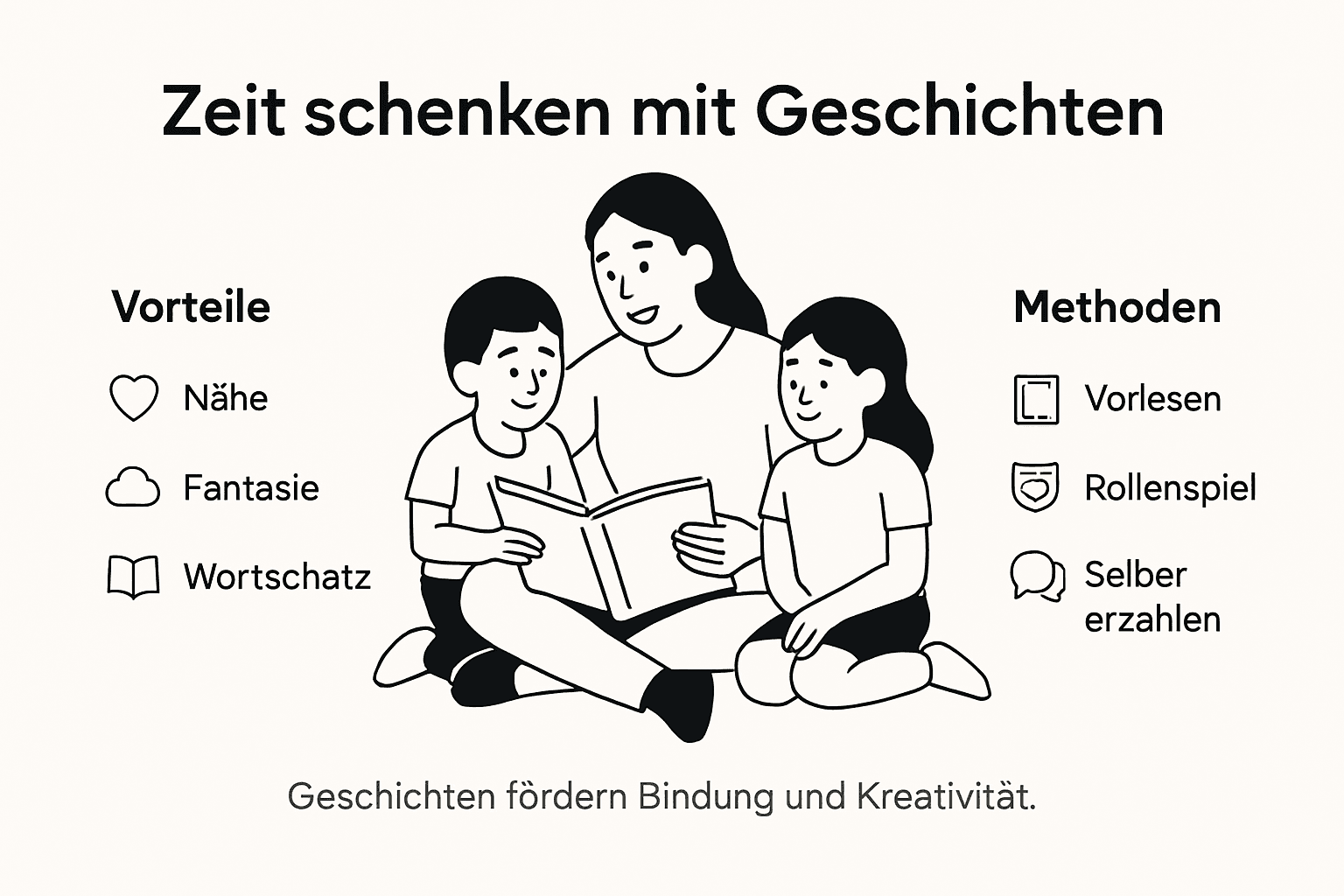
Giving the gift of time through stories means much more than simple entertainment – it's about a deep, emotional exchange between parents and children. Storytelling has connected people for thousands of years and serves not only for entertainment but creates a special form of communication and closeness.
The core of this concept lies in conscious attention and shared experience. Storytelling time is defined not only by the duration of telling, but by the quality of the moment. The term storytelling time refers to the time needed to tell and experience a story, which means that every minute is designed with intention and meaning.
The gift of time through stories has several important dimensions:
- Strengthen emotional connection between parents and children
- Foster creativity and language development
- Pass on cultural knowledge and values
- Create shared memories
Pro tip: Reserve 15 minutes daily for shared storytelling time, where your child is actively involved in the narrative and can develop their own ideas.
Benefits for children's development
Creative problem-solving is a crucial building block for children's development that encompasses much more than just entertainment. Regular engagement with stories promotes complex cognitive skills such as imagination, communication skills, and emotional intelligence. Children learn to view situations from different perspectives and develop a deeper understanding of human relationships.
The importance of fostering creativity becomes particularly clear when considering the OECD's perspective on creative thinking as a future skill. By telling and inventing stories, children develop important key competencies:
- Flexible thinking
- Emotional resilience
- Communication skills
- Social-emotional competence
Continuous engagement with stories supports not only language development but also social-emotional development. Children learn empathy, perspective-taking, and the ability to understand and express complex feelings. These are crucial competencies for their personal and social development.

Pro tip: Encourage your child to invent their own small stories and tell them together to playfully foster creativity and language skills.
This overview shows practical methods for how stories can be used intentionally to promote children's competencies:
| Method | Development goal | Brief description |
|---|---|---|
| Role-play with stories | Empathy and perspective-taking | Take on roles and explore feelings |
| Joint story-inventing | Creative thinking | Gather ideas and connect them into a new plot |
| Narrative dialogue (asking questions) | Language development | Active participation through targeted questions |
| Fantasy journeys and picture cards | Imagination | Visualization and connection with everyday life |
Individual Stories: Possibilities and Limitations
Interactive storytelling, where children act as narrators, offers a unique opportunity for personal development. Each child brings their own imagination, life experience, and emotional perspective to the story, creating a deeply individual storytelling process. This form of storytelling enables children to express their thoughts and feelings in a creative and relaxed way.
The possibilities of individual stories are diverse but not limitless. While digital platforms like Stories that Move show how personal narratives can be shared in a protected space, parents and educators must be sensitive to the following aspects:
- Age-appropriate complexity
- Emotional safety
- Respect for individual boundaries
- Fostering self-expression
Special challenges lie in balancing guidance with creative freedom. Children need a secure framework that supports their creativity without being too restrictive. The key is empathetic accompaniment that gives children room for their own ideas while providing supportive guidance.
Pro tip: Create a trusting atmosphere where your child can tell their story without judgment or correction, and show genuine interest in their unique storytelling perspective.
Intentionally combining educational content and imagination
The School of Fantasy stands for a pedagogical concept that intentionally fosters imagination and creative expression by presenting educational content not as dry knowledge transfer but as a lively, experiential process. Children learn best when knowledge is connected with emotions, creativity, and personal experience. Stories offer a unique opportunity to convey complex concepts in a playful and accessible way.
Creative projects combine educational content and imagination through free exploration and experimental design, which helps children develop their own approaches to the world. Connecting learning content with imaginative narratives enables various pedagogical approaches:
- Playful learning of abstract concepts
- Fostering critical thinking
- Development of problem-solving skills
- Strengthening emotional intelligence
The key lies in a balanced approach: educational content must be presented in a child-friendly, lively, and engaging way. The goal is not to instrumentalize imagination, but to use it as a natural learning channel that awakens curiosity and fosters intrinsic motivation.
Pro tip: Develop stories that incorporate learning objectives playfully and give your child the opportunity to creatively supplement and think along.
Safety and data protection in story apps
Story apps for children require strict data protection measures that go beyond standard security concepts. The challenge is to create a child-friendly digital environment that ensures both creativity and personal security. Parents must be particularly careful about what data potential apps collect from their children and how it is protected.
Data protection in apps includes all measures for processing, storing, and deleting personal data, with particularly strict criteria applying to children's apps. Important aspects include:
- Transparent privacy policies
- Parental consent procedures
- Minimal data collection
- Secure storage mechanisms
- Age-appropriate access permissions
Selecting an appropriate story app requires careful review. Trustworthy providers implement not only technical security mechanisms but also communicate their data protection policies clearly and understandably. Key aspects include data minimization, purpose limitation, and the ability to request and delete data.
The following table compares traditional and digital approaches to storytelling in the family context:
| Aspect | Traditional storytelling | Digital story apps |
|---|---|---|
| Interaction | Direct dialogue, personal closeness | Limited interactivity, but creative tools |
| Flexibility | Spontaneous, individually adaptable | Predefined framework and features |
| Data protection | No data traces, full control | Data protection depends on app provider |
| Long-term impact | Shared memories, emotional bonding | Digital memories, media literacy |
Pro tip: Before using an app, always check the privacy policy and set up privacy settings together with your child.
Foster creativity and consciously give the gift of time through stories
The article impressively demonstrates how important it is to consciously give the gift of time with stories for emotional connection and child development. Parents face the challenge of offering creative and age-appropriate stories daily that not only entertain but also promote language skills, empathy, and imagination. At the same time, the balance between digital safety and individual creativity poses questions for many families.
This is where Edory.ai comes in: Our innovative platform helps parents generate personalized stories daily with just a few clicks. With a combination of educationally valuable content and imaginative storytelling worlds, you can easily create special moments of shared storytelling time. Discover now how you can unite the benefits of storytelling with modern technology and give children creativity and learning joy in an individual way.
Start your journey to daily educational and fantasy stories today on Edory.ai and learn more about our offers on the page Uncategorized – Edory AI – Educational children's stories. Take the opportunity and give your child not just stories but valuable shared time.
Frequently asked questions
What does "giving the gift of time through stories" mean?
Giving the gift of time through stories means experiencing valuable moments of shared storytelling that foster emotional closeness and strengthen communication skills between parents and children.
How can storytelling foster children's creativity?
Storytelling stimulates imagination, fosters creative problem-solving, and helps children express complex feelings and ideas. Active participation in storytelling also supports language development.
What methods exist for using stories to intentionally develop competencies?
Some methods include role-playing, joint story-inventing, and narrative dialogue, which foster empathy, creativity, and language skills in a playful way.
How can I ensure that digital story apps are safe for my child?
Look for transparent privacy policies, minimal data collection needs, and appropriate security measures. Always review privacy settings and the app's data protection policies before use.