 edory
edory
One in three families in Germany faces the question of which fairy tales truly match their children's needs. Anyone who has experienced how quickly a story that is too difficult can cause restlessness knows how important the right selection is. Fairy tale categories help to tailor stories to age and developmental stage, so that children can safely, curiously, and joyfully immerse themselves in the fascinating world of storytelling.
Table of Contents
- What are fairy tale categories and why are they relevant
- The most important fairy tale categories at a glance
- Typical features of different fairy tale categories
- Quiz questions and playful learning with fairy tales
- Which fairy tale category suits my child
- Avoiding mistakes: Safety and educational selection
Key Takeaways
| Point | Details |
|---|---|
| Fairy tale categories are crucial for development | Each fairy tale category has specific pedagogical functions that support children's emotional and intellectual development. |
| Age-appropriate selection is important | Consider your child's age when selecting appropriate fairy tales that match their developmental stages. |
| Use the variety of fairy tales | Vary the fairy tale categories when reading aloud to comprehensively support your child's language and emotional development. |
| Thoughtful fairy tale selection is necessary | Avoid age-inappropriate content and reflect together with your child on the fairy tale content after reading. |
What are fairy tale categories and why are they relevant
Fairy tales are more than just entertaining stories for children. They are a complex cultural heritage that manifests itself in different categories with varying pedagogical and emotional goals. Folklore research on fairy tale categories shows that these stories are far more than simple entertainment.
The most important fairy tale categories include:
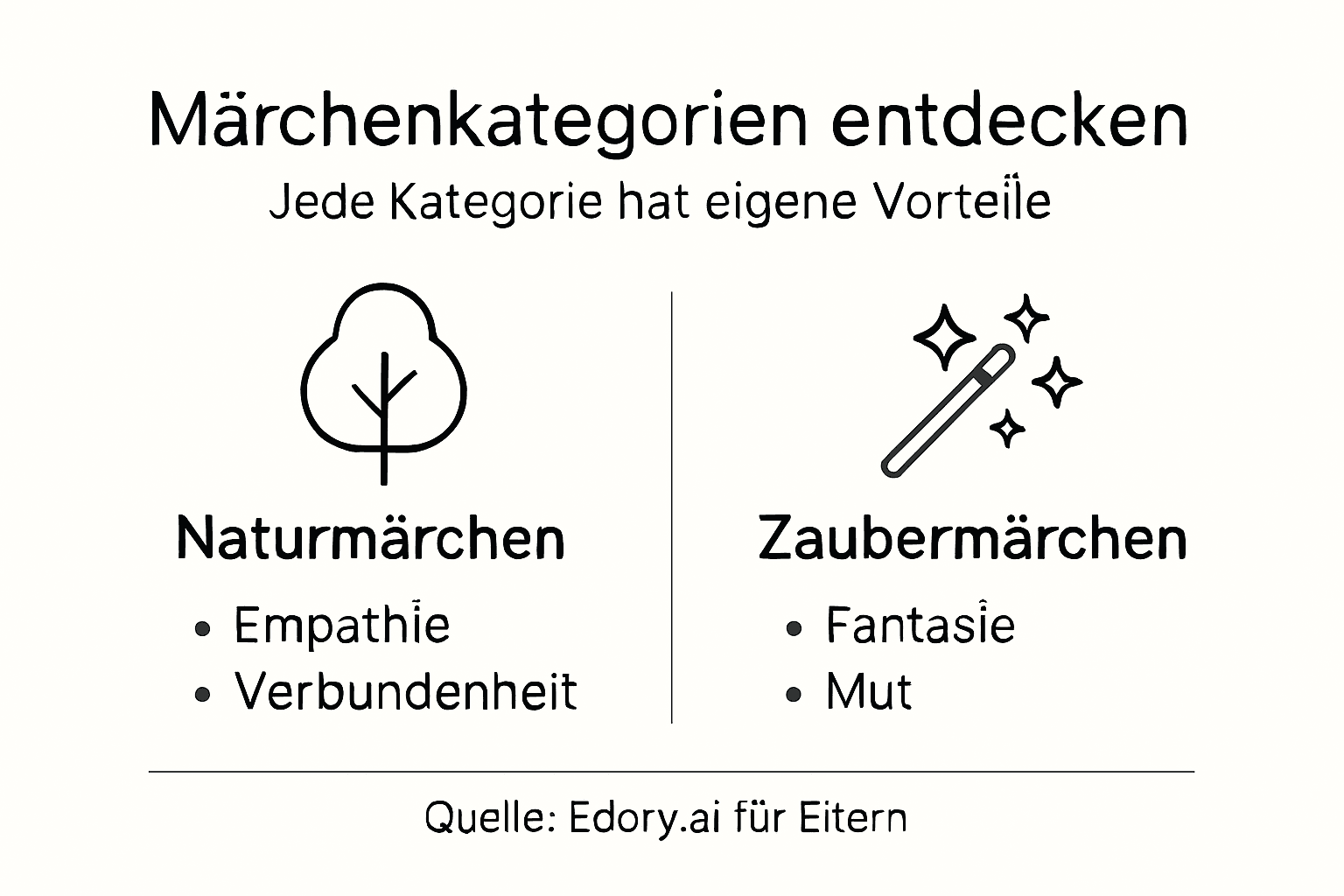
- Nature fairy tales: Stories with animals and nature beings
- Magic fairy tales: Narratives with magical elements and transformations
- Legend fairy tales: Stories with religious or moral backgrounds
- Humorous fairy tales: Funny stories with comedic elements
Each category fulfills specific developmental psychological functions. While nature fairy tales teach children empathy and connection with the environment, magic fairy tales help develop imagination and creativity. Fairy tales offer complex views of reality that help children interpret social structures and moral dilemmas.
Pro Tip: Select fairy tales consciously that match your child's developmental stages and emotional needs.
The most important fairy tale categories at a glance
The world of fairy tales is rich in categories, each fulfilling different pedagogical and emotional functions. Fairy tales can be classified into diverse categories that help parents select appropriate stories for their children.
Here are the most significant fairy tale categories:
- Folk fairy tales: Traditional stories passed down orally through generations
- Literary fairy tales: Fairy tales crafted by individual authors such as the Brothers Grimm
- Animal fairy tales: Stories in which animals play the main roles
- Magic fairy tales: Narratives with magical elements and transformations
- Legend fairy tales: Stories with religious or moral backgrounds
The Aarne–Thompson–Uther Index offers scientists and interested parents a systematic classification system that makes fairy tales comparable based on common motifs and plot patterns. This allows for deeper analysis and targeted selection of fairy tales for children of different age groups.
Each fairy tale category conveys specific values and learning experiences. While animal fairy tales teach empathy and moral lessons, magic fairy tales open spaces for children to explore creativity and imagination. Choosing the right fairy tale category can thus be decisive for children's emotional and intellectual development.
Here you will find a compact comparison of the pedagogical functions of selected fairy tale categories:
| Fairy tale category | Promotes empathy | Stimulation of creativity | Conveys moral values |
|---|---|---|---|
| Folk fairy tales | Particularly pronounced | Less focus | Direct communication |
| Literary fairy tales | Situationally possible | Strong stimulation | Often presented differentiated |
| Animal fairy tales | Strongly pronounced | Slightly pronounced | Indirect lessons |
| Magic fairy tales | Situationally present | Very strong | Symbolically communicated |
Pro Tip: Observe which fairy tale categories particularly fascinate your child and use these preferences to strategically select stories that support their development.
Typical features of different fairy tale categories
Each fairy tale category possesses characteristic features that distinguish it from others. Literary fairy tales differ fundamentally from traditional folk tales through their more complex narrative structure and psychological depth.
Here are the typical features of different fairy tale categories:
-
Folk fairy tales:
- Anonymous transmission
- Clear moral contrasts
- Simple, archetypal characters
- Orally transmitted stories
-
Literary fairy tales:
- Written by known authors
- More complex character development
- Psychologically differentiated perspectives
- Often more literary demanding
-
Animal fairy tales:
- Animals as main characters
- Personified characters
- Moral lessons through animal behavior
- Metaphorical representations of human qualities
-
Magic fairy tales:
- Magical elements dominate
- Supernatural transformations
- Fantastic plot elements
- Symbolic transformation processes
Folk fairy tales are usually anonymous and transmitted orally and are characterized by particularly clear moral structures. They often form the basis for more complex literary adaptations and convey central cultural values.

The differences between fairy tale categories enable parents to make targeted selections of appropriate stories for different developmental stages of their children. While folk fairy tales are more suitable for younger children, literary fairy tales often appeal to older children and adolescents with their more complex narrative structures.
Pro Tip: Vary the fairy tale categories when reading aloud to holistically support your child's language and emotional development.
Quiz questions and playful learning with fairy tales
Fairy tales offer excellent opportunities to educate children playfully and support their development. Didactic studies prove the effectiveness of playful learning methods with fairy tales for children's language and reading skills.
Quiz questions can support various learning objectives:
-
Content understanding:
- Who are the main characters?
- What is the central conflict?
- What lesson does the story teach?
-
Language development:
- Retelling the plot in your own words
- Inventing alternative storylines
- Discussing moral dilemmas
-
Creative challenges:
- Drawing scenes from the fairy tale
- Role-playing with fairy tale characters
- Creating your own fairy tale continuations
Playful learning in a family context enables children to improve their expressiveness and develop social competence. Through interactive methods such as quiz questions, role plays, and joint retelling, parents can actively support their children's learning processes.
When using quiz questions, it is important to make them age-appropriate and motivating. For younger children, simple yes-or-no questions are suitable, while older children can already answer more complex open-ended questions that promote critical thinking and interpretation.
Pro Tip: Make fairy tale quizzes a fun family event where everyone has fun together and learns from each other.
Which fairy tale category suits my child
Each fairy tale category appeals to children in different developmental phases in a special way. Children's and young adult literature offers age-appropriate fairy tale diversity with individual developmental possibilities.
Here are age recommendations for different fairy tale categories:
-
Ages 3-5:
- Folk fairy tales
- Simple animal fairy tales
- Short, picture-rich stories
- Clear moral messages
-
Ages 6-8:
- Magic fairy tales
- More complex animal fairy tales
- First literary fairy tales
- Stories with easily understandable conflicts
-
Ages 9-12:
- Sophisticated literary fairy tales
- Legend fairy tales
- Fairy tales with psychological depth
- Stories with moral dilemmas
Fairy tale categories are oriented to the child's developmental stage and can be strategically used for individual support. Folk fairy tales provide younger children with simple structures, while literary fairy tales challenge older children with more complex themes.
The following overview shows which fairy tale category is particularly suitable for which age:
| Age range | Recommended category | Typical learning advantage |
|---|---|---|
| 3-5 years | Folk & animal fairy tales | Basic values, clear structure |
| 6-8 years | Magic fairy tales | Promoting imagination |
| 9-12 years | Literary & legend fairy tales | Complex thinking, reflection |
It is important to consider your own child's interests and maturity level. Not every child develops at the same pace, so parents should observe individually and adapt the fairy tale selection flexibly.
Pro Tip: Let your child help choose the fairy tale and observe their reactions to find the right category.
Avoiding mistakes: Safety and educational selection
Selecting fairy tales is a sensitive pedagogical task that requires more than just an entertaining story. Scientific studies on fairy tale selection show how crucial a thoughtful approach is for children.
Common mistakes when selecting fairy tales:
-
Age-inappropriate content:
- Overly complex plots
- Overly intense emotional scenes
- Depictions of violence