 edory
edory
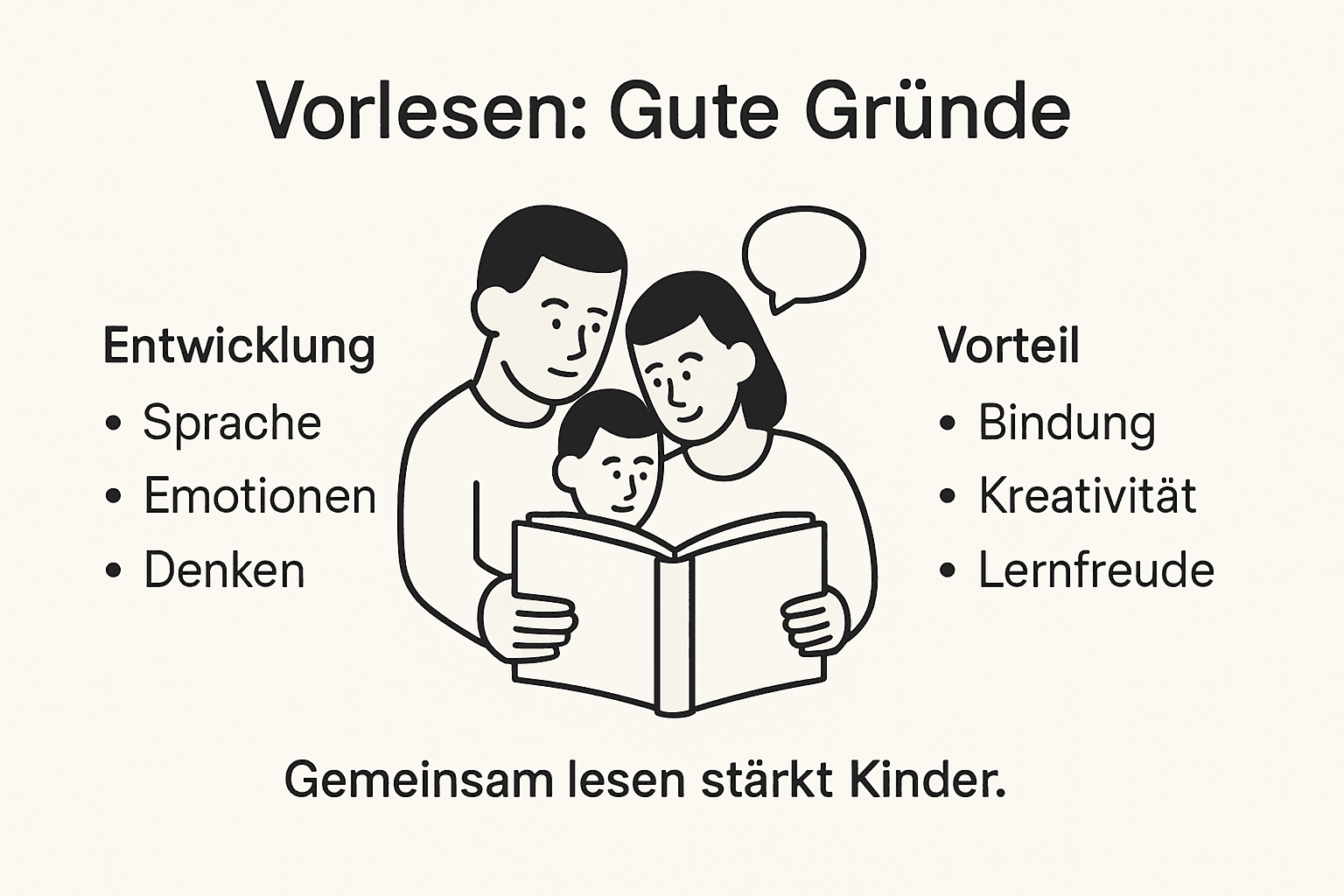
Nearly every other German father or mother knows the feeling of wanting to offer more than just entertainment when reading aloud. Particularly in early childhood, reading together is a key moment for development. Studies show that preschool children who are read to regularly develop significantly better language skills and social competencies. Here you will learn how interactive and educational stories transform reading aloud into a creative learning process and specifically contribute to supporting your child's development.
Table of Contents
- What Does Reading Aloud in Childhood Mean?
- Forms and Methods of Reading Aloud at Home
- Positive Effects on Development and Learning Behavior
- Parental Role and Child-Appropriate Design of Reading Time
- Typical Mistakes and Common Myths About Reading Aloud
- Digital Solutions and Interactive Alternatives to Traditional Reading Aloud
Key Findings
| Point | Details |
|---|---|
| Reading Aloud Promotes Development | Regular reading aloud strengthens the linguistic, emotional, and social development of children. |
| Interactive Methods Are Effective | Dialogic reading encourages active participation of children and improves their language competence. |
| Parents Play a Crucial Role | Engaged parents create a positive reading environment and serve as role models for their children. |
| Digital Media Complements Reading Aloud | Modern technologies can meaningfully support and enrich traditional reading aloud but do not replace it. |
What Does Reading Aloud in Childhood Mean?
Reading aloud is far more than just an evening activity with children. It is a critical educational process that fundamentally shapes early childhood development. According to a study by the Stiftung Lesen, regular reading aloud not only promotes language competence but also influences media behavior, academic performance, and social skills of children.
Reading aloud creates a safe emotional space where children experience and learn to understand language. Researchers at the University of Bamberg emphasize that this process forms the most important foundation for later reading and reading motivation. Children not only experience security but also develop a natural joy in dealing with language and literature.
The significance of reading aloud can be divided into several central aspects:
- Language Development: Children learn new words and sentence patterns
- Emotional Bonding: Shared reading time strengthens the relationship between parents and children
- Cognitive Promotion: Stories stimulate imagination and thinking ability
- Social Learning: Through stories, children understand complex emotions and social situations
Pro Tip: Make reading aloud a daily routine by reserving a fixed time in the evening for it and design the stories interactively.
Forms and Methods of Reading Aloud at Home
There are various approaches to reading aloud that parents can use at home. According to the Mercator Institute, dialogic reading offers a particularly interactive method in which children are actively involved in the narrative. In this way, they are not just passive listeners but develop an active role in experiencing stories.
The Reading Aloud Handbook distinguishes several basic forms of reading aloud that parents can use flexibly:
- Classical Reading Aloud: A traditional method with linear narrative flow
- Dialogic Reading: Active involvement of the child through questions and interaction
- Multilingual Reading Aloud: Integration of different languages for language promotion
- Creative Reading Aloud: Supplementing the story through gestures, facial expressions, and voice modulation
In dialogic reading, the reading aloud process becomes an interactive experience. Parents encourage their children to make predictions, ask questions, and develop their own thoughts about the story. This method promotes not only language competence but also critical thinking and creativity.
Pro Tip: Vary your reading aloud techniques and observe which method excites your child the most and encourages them to participate.
Positive Effects on Development and Learning Behavior
The Stiftung Lesen's reading aloud study demonstrates scientifically that regular reading aloud is far more than a simple activity. It is a decisive factor for holistic child development that has positive effects in various areas.
Research confirms several central areas of development promoted by reading aloud:
- Language Development: Expansion of vocabulary and improvement of language structure
- Emotional Intelligence: Promotion of empathy through stories
- Cognitive Abilities: Strengthening of concentration and imagination
- Social Competencies: Understanding of interpersonal relationships
A dissertation study from the University of Munich clarifies that children from reading-active families have significantly better developmental opportunities. The so-called Home Literacy Environment shapes not only current language development but also lays the foundation for lifelong learning and educational success.

Particularly remarkable is the long-term effect: Early reading experiences directly correlate with later academic performance, reading motivation, and media use. Children develop a positive attitude toward reading and playfully learn to understand, interpret, and reflect on stories.
Pro Tip: Make reading aloud a daily ritual and show genuine interest in the stories and thoughts of your child.
Parental Role and Child-Appropriate Design of Reading Time
The Reading Aloud Monitor 2022 shows how crucial parental engagement is for a child's educational biography. The role of parents goes far beyond simply reading aloud - they are active designers of an inspiring reading environment and role models for language joy and learning enthusiasm.
Important aspects of child-appropriate reading aloud design include:
- Age-Appropriate Selection: Choosing books suitable for the developmental phase
- Interactive Design: Encouraging children to think along and co-narrate
- Regularity: Establishing fixed reading times as a ritual
- Emotional Presence: Attentive and loving reading aloud
The Early Intervention Guidance emphasizes the importance of reading time as high-quality bonding time. Parents should not only read aloud but create a safe, attentive atmosphere where children can discover language, stories, and emotional nuances.
Equally important is individual adaptation: Every child has their own needs, interests, and attention spans. Flexible, responsive parents observe closely how their child responds to different books and reading techniques and adjust their strategy accordingly.
Pro Tip: Create a cozy, distraction-free reading corner and make reading time a special, anticipated moment that your child looks forward to.
Summarized recommendations for successful reading time:
| Recommendation | Benefit for the Child | Tips for Parents |
|---|---|---|
| Create Fixed Rituals | Promotes reliability and security | Best done daily at a fixed time |
| Encourage Interaction | Promotes language development and motivation | Ask questions, encourage storytelling |
| Age-Appropriate Selection | Supports individual development | Books appropriate to the current phase |
| Emotional Presence | Increases well-being and attention | Avoid distractions, listen actively |
Typical Mistakes and Common Myths About Reading Aloud
The scientific collection on Myths of Reading shows that many widespread assumptions about reading aloud do not correspond to reality. Parents often fall victim to misunderstandings that unnecessarily restrict or complicate their reading practice.
Some of the most common myths include:
- Perfection Myth: Reading aloud must be flawless and professional
- Time Myth: Reading aloud always takes a lot of time
- Age Limit Myth: Reading aloud is only worthwhile for small children
- Digital Media Myth: Books and digital media are incompatible
Experts from the Stiftung Lesen refute these myths with scientifically sound findings. It is important to understand that reading aloud is not a rigid concept but should flexibly adapt to the child's needs and interests.
What is decisive is an open, playful attitude: Reading aloud does not mean perfect delivery but rather joint discovery, experience, and communication. Short but regular reading sessions can be just as valuable as long reading hours. Digital media can also complement reading aloud, not replace it.
Pro Tip: Don't be too hard on yourself and focus on conveying joy and closeness when reading aloud, not perfection.
Digital Solutions and Interactive Alternatives to Traditional Reading Aloud
The Stiftung Lesen provides a scientific overview of digital reading promotion approaches that shows digital formats can meaningfully complement traditional reading aloud. Modern technologies open entirely new dimensions of shared story experiences.
Digital reading aloud alternatives include various innovative formats:
- Interactive Picture Book Apps: Animated stories with sound effects
- Reading Aloud Robots: Voice-controlled storytelling devices for children
- Augmented Reality Books: Stories that come to life
- Multilingual Reading Platforms: International story worlds
Digital reading offerings for elementary schools show how technological solutions can meaningfully complement traditional reading formats. Important is conscious, pedagogically reflective use that understands the digital offering not as a replacement but as a supplement to personal reading aloud.
Human contact remains decisive: Digital media cannot fully replace the closeness and emotionality of traditional reading aloud but can strategically support and expand it.
Comparison of traditional and digital reading methods:
| Method | Degree of Interaction |
|---|