 edory
edory
Almost every family knows the search for stories that not only excite children, but truly enrich them. Over 80 percent of parents want fairy tales that combine imagination and education. Old and modern narratives convey important values, strengthen emotions, and encourage reflection. Those who deliberately choose fairy tales and cleverly use digital offerings easily find content that playfully gives children knowledge and joy in life.
Table of Contents
- What distinguishes old fairy tales and why they fascinate
- Fairy tale types, cultural traditions, and modern variants
- Personalized Fairy Tales: New Ways for Individual Learning
- Pedagogical Opportunities and Age-Appropriate Story Design
- Safe Use of Digital Fairy Tale Apps for Children
Key Takeaways
| Point | Details |
|---|---|
| Fairy Tales as Educational Tool | Fairy tales promote cognitive, emotional, and social competencies in children by conveying moral lessons and complex life situations. |
| Cultural Diversity | Exploring different fairy tale types and cultures strengthens understanding of societal values and promotes children's creativity. |
| Personalization of Stories | Personalized fairy tales increase identification with characters and thus promote active learning and children's motivation. |
| Safe Use of Digital Media | Parents should carefully select fairy tale apps, paying attention to quality, data protection, and age-appropriate content to ensure their children's safety. |
What Distinguishes Old Fairy Tales and Why They Fascinate
Fairy tales are more than just stories for children. They are timeless carriers of wisdom, emotions, and cultural heritage. Psychological research shows that fairy tales have profound significance that goes far beyond simple entertainment. They reflect fundamental human experiences and universal themes such as good and evil.
The fascination of old fairy tales lies in their ability to convey complex emotions and moral dilemmas in a simple yet powerful way. They serve as symbolic maps of human emotions and developmental stages. Cultural narratives transport societal norms and ideals that connect generations and shape our collective understanding.
Fairy tales possess a unique language of symbolism. They use metaphorical elements such as enchanted forests, courageous heroes, and magical transformations to illustrate complex psychological processes. These archetypal stories help children understand and cope with emotional challenges by translating abstract concepts into tangible narratives.
Parent Tip: Consciously choose fairy tales that convey age-appropriate moral lessons and stimulate your child's imagination. Read together and encourage your child to interpret the story and develop their own thoughts.
Fairy Tale Types, Cultural Traditions, and Modern Variants
Fairy tale types form a complex and fascinating landscape of cultural narrative traditions. The Aarne-Thompson classification system systematically documents various global fairy tale categories, ranging from animal tales to magic tales to jokes. This system enables researchers to compare fairy tales from different cultures and understand their common narrative structures.
Here you can see an overview of significant fairy tale types and their characteristic features:
| Fairy Tale Type | Typical Motifs | Example Cultures |
|---|---|---|
| Animal Tales | Talking animals, cunning | Africa, Europe |
| Magic Tales | Magic, transformation | Russia, Arabia |
| Jokes | Humor, outwitting | Germany, Scandinavia |
| Legend Tales | Historical figures, miracles | Italy, China |
Each cultural tradition develops its own characteristic fairy tale traditions, deeply rooted in regional myths, historical experiences, and societal values. Modern interpretations expand these traditions through new narrative motifs and contemporary perspectives that reflect societal changes and diversity themes. In this way, dynamic narratives emerge that connect ancient wisdom with current challenges.

Particularly interesting are the transformations of traditional fairy tales in modern media. Digital platforms, films, and interactive formats make it possible to reinterpret classic stories and make them accessible to younger generations. Archetypal characters and plot patterns are creatively reinterpreted without losing their original symbolic power.
Parent Tip: Discover fairy tales from different cultural traditions together with your children. Encourage them to explore the differences and similarities and develop their own creative interpretations.
Personalized Fairy Tales: New Ways for Individual Learning
Personalized learning methods are revolutionizing the way children experience and understand stories. Empirical studies show the significant potential of individualized learning approaches that promote motivation, learning progress, and active participation. Customized content such as personalized fairy tales plays a crucial role in children's development.
Pedagogical concepts emphasize the effectiveness of individual learning materials for self-regulated learning. By tailoring fairy tales directly to a child's interests, strengths, and learning needs, highly engaging educational experiences are created. Children can identify better with characters and develop a deeper emotional connection to the learning process.
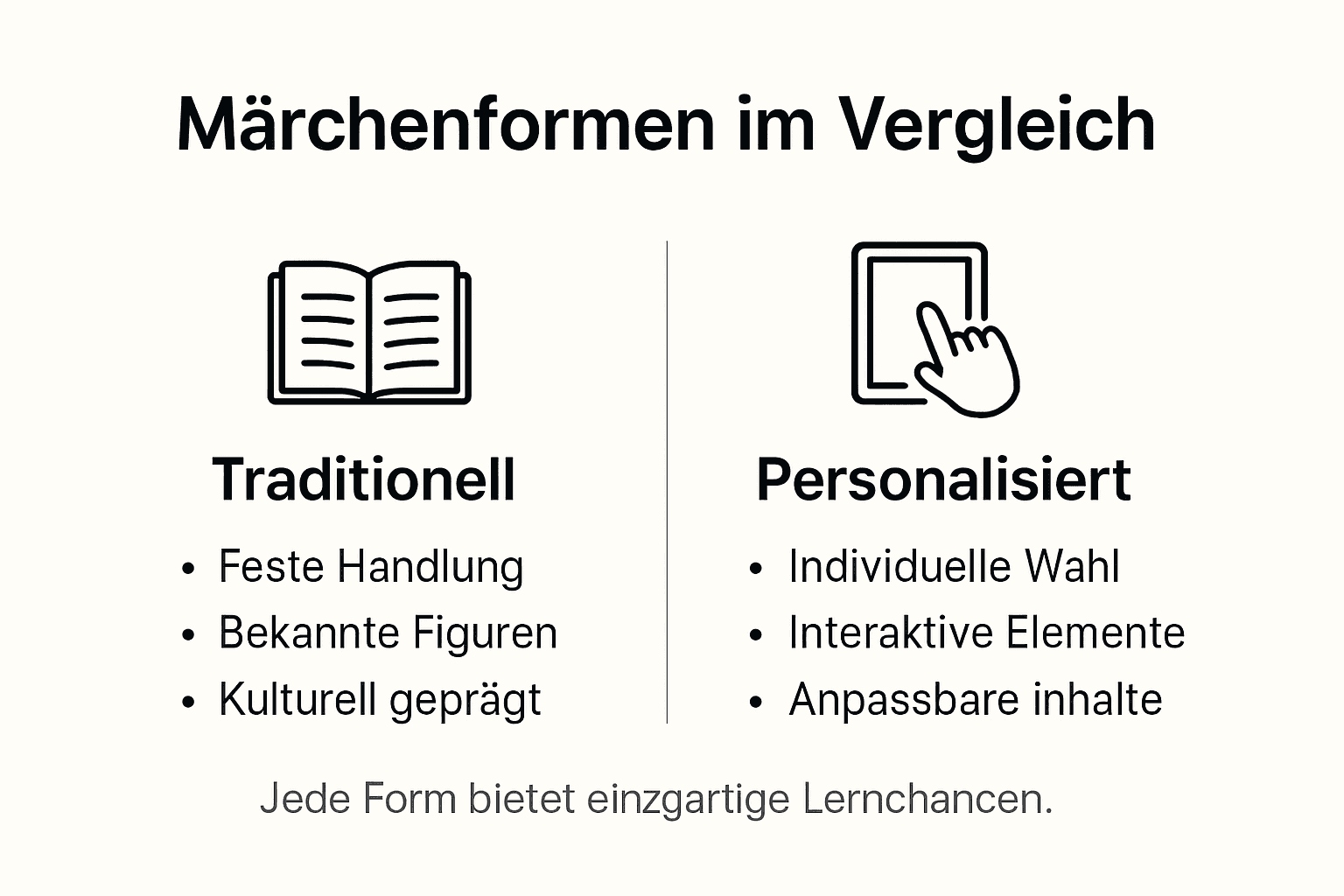
The digital transformation opens entirely new dimensions for personalized fairy tales. Interactive technologies make it possible to dynamically adapt stories: the protagonist can bear the name and characteristics of the child, plot decisions can be based on individual preferences, and learning objectives are seamlessly integrated into the narrative.
The following table compares traditional and personalized fairy tales in a learning context:
| Aspect | Traditional Fairy Tales | Personalized Fairy Tales |
|---|---|---|
| Identification | General heroes | Child as main character |
| Content Flexibility | Fixed plots | Adaptable to interests |
| Motivation | Passive listening | Active participation |
| Learning Experience | Classic experience | Individual support |
Parent Tip: Look for stories that actively involve your child and take their individual strengths and interests into account. The more personal the story, the greater the learning motivation.
Pedagogical Opportunities and Age-Appropriate Story Design
Scientific research shows the comprehensive pedagogical potential of fairy tales for children's development. Fairy tales are far more than simple entertainment—they are powerful educational tools that specifically promote cognitive, emotional, and social competencies. Through carefully selected stories, children can playfully understand and process complex life situations, moral dilemmas, and interpersonal dynamics.
Pedagogical experts recommend age-appropriate fairy tale selection that considers linguistic, cultural, and creative developmental phases. Each age group requires specifically adapted storytelling strategies: while preschool children need simple, pictorial stories with clear moral messages, school-age children can already process more complex narrative structures and ambiguous character development.
The art of age-appropriate storytelling lies in the balance between challenge and comprehension. Stories should touch children emotionally, stimulate their imagination, and at the same time respect developmental psychology boundaries. Important elements include careful dosing of suspense, age-appropriate metaphors, and avoidance of excessively frightening or traumatizing elements.
Parent Tip: Reflect on each story and consider whether it appropriately challenges and supports your child's current developmental stage. The perfect fairy tale selection is an individual process of observation and adjustment.
Safe Use of Digital Fairy Tale Apps for Children
Media experts provide comprehensive guidance for safe digital child protection when using fairy tale apps. The digital world offers numerous opportunities but also potential risks for children. It is crucial that parents actively accompany and guide children, consciously prioritizing quality, data protection, and age-appropriate content.
Educational institutions recommend clear guidelines for using children's apps to ensure safety and developmental support. Important aspects include transparent privacy policies, ad-free content, no in-app purchases, and age-appropriate design. Parents should test apps beforehand and explore them together with their children.
Choosing a suitable fairy tale app requires careful criteria. In addition to pedagogical quality, technical security aspects such as access rights, data protection, and absence of advertising must be considered. A good app enables parental controls, offers no hidden costs, and protects children's privacy.
Parent Tip: Use parenting magazines, test reports, and independent review portals to find reputable and child-friendly fairy tale apps. Stay in dialogue with your children about their digital experiences.
Experiencing Old Fairy Tales Anew and Designing Them Individually
Old fairy tales offer a valuable foundation for imagination, moral learning, and emotional development in children. Yet parents often lack appropriate, age-appropriate, or personalized stories that precisely address their child's interests and needs. This tension between tradition and individual support can be ideally bridged with digital solutions. The challenge is to design fairy tales so that children are actively involved and learning content is experienced in a playful way.
This is where Edory AI comes in. Our platform uses artificial intelligence to create new, personalized fairy tales daily that are precisely tailored to your child's age and preferences. This transforms classic fairy tale storytelling into a lively and individual experience. Discover diverse possibilities at Uncategorized – Edory AI – Educational Children's Stories and learn how modern digitally supported fairy tales promote your child's learning and empathy.
Start now with Edory AI and transform the fascinating world of old fairy tales into a unique and motivating educational experience for your child. Experience how personalized stories truly reach children and allow imagination and knowledge to grow playfully.
Frequently Asked Questions
What are the benefits of reading old fairy tales for children?
Old fairy tales promote emotional intelligence, stimulate imagination, and convey important moral lessons in an easy-to-understand way.
How can I customize fairy tales for my child's learning?
Fairy tales can be personalized by tailoring them to the child's interests and strengths to create a deeper emotional connection and motivation.
What types of fairy tales are there?
There are different types of fairy tales such as animal tales, magic tales, jokes, and legend tales, each with their own motifs and characteristics.
How can I ensure that digital fairy tale apps are child-friendly?
Parents should review apps for pedagogical quality, data protection, and age-appropriate design and explore the apps together with their children.