 edory
edory
Parents influence their children's worldview through their stories and everyday gestures more than many realize. Suddenly, a study shows that reading aloud even releases bonding hormones like oxytocin – creating closeness on a completely different level. Who would have thought that a simple fairy tale in the evening could so sustainably promote children's self-esteem and emotional development.
Table of Contents
- What are the Foundations of the Parent-Child Relationship?
- The Role of Stories in Family Communication
- Why Stories are Important for Emotional Bonding
- How Stories Promote Learning and Development
- Practical Examples of Story-Based Learning
Brief Summary
| Takeaway | Explanation |
|---|---|
| Emotional Availability Strengthens Bonding | Parents must be emotionally available and empathetic to build trust. |
| Open Communication Promotes Trust | Respectful, open conversations are essential for a stable relationship. |
| Use Stories as an Educational Tool | Stories help convey complex emotions and values in a playful way. |
| Joint Storytelling Promotes Bonding Hormones | Telling stories promotes the release of oxytocin, which strengthens relationships. |
| Narratives Strengthen Social Skills | By hearing and telling stories, children develop empathy and problem-solving skills. |
What are the Foundations of the Parent-Child Relationship?
The parent-child relationship is a complex and dynamic system that fundamentally shapes a child's entire development and personality formation. It is much more than just a biological connection - it is an emotional, psychological, and social bond that has profound effects on a person's growth.
Emotional Foundations of Bonding
The basis of a healthy parent-child relationship lies in the emotional availability and sensitivity of parents. Scientific studies show that children who develop secure attachment to their caregivers build better social competencies and a more stable sense of self-worth. This emotional foundation is created through:
- Reliable emotional support
- Consistent behavior and dependability
- Empathy and active listening
Communication and Trust
Trust forms the foundation of every stable parent-child relationship. It means more than just meeting physical needs. Trust is created through open communication, respect, and willingness to perceive the child as an independent person. Research emphasizes that children who grow up in a trusting environment are later more self-confident and emotionally balanced.
The quality of the parent-child relationship is not defined by perfection, but by authenticity, patience, and willingness to grow together. Interestingly, our guide to reading stories aloud can help deepen this bond playfully and build trust.
Each interaction, each shared experience contributes to the development of this unique relationship.
This table compares central components of a healthy parent-child relationship as described in the article.
| Component | Description | Significance for the Relationship |
|---|---|---|
| Emotional Availability | Parents respond sensitively to the child's needs and feelings | Building trust and security |
| Open Communication | Honest, respectful exchange on equal footing | Promotes mutual understanding and closeness |
| Empathy | Ability to put oneself in the child's perspective | Facilitates conflict resolution, strengthens bonding |
| Consistency and Reliability | Predictable, authentic behavior from parents | Provides orientation and stability |
| Shared Experiences | Sharing time and experiences together | Intensifies emotional connection |
The Role of Stories in Family Communication
Stories are much more than just entertaining narratives. They are a powerful communication tool that helps families share emotions, convey values, and build deeper connections. They function as emotional bridges between generations and enable open, playful exchange.
Emotional Communication Through Stories
Through stories, families can express complex feelings and experiences in an accessible and understandable way. Research in family psychology shows that narrative communication is particularly effective for:
- Conveying abstract emotional concepts
- Creating empathy and mutual understanding
- Normalizing feelings and experiences
Values and Learning
Stories are a subtle but effective tool for conveying values. They provide children with models for moral behavior without being preachy. Our guide to storytelling in family life explains how parents can use stories to communicate ethical principles.
Telling stories allows families to share complex life experiences without seeming instructional. Children learn important life lessons through narrative structures - about compassion, courage, togetherness, and personal development. The power of stories lies in their ability to make abstract concepts tangible and emotionally meaningful.
Why Stories are Important for Emotional Bonding
Stories are more than just words. They are an emotional communication tool that triggers deep psychological and neurological processes, which fundamentally strengthen the bond between parents and children.
Neurobiological Foundations of Bonding
Scientific research shows that jointly telling stories triggers a biochemical reaction. When listening, bonding hormones like oxytocin are released, which promote trust and emotional closeness. This biological mechanism explains why stories are so effective in strengthening family relationships.
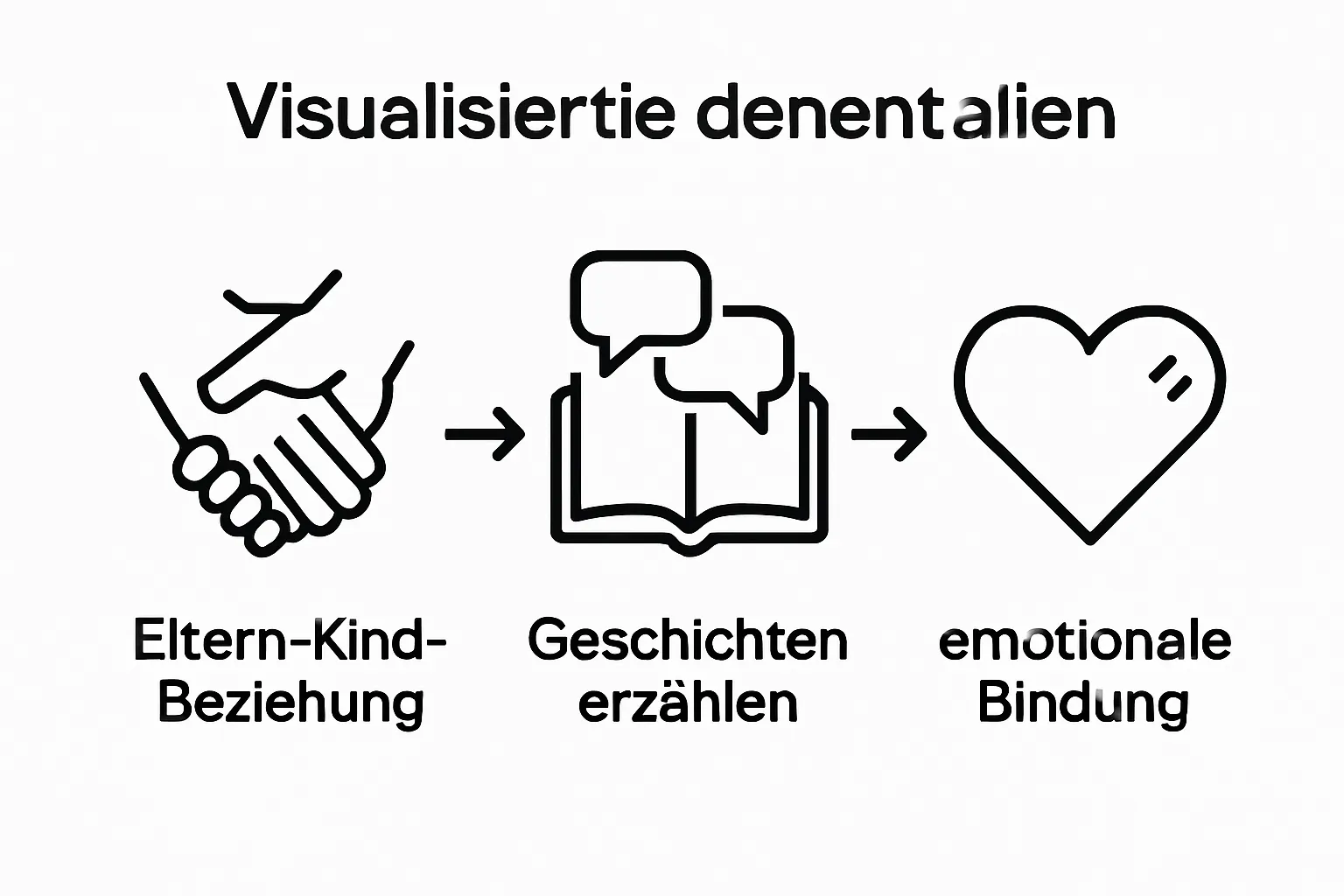
The neural processes during storytelling include:
- Activation of empathy centers in the brain
- Synchronization of emotional states
- Promotion of nonverbal communication
Psychological Dimensions of Storytelling
Stories offer a safe space for emotional exploration. They enable children to understand and process complex feelings without having to speak directly about personal experiences. Our guide to the educational value of storytelling clarifies how narratives develop emotional intelligence.
Through stories, children learn to structure and understand their inner worlds. They develop a deeper understanding of emotional nuances and social dynamics. The power of stories lies in their ability to make abstract emotional concepts tangible and meaningful.
How Stories Promote Learning and Development
Stories are not just entertainment, but powerful learning tools that support children's development in many ways. They work like a multidimensional educational instrument that stimulates cognitive, social, and emotional skills simultaneously.
Cognitive Development Through Narrative
Scientific research proves that stories activate children's neural networks in a unique way. When listening, brain areas are stimulated that connect language, logic, and imagination. Children thereby develop:
- Improved language competence
- Strengthened concentration ability
- Expanded cognitive flexibility
Social Learning Through Story Experiences
Narratives function as social simulation spaces in which children playfully explore complex behaviors and moral concepts. Our guide to learning through stories shows how children develop social competencies through stories.
By experiencing different perspectives, children learn empathy, problem-solving strategies, and social interaction patterns. Stories provide a protected space to understand complex social dynamics without being directly exposed. They are like mental training programs that build social intelligence in a playful way.
Below you will find an overview of how stories can specifically promote different developmental areas of children, based on the key aspects of the article.
| Developmental Area | Promotion Through Stories | Exemplary Effects |
|---|---|---|
| Emotional Development | Conveying and reflecting on feelings, building empathy | Increased self-esteem, emotional security |
| Social Competencies | Understanding social roles and conflicts | Improved empathy, teamwork and problem-solving |
| Cognitive Development | Promoting language, logic and imagination | Increased language competence, concentration and flexibility |
| Values and Morality | Illustrating ethical concepts through narrative examples | Development of compassion, honesty and cooperation |
| Bonding and Relationships | Shared experiences and exchange, release of bonding hormones | Deepening of parent-child relationship, more trust |

Practical Examples of Story-Based Learning
Story-based learning is a dynamic method that helps children understand complex concepts in a playful and meaningful way. It is about making learning not a dry transmission of knowledge, but an emotional and interactive experience.
Emotional Intelligence Through Stories
Educational studies show that stories are an excellent tool for developing emotional competencies. A practical example would be jointly reflecting on the feelings of book characters:
- Identifying different emotions
- Understanding motivations and behaviors
- Developing empathy skills