 edory
edory
Storytelling can do much more than entertain. It changes how children feel, think, and experience the world. When listening to stories, the same areas of a child's brain are activated as during real experiences. Most people believe storytelling is only for creative evenings or bedtime rituals. Yet in reality, it contains a remarkable tool with which parents can support their children's development every day.
Table of Contents
- What is Storytelling and Why is it Important?
- The Role of Storytelling in Child Development
- How Stories Convey Emotions and Values
- Practical Examples for Parents in Everyday Life
- Cultural and Social Aspects of Storytelling
Quick Overview
| Conclusion | Explanation |
|---|---|
| Storytelling promotes language development | Stories support children in learning new words and sentence structures. They contribute to linguistic competence and expressive ability. |
| Building emotional intelligence through stories | By retelling experiences, children learn to understand their own feelings and those of others. It promotes compassion and empathy. |
| Targeted promotion of cognitive skills | Storytelling improves logical thinking, concentration, and memory. Children process information and learn to recognize connections better. |
| Conveying moral values through narratives | Stories show characters making ethical decisions, which helps children understand values such as honesty and respect. |
| Creatively use everyday stories | Parents can use everyday situations to tell stories that offer learning opportunities and strengthen emotional connections. |
What is Storytelling and Why is it Important?
Storytelling is a powerful communication method that goes far beyond simple narration. It is an art of shaping and presenting stories in a way that awakens emotions, conveys information, and deeply touches people. For parents, storytelling is a particularly valuable tool for their children's development and education.
The Psychology of Storytelling
Stories appeal to people on an emotional and cognitive level. Scientific research shows that the brain is activated in a similar way during storytelling as during real experiences. This means children can better understand and process complex concepts through stories. They not only learn facts but also develop important social and emotional skills.
Significance for Children and Families
Storytelling fulfills several crucial functions for children:
- Promoting language development
- Strengthening creativity and imagination
- Conveying moral values and cultural knowledge
Through targeted storytelling, parents can learn more about age-appropriate stories to optimally support their children's development. It is not just about telling a story, but building a bridge between experience, emotion, and understanding.
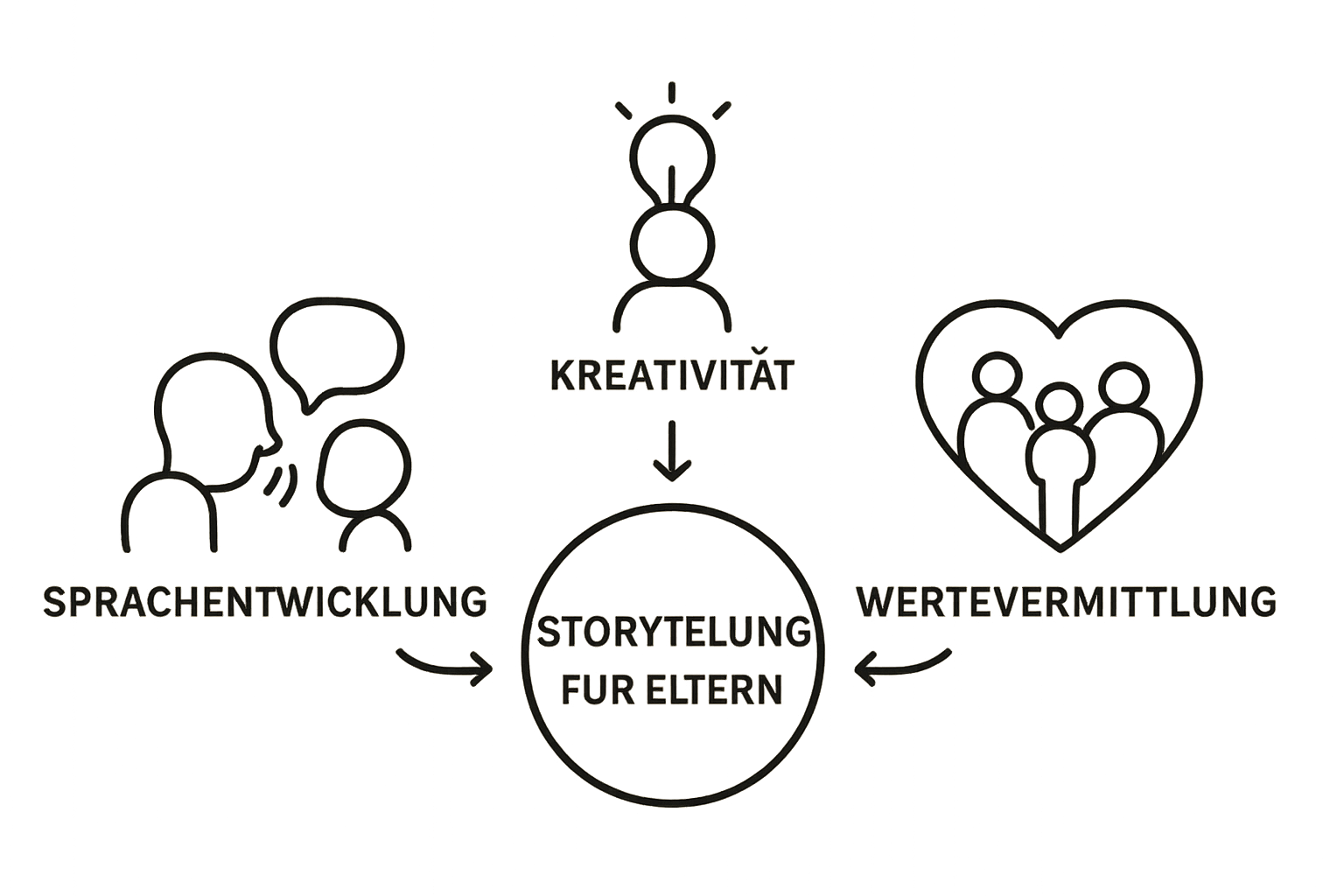
Through storytelling, parents can explain complex topics in a child-friendly way, promote empathy, and at the same time build a deep emotional connection with their children. It is a method that goes far beyond simple entertainment and plays a significant role in early childhood education and development.
The Role of Storytelling in Child Development
Storytelling is more than just an entertaining activity. It is a crucial mechanism for the holistic development of children, extending far beyond simple entertainment. Through targeted storytelling, parents can systematically promote important cognitive, emotional, and social skills in their children.
Cognitive Development Through Stories
Scientific research shows that storytelling stimulates the child's brain in various ways. Through stories, children not only develop their language skills but also train important cognitive functions such as:
- Logical thinking and understanding of cause and effect
- Concentration ability and attention span
- Memory performance and information processing
Emotional and Social Intelligence
Stories are powerful tools for developing emotional competence. They help children understand feelings, develop empathy, and interpret complex social situations. Parents can read more about age-appropriate storytelling formats here to optimally support their children's emotional development.
Through narrative experiences, children learn to take different perspectives, name emotions, and better understand social interactions. They develop a deeper understanding of human relationships and learn to resolve conflicts in constructive ways.
Storytelling is thus much more than a communication method. It is a central educational instrument that helps children discover and understand the world, and develop emotionally and intellectually.
The following table provides an overview of the central effects of storytelling on child development compared to conventional knowledge transfer.
| Aspect | Storytelling | Traditional Knowledge Transfer |
|---|---|---|
| Language development | Promotes vocabulary and expressive ability | Conveys basic knowledge |
| Emotional intelligence | Enhances compassion and empathy capacity | Conveys facts, little emotional engagement |
| Cognitive skills | Improves memory and logical thinking | Promotes repetition, less transfer |
| Value transmission | Ethics through identification with characters | Values through explanations and instruction |
| Social skills | Promotes perspective-taking and communication | Focus on individual achievement |
How Stories Convey Emotions and Values
Stories are much more than a sequence of events. They are a powerful communication instrument that transports emotions and conveys complex moral concepts in an understandable and accessible way. For children, stories are particularly significant because they shape emotional intelligence and ethical understanding.
The Emotional Language of Stories
Scientific research shows that narratives possess a unique ability to awaken and transport feelings. Children identify with characters, experience their emotions, and thus develop a deeper understanding of human emotional worlds. This emotional resonance space enables them to develop empathy and take different perspectives.
The most important emotional learning aspects through stories include:
- Recognizing and naming feelings
- Understanding emotional nuances
- Developing compassion and understanding
Value Transmission Through Narrative Structures
Stories are subtle and effective tools for value transmission. Parents can learn more about the art of value transmission through stories here to expand their educational strategies. By portraying characters who make moral decisions, children learn fundamental ethical principles such as honesty, respect, and compassion.
The narrative structure allows complex moral dilemmas to be presented in a child-friendly way. Children do not learn through lectures, but through emotional identification and the observation of action consequences in stories. In this way, they develop an intuitive understanding of social norms and ethical behavior.
Stories are thus much more than entertainment. They are a central instrument for emotional education and moral development that helps children understand the world in all its emotional complexity.
Practical Examples for Parents in Everyday Life
Storytelling is a skill that parents can strategically use in various everyday situations. It is not about becoming a perfect storyteller, but about using creative moments to promote children's emotional and cognitive development. The right techniques can turn simple moments into real learning opportunities.
Storytelling in Everyday Situations
Every moment can become a storytelling opportunity. While dressing, eating, or playing, parents can develop stories that help children understand connections. Parents can find more creative learning activities for children here to expand their storytelling skills.
Practical applications include:
- Shaping morning routines with small stories
- Using mealtimes for storytelling
- Resolving conflicts through narrative explanations
Interactive Storytelling Techniques
Research on language development shows that interactive storytelling methods are particularly effective. Parents can actively involve their children in stories by asking questions, creating characters together, or developing alternative plot lines.
An effective method is co-creating stories. One parent tells the beginning, and the child is encouraged to continue the story. This technique not only promotes creativity but also builds confidence and communication skills.
Storytelling in everyday life means being attentive to small moments that can transform into meaningful storytelling experiences.
Here you will find an overview of central practical storytelling techniques and their specific effects on child development.
| Technique | Description | Benefits for Children |
|---|---|---|
| Co-creating stories | Parents begin, children continue the story | Promotes creativity and self-confidence |
| Questions about stories | Children answer questions during/after the story | Increases attention and language skills |
| Stories in everyday life | Storytelling during routine activities like eating or dressing | Links experiences with learning |
| Alternative actions | Child develops alternative plot lines | Strengthens problem-solving and perspective-taking |
| Creating characters
🦉
📱 Now Available
Ready for the First Adventure?Get Edory AI for free and start today with personalized children's stories your child will love. ⭐⭐⭐⭐⭐ Over 1,000+ happy families · Start for free |